

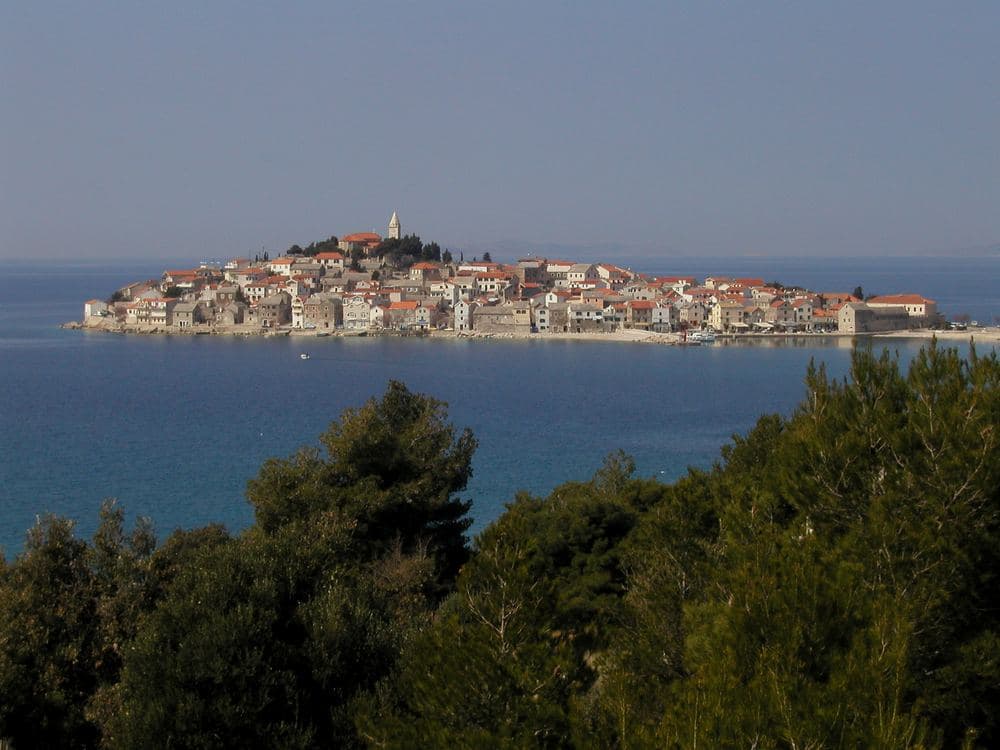
Primošten is one of the Adriatic's most photographed silhouettes: a round islet of stone houses spiralling up to a church, joined to the mainland by the causeway that gave the town its name. Around it: two shingle beaches under pines, the honeycomb of dry-stone walls in which the Babić vine grows, one of Europe's most singular vineyard landscapes, a marina in a bay sailors dream of, and a hilltop statue with the widest view in the region. Half a day for the town, a day with the beaches, on the coast road between Šibenik and Trogir.
Checked: 14 September 2026
Primošten lies on the Adriatic coast road between Šibenik, 25 km to the north, and Trogir, 30 km to the south; from the A1 take the Šibenik exit and follow the coast, from Split airport it is about 45 minutes. The old town stands on what was an island until the 16th century, when refugees from the hinterland settled it ahead of the Ottoman advance and raised the drawbridge at night; the name comes from the verb primostiti, to bridge over. The bridge became a causeway, the defensive plan stayed: lanes narrow enough to hold, houses pressed together, every passage leading either to the church or to the sea.
The old town: gate, spiral, church, graveyard
Enter on foot through the town gate at the causeway's end, the only door Primošten ever had, with its arch of dressed stone and a threshold worn by generations who carried everything through it. Then let the climb lead you: the lanes spiral up to the Church of St George, raised in the 15th century by the settlers and extended since, Dalmatian-simple inside with baroque altars that flare in the evening sun. Its true value is the position: the church stands on the islet's highest point, and around it, as the custom is on Dalmatian islands, lies the graveyard, white headstones with a view of the open sea. It sounds odd, but the graveyard by St George is one of central Dalmatia's most serene places. Descend the other side to the waterfront; the loop takes half an hour, the pauses stretch it into an evening. The loveliest view of the islet is not from it but from Raduča beach or the Gaj hill, when the lights come on at dusk.
The riva in the causeway's lee is the town's forecourt: fishing boats and excursion boats at the stone piers, a row of tavern and café terraces to the town gate, fruit and souvenir stalls before noon, the corso in the evening. The excursion boats to the Krknjaši lagoon, Šibenik and the hidden coves leave from here; buy tickets a day ahead. Around the old town runs a seaside walk of barely a kilometre, always with stone houses on one side and open sea on the other, with levelled rocks and ladders into the water, benches under pines and tamarisks: this is the locals' morning swim and the town's alternative to the beaches, lit and pleasant at night too.
Two beaches called Raduča
Velika Raduča is the main beach and a permanent resident of the lists of the Adriatic's loveliest: a long shingle arc on a pine-wood peninsula whose crowns come down to the shore, natural shade steps from the sea, a gradual and transparent bottom, loungers and showers where needed, bars along the promenade, and from the water the best view of the old town, which looks like a scale model. Ten minutes on foot from the centre by the seaside walk, car park above. In July and August the morning is gold, until ten you have it to yourself. Mala Raduča, right beside it and turned towards the old town, has the same white shingle with half the towels, a lee that keeps the sea calm when the maestral blows, and the frame that turns a swim into a postcard: the islet rising from the sea with its bell tower. Swim on Velika before noon, take the view from Mala after.
Babić on Bucavac: a honeycomb of stone
South of town, the slopes above the sea at Bucavac are furrowed by thousands of small dry-stone partitions into a regular net, a honeycomb that generations built bare-handed, prying out the rock so that a handful of red earth and a Babić vine could fit between the walls. The landscape is protected as a cultural good and a candidate for world heritage, and the local story likes to point out that a photograph of these vineyards once represented Croatian persistence in New York. The meagre stone gives little grape but dense and mighty wine, so Primošten's dark Babić ranks among Dalmatia's most esteemed; the tasting rooms in town and the taverns around pour it with the view of the slopes it came from. The best view of the honeycomb is from the road towards Kremik and from the lookouts above the bay; walk the paths between the partitions if you like, but do not climb or unpick the walls, every stone was laid by hand. Kremik itself, ten minutes' drive or an hour's walk by the coastal path, is a marina in a deep bay shielded from every wind, with vines climbing behind the masts.
Gaj: the statue with the widest view
On the Gaj hill above the town stands the statue of Our Lady of Loreto, consecrated in 2017, visible from the sea and the coast road, its mosaic mantle catching the sun by day. An arranged road and a walking path with rest stations lead up; the climb from town is half an hour of easy walking through the maquis, or drive to the car park below the summit. The reward is the widest view in the surroundings: the old town on its islet as on a palm, Raduča with its pines, the stone honeycomb of the vineyards to the south and the islands of the Šibenik archipelago stacking into paler and paler blue. Come an hour before dusk, when the lights of the old town come on.
Frequently asked questions
- How long do I need in Primošten?
- Half a day for the old town, the riva and the seaside walk, a full day with a swim at Raduča and the climb to the Loreto statue at dusk. Šibenik and Trogir are each half an hour away for a second day.
- Which beach in Primošten is best?
- Velika Raduča for a full day with shade, facilities and a gradual bottom; Mala Raduča next to it for calm water and the view of the old town. Both are shingle and ten minutes on foot from the centre.
- What is special about the Primošten vineyards?
- The slopes at Bucavac are divided by thousands of hand-built dry-stone walls into a honeycomb in which the Babić grape grows on a handful of red earth; the landscape is protected as a cultural good and a candidate for world heritage.
Official sources
Make Croatia Atlas a preferred source
One click and Google shows you our stories more often in Top Stories and in AI answers. It changes your own results only.