Trogir is a UNESCO old town on its own island, small enough to cross in ten minutes and dense enough to hold the finest Romanesque portal in Croatia.
Checked: 26 September 2026
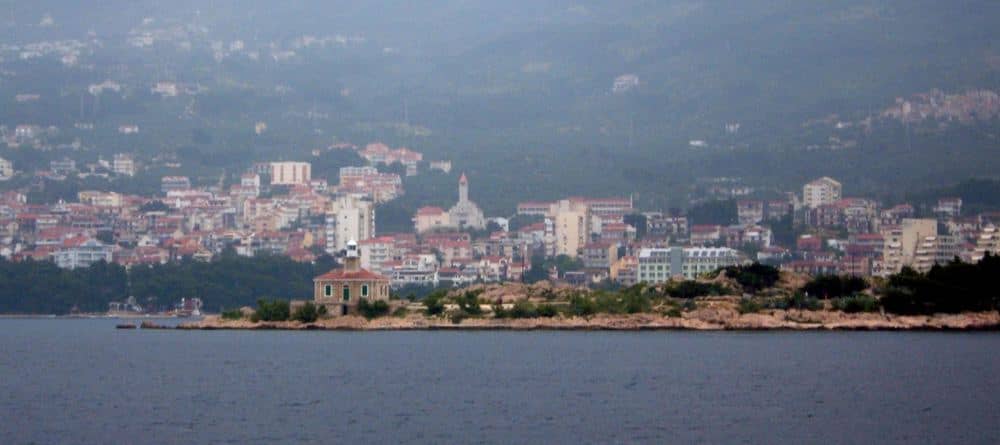
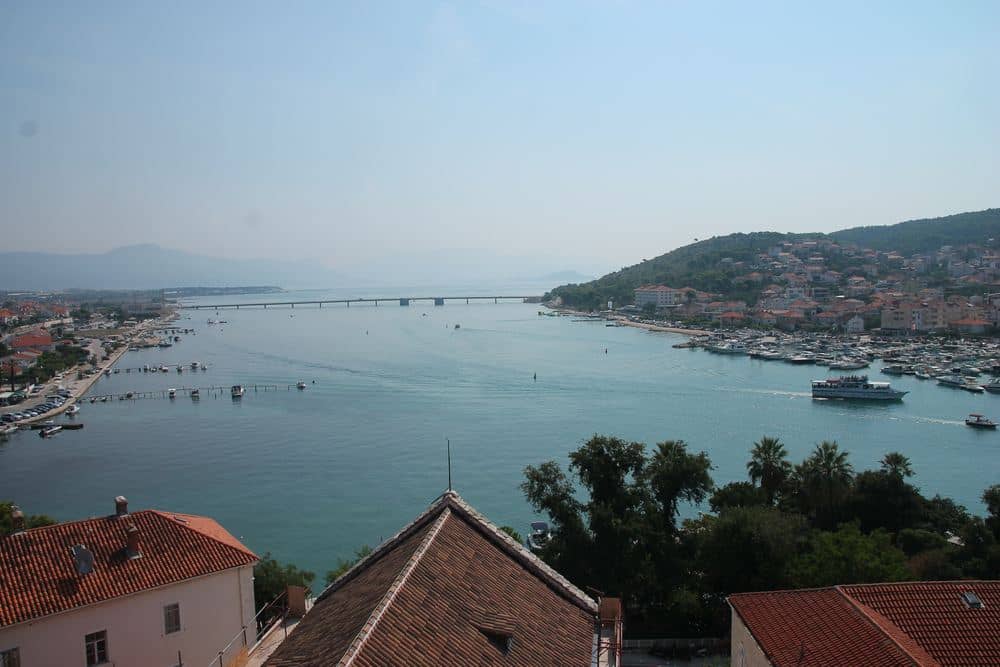
Trogir sits on an island between the mainland and Čiovo, connected by bridges at both ends, and that is the whole trick of the place. Nothing could expand, so everything was built into what was already there. Greeks from Issa founded it as Tragurion in the third century BC, Rome, Venice and Austria each added a layer, and UNESCO listed the result in 1997 as one of the best preserved Romanesque and Gothic town complexes in central Europe. It is also five kilometres from Split airport, which makes it the easiest first or last night in Dalmatia.
The portal is the reason to come
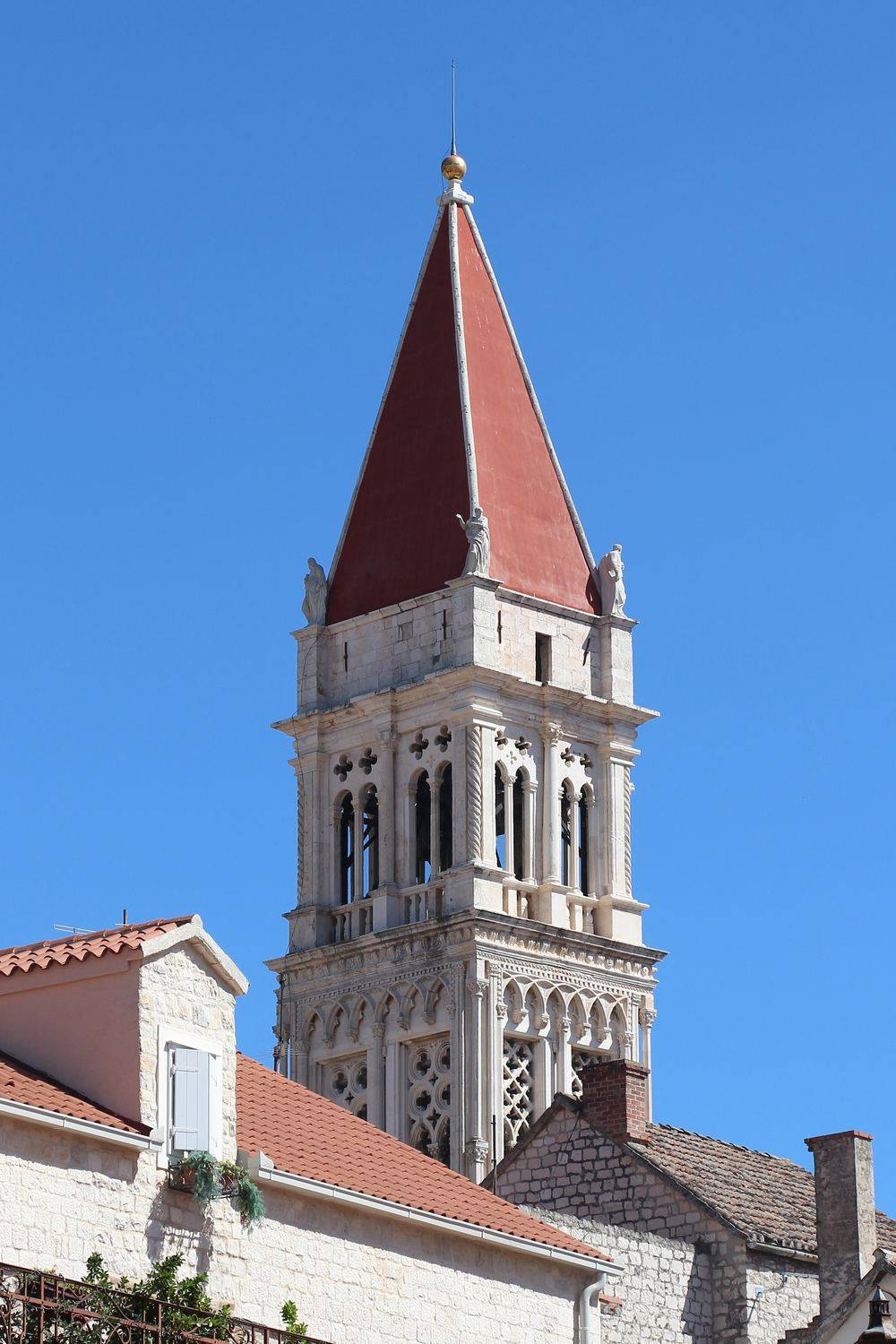
Master Radovan carved the west portal of the Cathedral of Saint Lawrence in 1240, and it is the single most important piece of Romanesque sculpture in the country. Give it fifteen minutes before you step inside. The lions at the base carry the figures of Adam and Eve, the arches above run through the months of the year as farm work, hunting scenes and the nativity, and the detail is deep enough that it changes with the angle of the sun. Inside, the Chapel of Blessed John is a complete Renaissance interior, and the bell tower can be climbed for the view over the roofs and the channel.
- Cruise groups arrive from Split mid morning. Before nine and after six the old town belongs to residents again.
- Do not drive into the old town, there is no through traffic. Park on the mainland side or on Čiovo and cross on foot.
- The Kamerlengo fortress is largely an empty shell, and the ticket buys the wall walk and the view rather than an interior.
- The Blue Lagoon at Krknjaši is reached by boat from the Riva, roughly forty minutes each way, and the water justifies the trip.
The rest of the island town
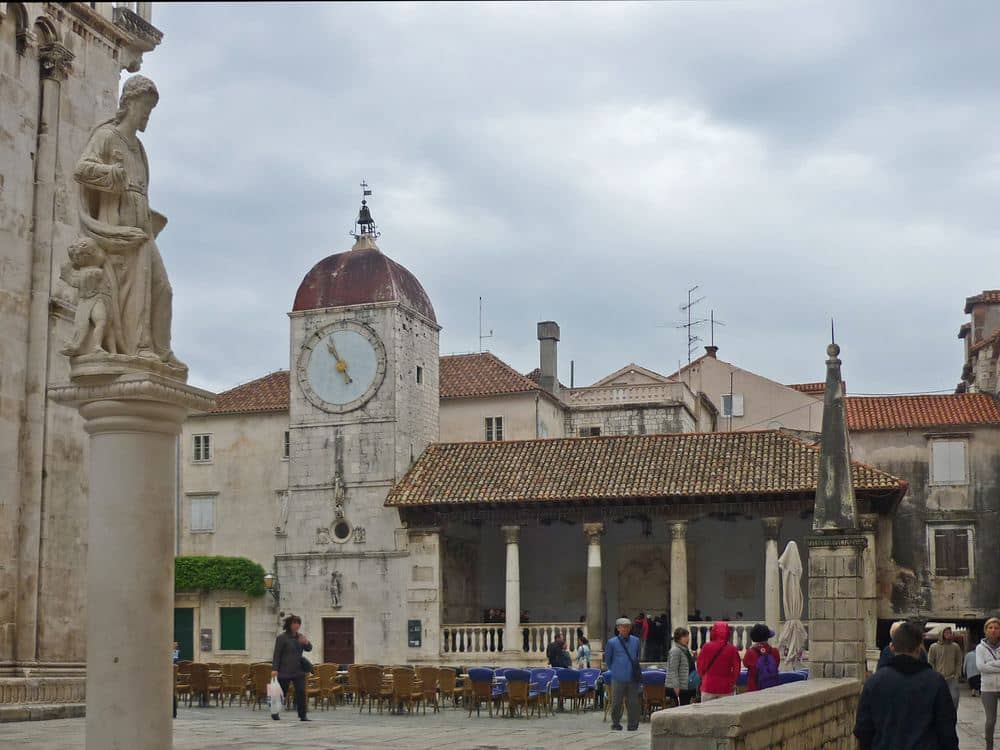
Around the cathedral square stand the town loggia with its clock tower, the fifteenth century Cipiko palace opposite and the city hall with its courtyard. The Benedictine monastery of Saint Nicholas holds the Kairos relief, a Greek carving of the god of the fleeting moment, which is easy to miss and takes five minutes. Then walk the southern Riva to the Kamerlengo at the western tip, cross the bridge to Čiovo, and you are out of the crowds within two minutes and looking back at the town from the water side.
“Trogir is the rare old town you can see completely and still return to. Nothing is far, so the second walk shows what the first one passed.”
Half a day covers the town properly. A full day works if you add Čiovo, either the beaches at Okrug and Slatine or the boat to the Blue Lagoon. As a base it beats Split for anyone who wants to sleep somewhere quiet and be in the palace in thirty minutes by bus or boat, and the airport proximity means you never need a transfer of more than ten minutes.
One day in Trogir, stop by stop
- 09:00In through the north gate
The Renaissance gate is the main way in from the mainland, once reached over a wooden drawbridge across the moat. Above it stands the town's patron, the blessed John of Trogir, hand raised over everyone who walks through.
- 09:20Radovan's portal, and the months of the year
Stand in front of it before you go in, and give it fifteen minutes rather than one. Adam and Eve stand on two lions; around them the twelve months of the year are carved as the work each one demanded. Inside is the Renaissance chapel of the blessed John, and the bell tower climb gives you the whole island.
- 10:30The loggia, where judges sat outdoors
One wide arch across the square from the cathedral. Judgment was passed here in the open, and a stone bench still marks where the accused stood. Behind it a relief of Justice by Nicholas of Florence, next to a horseman added in the 1930s.
- 11:00The Cipiko palace, and a wooden cockerel
Venetian gothic windows by Andrija Aleši and Nicholas of Florence, made for the family that ran the town's golden age. Above the door sits a wooden cockerel, taken from a Turkish galley at the battle of Lepanto.
- 12:00Kamerlengo, and the walls above the channel
Venice built this in the fifteenth century to hold the harbour, once linked by walls to the round Saint Mark's tower. Walk the ramparts for the view across to Čiovo. In summer the roofless interior becomes an open-air stage after dark, which is a second reason to stay the evening.
- 14:00Over the bridge to Čiovo
The southern bridge takes you off the island and out of the crowd in five minutes. Čiovo has coastal lanes, konobas and pebble coves, and the middle of the bridge is the best place to look back at the town you just left.
- 19:00The riva, when the day boats have gone
The waterfront is the stage the whole island is seen from, and after six it belongs to the town again. Take a table, watch the boats cross the channel, and stay for the light on the stone.
Getting there and parking
The bus station stands on the mainland north of the town gate, beside the market. The Split line runs along the coast through Kaštela, every half hour and more often in summer, and the coaches toward Šibenik and Zadar also stop here. In summer a passenger boat runs from the Riva to Split with a call at Slatine on Čiovo, slower than the bus but with the view across Kaštela bay the whole way. The car parks by the bus station and just over the bridge on Čiovo fill by late morning in July and August, so arrive early or leave the car at your accommodation. Sailors berth at Marina Baotić, on the shore between Seget and the town.
Beaches on Čiovo and the mainland
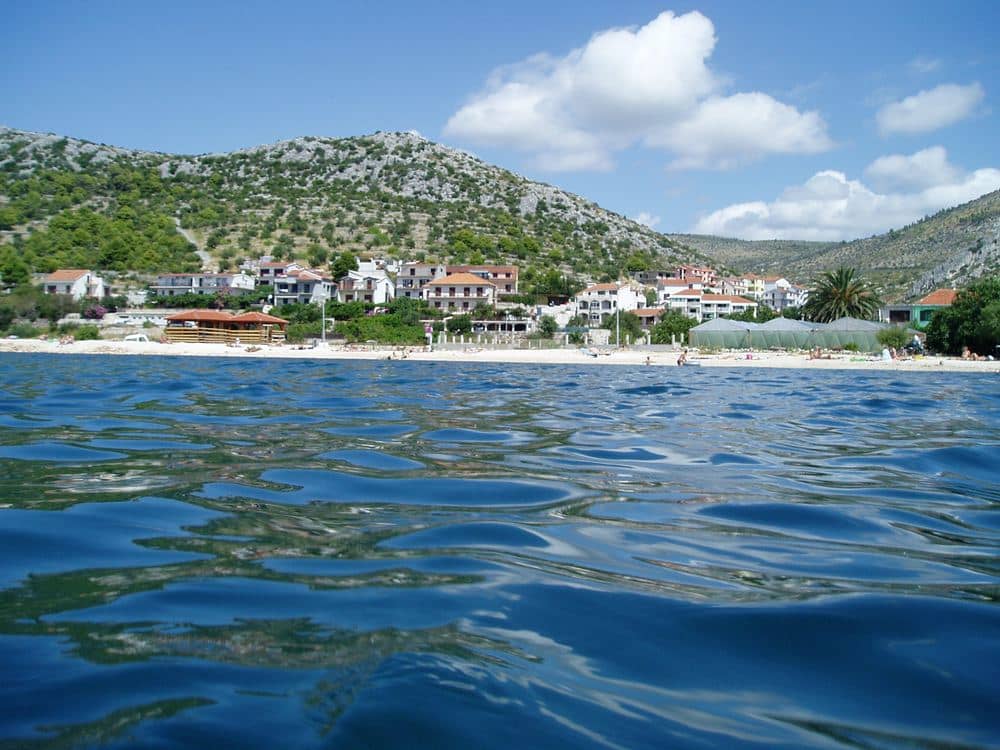
The old town has no beach. The nearest swimming is over the bridge on Čiovo, whose northern shore faces the mainland across a narrow channel, so the sea is calm and the coves are small and shingle: Saldun and Rožac lie west of the bridge, Miševac and Kava east of it toward Slatine. The southern shore is open to the offing, with clearer water and more wind. On the mainland, Medena runs almost 2 km along the shore west toward Seget, and Pantan lies east of town where fresh water surfaces in a marsh beside a 16th century mill and its defensive tower. Every beach is pebble or rock, so bring sea shoes.
| Beach | Where | What to expect |
|---|---|---|
| Okrug Gornji (Copacabana) | Čiovo, south-west | Almost 2 km of fine shingle, bars, loungers, slides and water sports |
| Medena | Mainland, west toward Seget | Shingle coves and platforms below a hotel zone, gradual entry |
| Labadusa | Čiovo, south, near Cape Okrug | Shingle and flat rock, pines to the water, shade all day |
| Duga bay | Čiovo, south | Fine shingle with sand, shallow and sheltered, good for small children |
| Saldun | Čiovo, north, west of the bridge | Narrow deep cove, no swell, warmer sea, boats moored |
| Slatine and Cava | Čiovo, eastern end | Small quiet coves, about 30 minutes by narrow road from town |
Smaller sights beyond the square
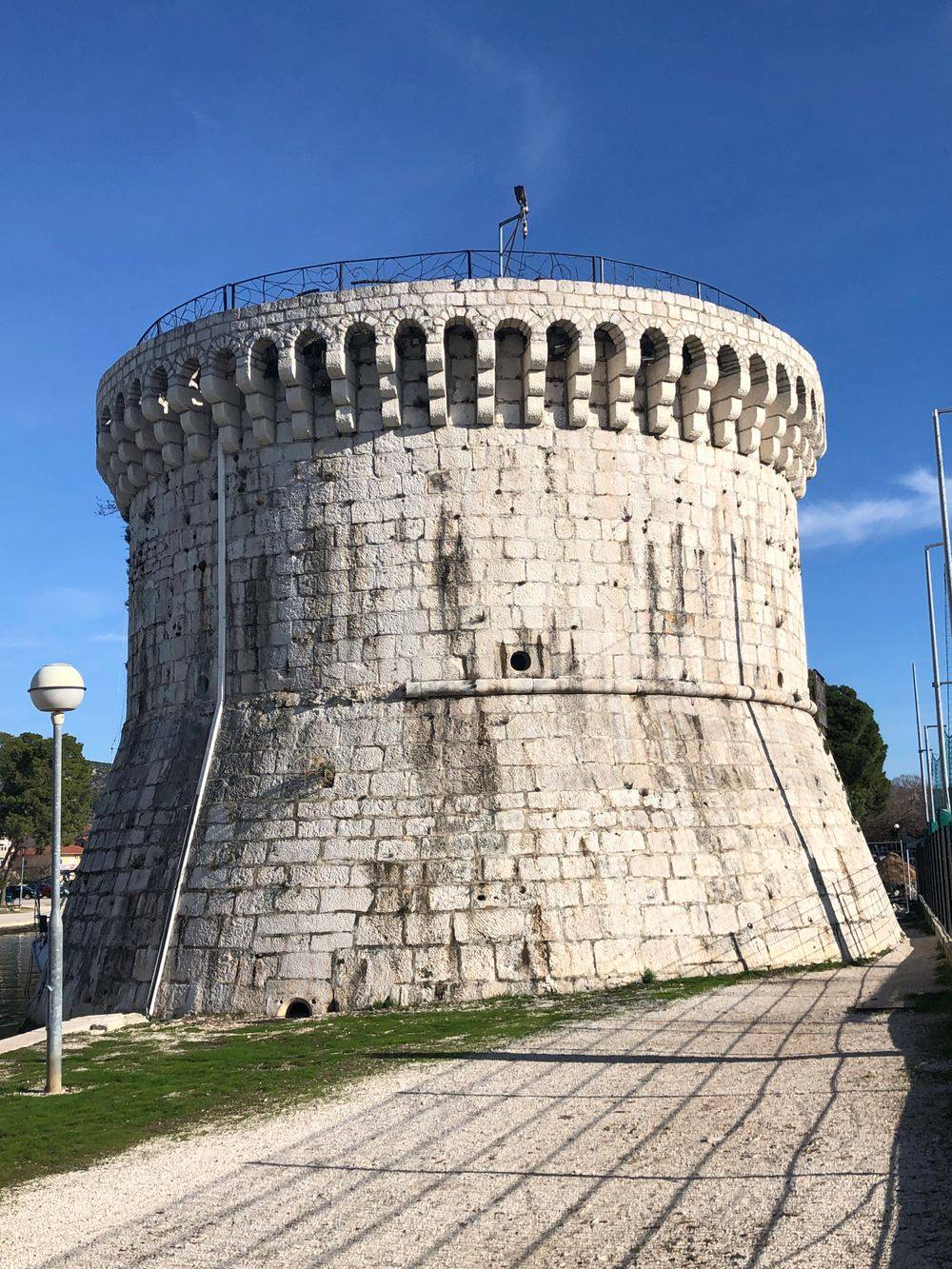
Once the square is done, the lanes hold a dozen smaller things, and most cost nothing to see from the street. The North Town Gate is a 17th century Renaissance arch with Blessed John, the town's patron, in the niche above. At the north-western corner stands Saint Mark's Tower, round and low, raised in the second half of the 15th century to close the western approach together with Kamerlengo, and the Čiovo bridge is the one spot that catches both in a single frame. In the park by the western edge is the Marmont Gloriette, a small domed pavilion on stone columns, built under French rule at the beginning of the 19th century.
- Church of Saint Sebastian, raised on the main square in 1476 as a vow after the plague, with statues in the niches of its Renaissance facade.
- Vitturi Tower in the southern lanes, a noble family's tower house with the store on the ground floor and the living rooms above.
- Garagnin-Fanfogna Palace in the northern part of the core, joined from older houses in the 18th and 19th centuries, now the Town Museum.
- Church and Monastery of Saint Dominic by the southern shore, 14th century, one tall nave under an open roof and a plain interior.
- The fish market in the covered stone hall north of the core, beside the town market, open from early morning until the night's catch is sold.
Day trips by ferry and on foot
Drvenik Veli is the island west of Trogir, about 12 square kilometres with around 100 residents, no spring and a life built on cisterns, olives and fish. A ferry runs from Trogir, sailings are few, so check the return before you board. Inland, the Malačka pass crosses the Kozjak ridge north of Kaštela at about 400 m and opens the walk along the crest, where there is almost no shade, so carry water and start early. Seget Donji, 2 km west, keeps part of the walls it built against pirates in the 16th century, and Arbanija, 3 km along the north shore of Čiovo, has the monastery of the Holy Cross, raised in 1432 by Dominicans who came with settlers from Albania.
Where to stay
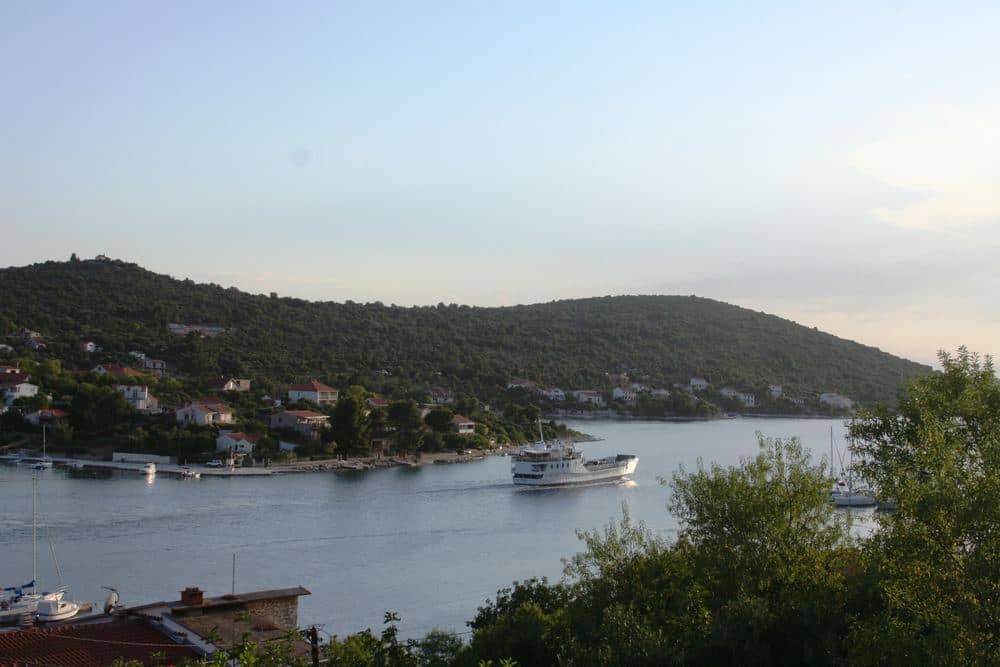
Inside the old town you sleep in a stone house on a lane too narrow for a car: luggage comes from the car park on foot, and rooms above the Riva hear the bars until late. Mastrinka, just over the bridge on Čiovo, gives you the whole old town across the channel from the balcony, a Ribola supermarket for daily supplies and a short walk in. Okrug Gornji is for anyone who wants the beach first and the town second. Arbanija and Slatine on the north shore are the quiet choices, and Slatine has the summer boat stop for Split. Seget Donji and the Medena hotel zone lie 2 km west on the mainland with a promenade and a long beach.
The places, one by one
| Place | What it is | Time needed |
|---|---|---|
| Cathedral of St Lawrence | Cathedral built from the 13th to the 17th century, 47 m bell tower | 1 hour |
| Town Loggia | 15th century open court hall on the main square | 10 minutes |
| Cipiko Palace | Gothic and Renaissance palace of a noble family | 10 minutes |
| Trogir City Hall | 15th century seat of the town with an arcaded courtyard | 15 minutes |
| Benedictine Monastery of St Nicholas | Convent of 1064 with the Kairos relief and a sacral art collection | 30 minutes |
| South Town Gate | 16th century sea gate onto the waterfront | 5 minutes |
| Kamerlengo Fortress | Venetian fortress of 1420 to 1437 with a rampart walk | 30 to 45 minutes |
| Trogir Fish Market | Morning fish hall beside the town market | 20 minutes |
| Trogir Souvenir Market | Stalls and shops by the North Town Gate | 20 minutes |
| Čiovo Bridge | Opening bridge over the channel to Čiovo | 5 minutes |
| Rožac Beach | Shingle campsite beach with pine shade on Čiovo | half a day |
| Pantan Beach | Marsh reserve, 16th century mill and shingle beach | 1 to 2 hours |
| Blue Lagoon Krknjaši | Shallow sandy lagoon off Drvenik Veli, by boat | half a day |
Cathedral of St Lawrence
Building ran from the 13th century to the 17th, so the cathedral you walk into was raised over 400 years on one plan. Radovan signed his portal, which is rare for a medieval mason and part of why his name survives. Inside, the chapel of Blessed John of Trogir is 15th century work by Nikola Firentinac, with a series of statues standing in niches around the walls. The bell tower is 47 m high, built over several centuries, and the way up is by narrow steps, so take the turns slowly and let people coming down pass. From the top the whole island lies below you.
Town Loggia
The loggia was raised in the 15th century as the town's open courtroom. Judgement was passed here in public and the decisions of the town government were read out to whoever stood on the square. It is open on 3 sides under a roof, and the stone table where the judges sat is still in place. On the wall behind it is a relief of Justice by Nikola Firentinac, set exactly where the judges could not avoid it. In the 20th century a relief of Ban Petar Berislavić by Ivan Meštrović was added. The loggia is always accessible, and at midday its roof gives the only shade on the square.
Cipiko Palace
Opposite the cathedral stands the house of the Cipiko, the most powerful family in 15th century Trogir. They were nobles, shipowners and humanists. Koriolan Cipiko sailed on Venetian naval campaigns and wrote an account of them in Latin, and here he kept a library and a collection of ancient inscriptions. The facade mixes a Gothic part, with a triple window on the upper floor, and Renaissance work by Andrija Aleši and Nikola Firentinac, the same masters who worked across the square on the cathedral. In the courtyard the beak of a galley captured in a naval battle is still kept. You see the palace from the square, and part of the interior opens now and then for exhibitions.
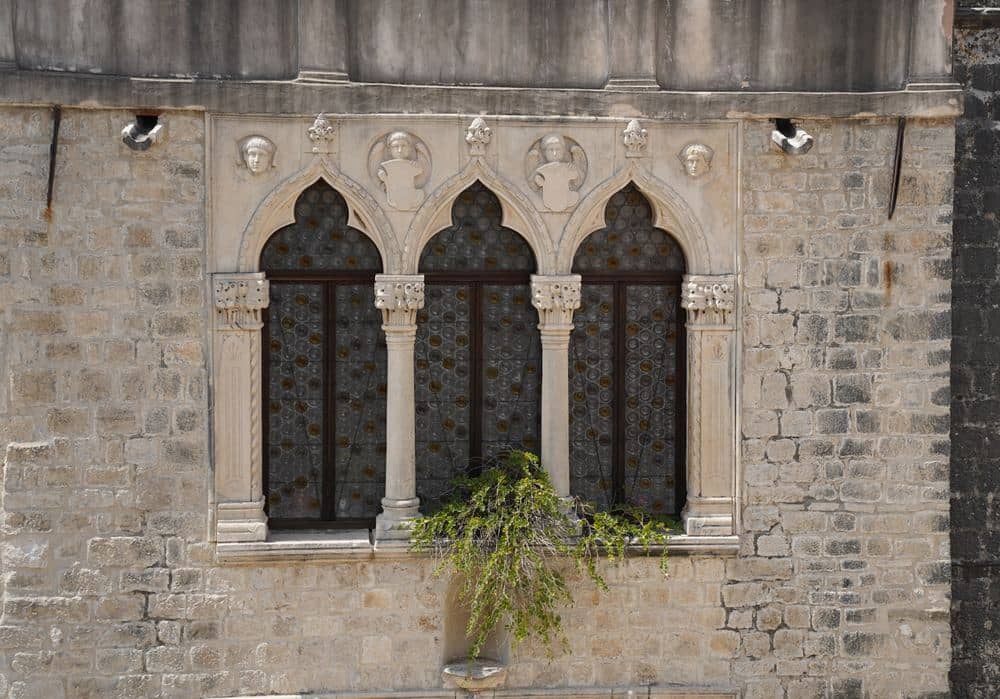
Trogir City Hall
The town hall closes one side of the square and has housed Trogir's administration since the Middle Ages. The present building went up in the 15th century, and the facade was last renewed in the 19th century. The part worth your time is inside: an inner courtyard with a stone staircase, an open arcade of arches and the coats of arms of the town's counts set into the wall, one beside another. Courtyards like this were working space, and part of the town's business was done in the open. The council still works here, so the courtyard is open during office hours. Entry is free, and none of it can be guessed from the square.
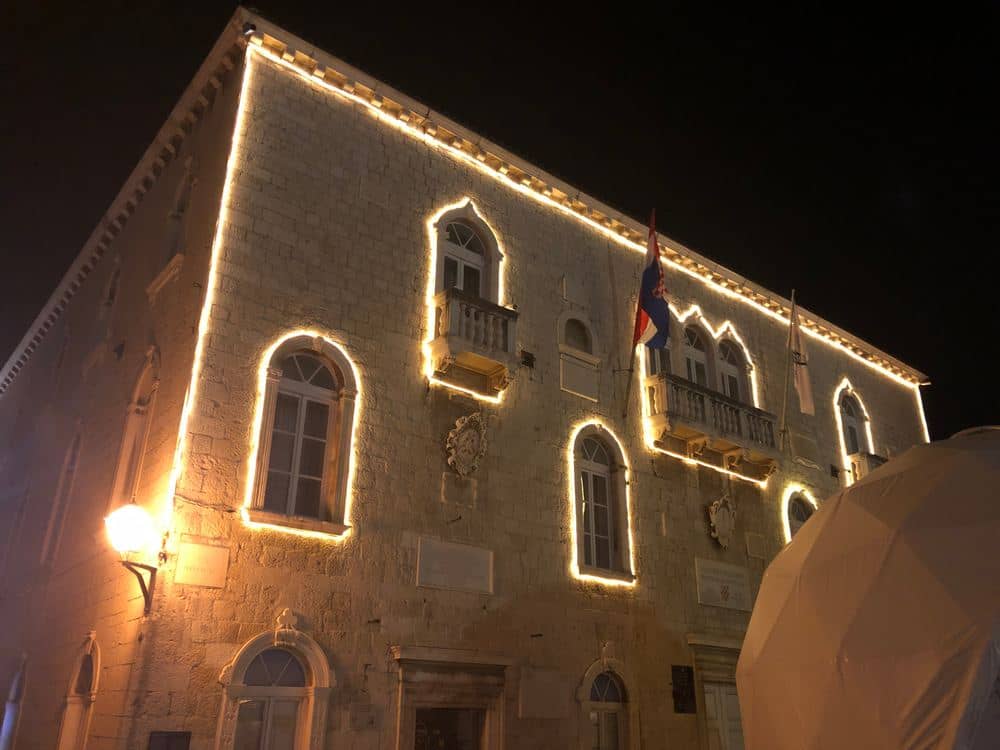
Benedictine Monastery of St Nicholas
The convent of St Nicholas was founded in 1064, and no other community in Trogir has stayed in the same place for as long. It stands on ancient foundations, which is how the Kairos relief came to light: in 1928 it was found built into a wall, where it had served as an ordinary stone for centuries. Kairos is a winged youth in mid-run, with a lock of hair on his forehead and a shaven nape. The sisters still live here and run a collection of sacral art around the relief: medieval manuscripts, liturgical vessels, paintings and stone fragments from its earliest years. The ticket is cheap and modest dress is required. The visit takes about half an hour.
South Town Gate
The south gate was the town's door to the sea, the way out to the boats and to the place where fish was sold. It dates from the 16th century and is plain on purpose: an arch with a carved frame and no ornament, because it carried everyday traffic and was never meant for show. A coat of arms is set above the passage, and at the sides you can make out traces of the walls that once ringed the whole island. Today the gate opens straight onto the waterfront and its palms. The passage is narrow and roofed, which gives a moment of shade in summer, and from it the main square is 2 minutes north by the lanes.
Kamerlengo Fortress
Kamerlengo went up between 1420 and 1437, in the first years after Trogir passed to Venice. The name comes from the camerlengo, the Venetian official who ran the town's finances and lived inside, so the fortress was an office as much as a garrison. The plan is an irregular quadrangle with a tower at each corner and one tall round tower on the seaward side, and the walls are angled to watch the harbour entrance and the passage toward Čiovo. In summer the interior serves as an open-air stage for concerts and film screenings, so check the programme. The ticket is cheap. From the tower you take in the whole old core and the channel running east toward Split.
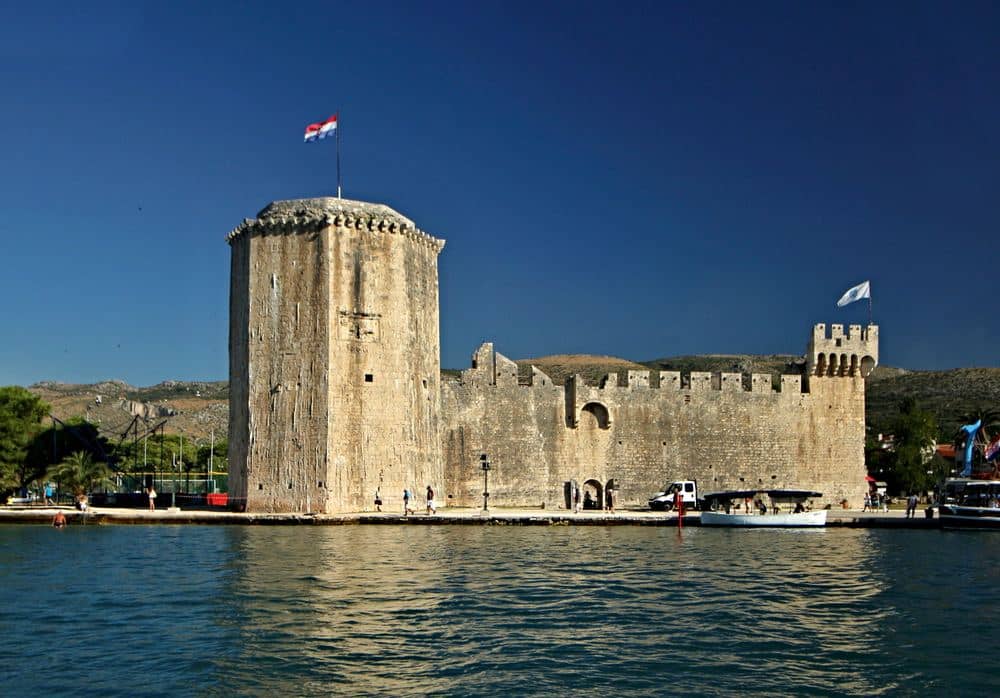
Trogir Fish Market
The fish hall stands beside the town market at the northern edge of town, and the building was made for the job: stone counters, open sides for the draught and drains in the floor, because fish needed shade and running water before there were refrigerators. The catch comes from the bays of Kaštela and Split and from the open sea around Šolta and Drvenik: sardine, anchovy, hake, sea bream, sea bass, scorpionfish and squid, and now and then langoustines. Prices change with the day, and on Mondays there is less to choose from. The sellers will clean the fish if you ask. It works in the morning only, and the best choice is right after opening.
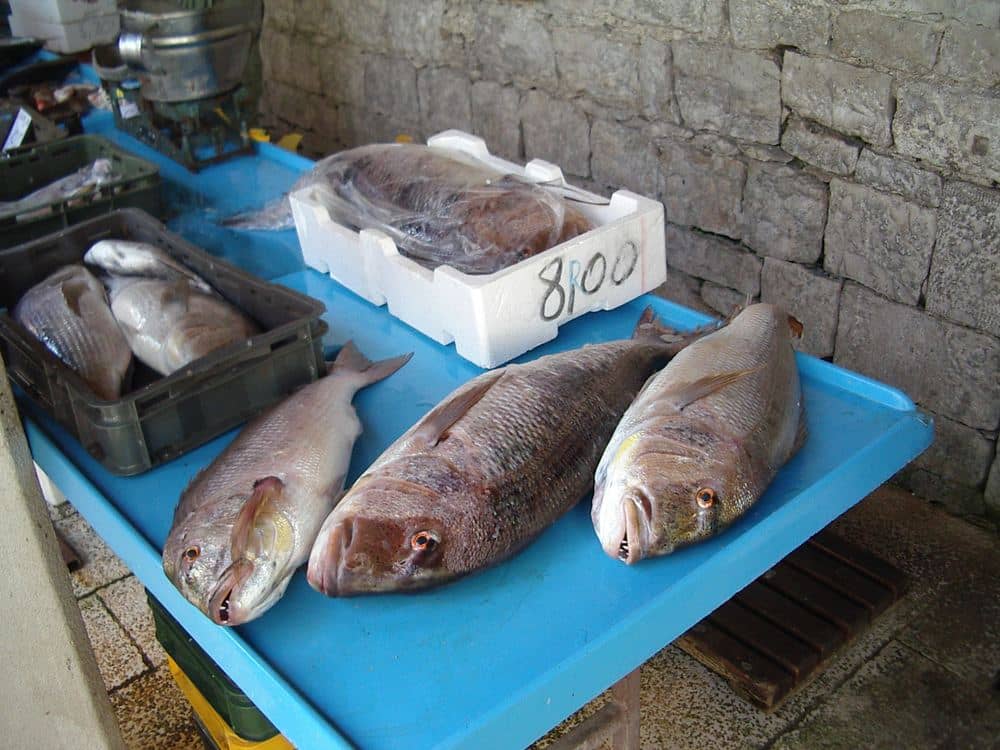
Trogir Souvenir Market
The souvenir stalls and shops cluster by the North Town Gate and along the stretch toward the market, where most visitors walk in. The offer is the standard one for Dalmatian towns: magnets, postcards, T-shirts, sea salt, lavender, soaps, jewellery and textiles. What really comes from this region is olive oil from the surrounding fields, honey, herbs, and objects of Brač stone from the stonemasons' workshops, because stonecutting in Trogir goes back to the masters who carved the cathedral. If you buy oil, ask which mill pressed it and which harvest it is from. With stone, ask who made it. Prices are higher than in the hinterland, and browsing is easiest toward evening, when the day groups have gone.
Čiovo Bridge
A crossing has existed at this point for centuries, first a ferry and boats, then a bridge. The channel is so narrow that you can read the details on the far bank, yet it mattered to the town because it separated the core from the land beyond and made it easier to defend. The present bridge is low and has a movable section that lets vessels through. In summer it opens to a schedule, traffic stops briefly and people gather to watch. Every car heading for the Čiovo beaches uses it, so in July and August the queue is constant. On foot you are across in a minute, and from the middle you see the whole Riva at once.
Rožac Beach
Rožac is a cove on the northern shore of Čiovo, by the road toward Okrug, and serves as the beach of a campsite that has run here for decades. The shore is shingle, partly concreted, with a gradual slope into the sea, and the pines behind it were planted when the campsite opened, so there is shade even at midday. The mainland across the channel shelters the water, so it stays calm almost all summer and shallow near the shore, which is why families come. There are showers, a bar and loungers for hire, and a shop in the campsite. From Trogir it is a 10 minute drive over the bridge. The car park is by the road and is full before noon in summer.
Pantan Beach
Pantan lies east of town, about 10 minutes by bicycle or car from the core, at a spot where underground water surfaces and makes a marsh, a habitat rare on this coast. The constant fresh water is why a mill worked here from the 16th century, and the fortified tower that defended it against pirates is preserved and restored. The marsh is protected as an ornithological reserve. Migratory birds nest and rest in the reeds, herons and ducks among them, and endemic fish live in the water, so bring binoculars if you have them. At the edge of the reserve is a shingle beach facing the open sea, quieter than the beaches nearer town.
Blue Lagoon Krknjaši
The lagoon lies between Drvenik Veli and 2 small islets that close it from the south-west. The bottom is sand, pale and shallow, so the water turns a light colour you rarely see on this stretch of the Adriatic, and that colour is what the excursion boats from Trogir and Split come for. They arrive in the later morning. Swimming suits children, because you can wade a long way out and there is no current. A tavern on Krknjaši works in season, and otherwise the islets are uninhabited, so take water and something for shade. You come on an organised trip or in your own boat. The lagoon is calmest early in the morning, before the first boats swing in.
Frequently asked questions
- Is Trogir worth visiting if you have already seen Split?
- Yes, because the two are not the same kind of place. Split is a Roman palace that a city grew into, Trogir is a compact medieval and Renaissance town that never grew at all. Trogir also holds something Split does not: Radovan's 1240 cathedral portal, the finest Romanesque sculpture in Croatia. Half a day is enough, and the bus from Split takes about forty minutes.
- How far is Trogir from Split airport?
- About five kilometres, which is ten minutes by car and roughly the same by local bus. The airport is actually closer to Trogir than to Split, so an early flight or a late arrival is far easier to handle from here. For a first or last night in Dalmatia this is the practical choice, and you can walk from most accommodation into the old town.
Official sources
Share this guide
Questions about your trip?