Wildfires burned in Croatia from mid-August into mid-October 2026. First came the fires above Omiš and on Pelješac. In early October fires broke out near Trogir, Metković and Imotski. On 16 October crews contained the Jakljan fire. The page also covers fire stages, the phone alert and coast rules.
Checked: 16 October 2026, 19:08
Wildfires burned along the Croatian coast and hinterland from mid-August into mid-October 2026. On 2 September the last front in the south, at Duba Konavoska, went out. In early October fires broke out near Trogir, Metković and Imotski. On 16 October crews contained a forest fire on Jakljan, an island near Dubrovnik. This page follows the fires in order and ends with the fire rules. Dates and figures are the ones the fire service reported at the time.
16 August: arrests near Zadar
August is the peak of the Croatian fire season. Several fires burned in Dalmatia in August 2026, among them the fire above Omiš: according to the fire service it stopped spreading on 14 August, and from 15 August crews were mopping up and guarding the burnt ground. According to media reports, Croatian police have detained suspects in connection with fires in the Zadar area, and the investigation is ongoing.
20 August: four fire sites
The Croatian fire service reports four fire sites for 20 August. Two are still burning; on Pelješac and above Omiš crews are guarding and mopping up the burnt ground. None of them closes a coastal town, but two of them change what a day outdoors looks like, and one of them sits in an area walkers use.
On Dinara, in the Šibenik-Knin county, the fire has been burning since 14 August after crossing over from Bosnia and Herzegovina. Twenty-three firefighters with twelve vehicles are on it, supported by twenty-six soldiers and four aircraft. Dinara is mountain country rather than a resort, but it carries the trail to the highest peak in Croatia, and that is reason enough to check before setting out. Near Otrić by Gračac, in the Zadar county, a fire started on 19 August and has covered twelve hectares, with twenty firefighters and eight vehicles on site.
The fire on the Pelješac peninsula, in the Dubrovnik-Neretva county, started on 14 August and took about 500 hectares of pine forest. It is under control, and the ground is still being worked. At its height it drew 250 firefighters with 73 vehicles and five aircraft, with crews sent in from several counties. The larger one, above Omiš and Lokva Rogoznica in Split-Dalmatia, started on 13 August and covered roughly 1,000 hectares. It is the one that carried the human cost of this fortnight: one person died, 43 were injured, and around 2,500 people were evacuated to reception centres. It drew 253 firefighters with 83 vehicles and eight aircraft.
22 August: one fire still active
| Where | Status | Area |
|---|---|---|
| Dinara (Šibenik-Knin) | Still active since 14 Aug | not yet assessed |
| Primošten Burnji (Šibenik-Knin) | Contained 21 Aug, 19:20 | about 100 ha |
| Omiš / Lokva Rogoznica (Split-Dalmatia) | Not spreading, crews on guard; out 26 Aug, 20:00 | about 1,000 ha |
| Pelješac (Dubrovnik-Neretva) | Under control, mopping up | about 500 ha |
| Otrić near Gračac (Zadar) | Out since 20 Aug, 19:02 | 12 ha |
One word in that table decides what you can do: contained. In Croatian reporting a fire moves through four stages, and travellers regularly read the second as the fourth. Active means it is spreading. Contained means it is ringed and no longer growing, but still burning inside the ring. Under control means the flames are down and crews are working the ground. Out means out. A contained fire still has aircraft over it and closed roads under it.
Primošten: fifteen metres from the houses
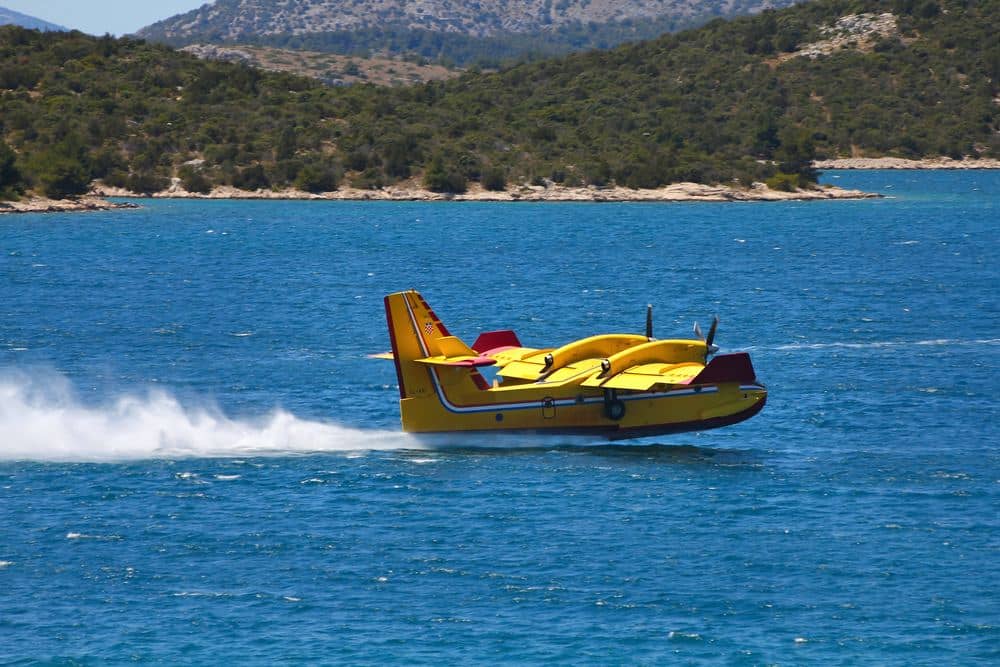
The fire above Primošten Burnji started on 20 August at 13:49 and ran through olive groves, which make up most of the hundred hectares it took. Four Canadairs worked it. According to a resident quoted in the local press, the wind turned and a wall of flame came within fifteen metres of the houses before the aircraft arrived; the county fire commander confirms no house was lost. That is the difference between a bad day and a catastrophe, and it took four aircraft to make it.
Your phone will warn you, in your language
During the Primošten fire the authorities triggered SRUUK, the national emergency alert. Every phone in the affected cells gets a message with instructions, and it goes out in Croatian, German and English. You do not sign up and you cannot switch it off: depending on the threat level it arrives as an SMS or as a cell broadcast alert. If it fires, follow it, and do not drive towards the smoke to look. The single most useful thing to know about wildfire season in Croatia is that the warning finds you.
2 September: the last front in the south is out
Status as of 3 September 2026. The Croatian firefighting association HVZ reported on 2 September that the open-space fire which had spread from Bosnia and Herzegovina onto Croatian territory at Duba Konavoska was completely extinguished. It was the last of a series: the first crossing at Ivanica burned from 18 to 24 August, two more fires stood for days on inaccessible ground along the border above Župa dubrovačka and Konavle, and for about ten days people from Prevlaka to Dubrovnik woke up to smoke. Canadair water bombers flew daily and around fifty firefighters held the lines on the ground; no houses were lost on the Croatian side.
Pelješac: out, but the marks stay
The large fire on the peninsula in mid-August ran through the vineyards between Kuna Pelješka and Potomje, the heart of the Dingač and Postup wine country, and destroyed the church in Potomje. It was contained after several days with aircraft and crews from Konavle to Metković, and there has been no new outbreak since. The wine road is open and the harvest is under way; what you will see are black slopes above the road and vineyards with scorched edges. Wineries in Potomje are receiving visitors and could use them.
October: new fires near Trogir, Metković, Imotski and on Jakljan
Status of the reports: Friday 16 October 2026. Dry ground and wind brought a new run of fires to Dalmatia in the first week of October. Rain was forecast from the evening of 7 October, with downpours on 8 and 9 October (warnings and forecast). In mid-October a strong bura fanned a forest fire on the island of Jakljan near Dubrovnik; it was officially contained on 16 October.
- 3 October, Seget near Trogir: grass and macchia burned on the Vlaška hill above Seget; 50 firefighters with 20 vehicles and two Canadairs had it under control the same evening. The D58 between Seget Donji and Seget Gornji was closed from about 16:00 to 17:40. Police say sparks from an angle grinder started it, 25 hectares burned (police, morski.hr).
- 3 and 4 October, Kula Norinska near Metković: a forest fire on the Rujnica hill came close to the villages of Podrujnica and Momići. The D62 between Kula Norinska and Nova Sela was closed; the fire was contained on 4 October (Dalmacija Danas, juginfo.hr).
- 6 October, Šumet near Imotski: between the alarm at 13:11 and 18:00 about 30 hectares of grass, low vegetation, woodland and vineyards burned. Sixty firefighters with 20 vehicles and two Canadairs put it out (Dalmacija News).
- 7 October, Proložac near Imotski: fire broke out again around noon in dense pine forest at Vučja draga and, pushed by the jugo, spread towards the Badnjevica canyon. At 14:00 about 70 firefighters with some 25 vehicles and three Canadairs were fighting it, and it was not yet under control (Slobodna Dalmacija, N1). It was brought under control later that day; more than 25 hectares of mostly pine forest burned in an uninhabited area, and 50 firefighters with 15 vehicles stayed on watch overnight (Novi list).
- 7 October, Vid near Metković: the reed marsh flared up again two days after the last fire there was contained. Crews and one Canadair defended the houses in Vid and Dragovija and nothing was damaged, county fire chief Stjepan Simović said; the marsh keeps crews away from parts of the fire (N1, Index.hr). By Wednesday afternoon 30 firefighters with 11 vehicles and seven aircraft, three of them Canadairs, had the fire under control, said Jure Pilj, commander of the Metković fire brigade (Novi list).
- 8 and 9 October, Neretva valley: there are no more open flames, but the marsh at Vid keeps smouldering under the surface. Smoke spreads over the area, the air quality in Metković and the nearby villages is poor, and Vid is worst affected (Slobodna Dalmacija).
- 13 to 15 October, Jakljan island near Dubrovnik: tall vegetation and pine forest burned on the south-west side of the island, on terrain without paths. The alarm came at 13:53 on 13 October; crews landed from the fire boat Orlando and had the fire under control by 21:00, but bura gusts rekindled it around 01:00. From 08:40 on 14 October two Canadairs joined, while the strong bura spread the fire and at times kept the aircraft on the ground. On 15 October it was no longer spreading but not yet officially contained, with 48 firefighters, three boats and, during the day, two Canadairs at work (HVZ, Novi list, Morski).
- 16 October, Jakljan: on the fourth day the fire was officially contained at 13:30, the Dubrovnik fire brigade reported. By first estimates about 100 hectares burned. In the morning county fire chief Stjepan Simović said the crews had ringed the fire overnight and no open flames remained. In the afternoon 32 firefighters were on the island with three boats supporting them from the sea, and they stay through the night to secure the edges of the burnt ground, which is hard to reach. On 15 October HVZ had counted 43 firefighters with three fire boats and two Canadair CL-415 aircraft (Dubrovnik Insider, Slobodna Dalmacija, Slobodna Dalmacija, HVZ).
For visitors, as of 16 October
- Jakljan: the Dubrovnik fire brigade declared the fire contained at 13:30 on 16 October. By first estimates about 100 hectares burned on the south-west side. In the afternoon 32 firefighters were on the island. Crews stay overnight to secure the edges of the burnt ground.
- Trogir, Metković, Imotski: crews had the Seget fire under control on 3 October. The Kula Norinska fire was contained on 4 October. The Šumet fire was out on 6 October. The Proložac and Vid fires were under control on 7 October.
- Neretva valley: on 8 and 9 October the marsh at Vid still smouldered under the surface. Smoke spread over the area. The air in Metković and nearby villages was poor, worst in Vid.
- Summer fires: the fronts above Omiš, on Pelješac and at Duba Konavoska are out. Keep off the burnt hills above Konavle and on Pelješac: the ground is unstable. Sniježnica and the Konavle cliffs path, the usual walks, were spared.
- Roads: on 3 October the D58 at Seget was closed from about 16:00 to 17:40. The D62 between Kula Norinska and Nova Sela was closed during the Rujnica fire. HAK lists any short closure for firefighting within minutes.
- Phone alert: SRUUK sends a message with instructions to every phone in the affected cells. It arrives in Croatian, German and English. Follow it and keep away from the smoke. Report smoke to 112 at once; 193 is the fire brigade.
- Before you set out: hvz.gov.hr publishes a daily report of major interventions. For wind and weather, see warnings and forecast.
The fire rules, and why they are strict
Through the summer months the coastal counties run a fire protection regime that restricts open flame outdoors. The reasoning is mechanical rather than moral: dry maquis, a strong bura or jugo and steep terrain turn a small ignition into a front that aircraft cannot stop before it reaches a village road.
- No open fire outside marked and prepared fireplaces, including beach fires.
- No burning of garden waste or stubble during the summer restriction.
- No cigarette ends from a car window. This is a common ignition source along coastal roads.
- Report smoke to 112 immediately. Early minutes decide whether a fire stays small.
Penalties are set by county fire protection orders and by the criminal code where a fire is started deliberately or through gross negligence. The exact amounts change, so the county order rather than a travel blog is the place to check.
More on the fire season
Frequently asked questions
- Where do I find the current fire situation?
- The Croatian fire service publishes a daily report of significant interventions at hvz.gov.hr, and the weather warnings sit at meteoalarm.org for the Croatian regions. In an emergency the number is 193 for the fire service and 112 for everything else, and both work from any phone without a local SIM.
- Why are the fire rules so strict?
- Because a pine slope in August carries fire faster than anyone can walk. Open flame outdoors is banned along the coast in summer, and that includes a cigarette out of a car window and a barbecue outside a marked place.
Official sources
- hvz.gov.hr
- Croatian Firefighting Association, coastal fires 2026
- civilna-zastita.gov.hr
- hak.hr
- Croatian Ministry of the Interior
- Novi list: fires near Metković and Proložac under control
- Slobodna Dalmacija: no fire, but smoke in the Neretva valley
- HVZ: Jakljan fire still active, 28 more firefighters
- Novi list: Jakljan fire no longer spreading
- HVZ: daily report 15/16 October, Jakljan fire active
- Morski: Jakljan fire still being fought on day four
- Dubrovnik Insider: Jakljan fire contained, about 100 hectares
- Slobodna Dalmacija: firefighters contain the Jakljan fire
- Slobodna Dalmacija: no open flames on Jakljan, says Simović
Share this guide
Questions about your trip?