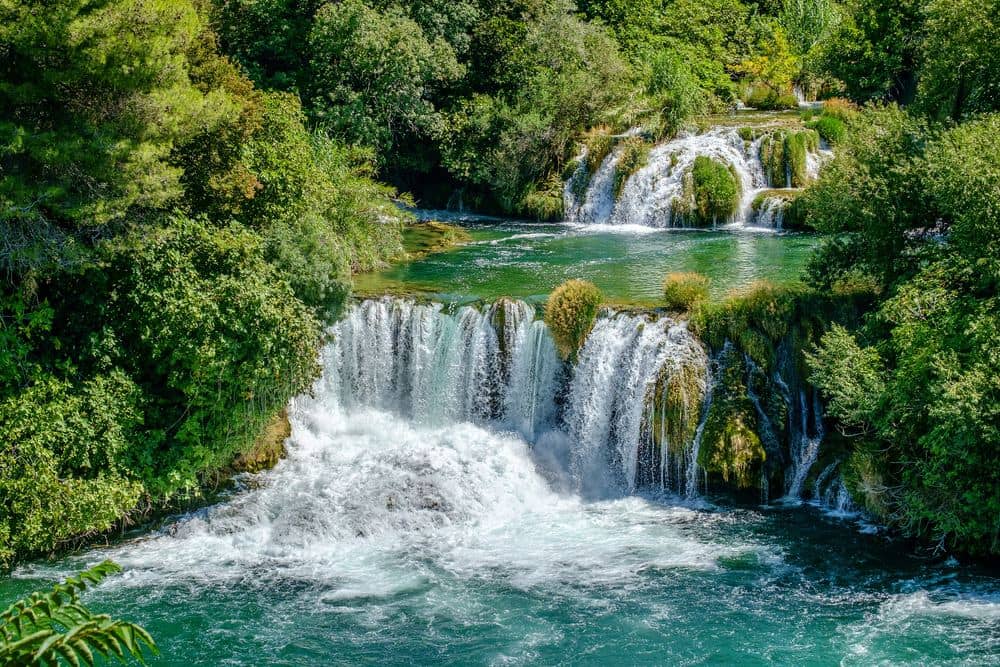
The same walk costs 40 euros in July and 7 in January. What you get for each, when the boats and shuttle buses run, and what closes outside the season.
Checked: 17 October 2026, 20:00
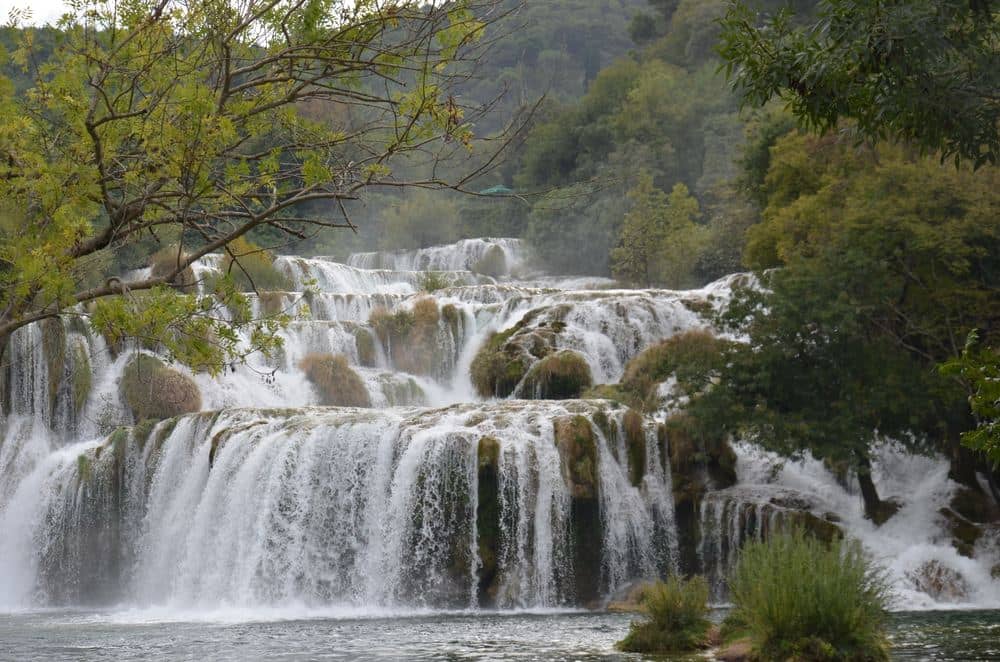
Skradinski buk is the part of the Krka national park almost everyone means when they say Krka: the wide travertine cascade at the southern end, reached on a boardwalk loop of about two kilometres. The walk itself barely changes across the year. The price does, by a factor of nearly six, and so does what the ticket includes.
What a ticket costs
| Visitor | Jan to Mar, Nov, Dec | Apr, May, Oct | Jun to Sep |
|---|---|---|---|
| Adults | 7 € | 20 € | 40 € |
| Children 7 to 18, students | 4 € | 12 € | 15 € |
| Adult groups from 20 | 5 € | 16 € | 30 € |
That is the whole planning decision in one table. A family of two adults and two teenagers pays 110 euros in July and 22 euros in November for the same boardwalk. Children under seven are free.
What the cheap months cost you
The low price is not a bargain without a catch. Boat excursions, the shuttle bus between Lozovac and Skradinski buk, the boat between Skradin and Skradinski buk, and the visits to Visovac island and Oziđana pećina all run only from 1 April to 31 October. Outside that window you reach the falls on your own and walk the loop on foot, and the Manojlovac falls and Burnum are closed from November through March. Swimming has not been allowed at Skradinski buk since 2021 in any month.
Opening hours by month
| Month | Open |
|---|---|
| January, February | 9:00 – 16:00 |
| March | 9:00 – 17:00 |
| April | 8:00 – 18:00 |
| May | 8:00 – 19:00 |
| June to August | 8:00 – 20:00 |
| September | 8:00 – 19:00 |
| 1 to 15 October | 8:00 – 18:00 |
| 16 to 31 October | 9:00 – 17:00 |
| November, December | 9:00 – 16:00 |
Getting there from Šibenik
Šibenik is the usual base and the park is about 30 minutes away by car. The entrances that matter for Skradinski buk are Lozovac and Skradin. Lozovac is the road entrance, about 12 km from Šibenik on the road toward Drniš, with the largest car park and the shuttle bus down to the falls in season. Skradin, 17 km from Šibenik at the mouth of the Krka, is the water entrance: you park in the town and take the park boat up the river, a trip of half an hour. Both lie close to the A1 motorway, which has exits for Šibenik and for Skradin, so drivers from Zadar or Split bypass Šibenik entirely.
Without a car, local buses from Šibenik bus station serve Skradin and Lozovac, with far fewer departures outside the season, so check the return times before you leave: in the low months the last bus back can go before the park closes. Outside the boat season Skradin still works as an entrance. A footpath of about 4 km follows the river bank from the town to the lower end of the falls, roughly an hour on foot, and it is open all year. From the Lozovac car park the walk down to the loop is a zigzag path of about 15 minutes, with the same climb back at the end.
| Entrance | From Šibenik | Reach the falls by | Outside April to October |
|---|---|---|---|
| Lozovac | about 12 km | shuttle bus, or 15 minutes on foot | own car or on foot |
| Skradin | 17 km | park boat, 30 minutes | footpath of about 4 km |
| Roški slap | 35 to 40 km | own car to the falls | open, same hours as Skradinski buk |
The loop in detail
Whichever way you arrive, you start at the bottom of the falls, where the restored mills, the fulling stamps and the smithy stand around a flat area with the restaurant and the toilets. This is the only place on the loop where you can sit down properly, so do it before you set off. The boardwalk then climbs over wooden bridges between the cascades, with water moving under your feet on both sides, until it reaches the top of the falls. The return leg comes down the far bank on steps and boards. In the busy months the loop is signed in one direction, so you cannot shorten it by turning round. Allow an hour and a half with stops for photographs, and more when the boards are crowded.
The month that pays off
Put the price bands and the service dates together and one answer comes out. April, May and the first half of October give you the boats, the shuttle and Visovac at half the summer price, with the gates open long enough for a full day. The water is at its highest in April and May after the winter rain, so the cascades are wider and louder than in August, when the flow drops to a fraction. The winter price suits a quiet walk on a clear day, but expect closed kiosks and a short window of daylight.
Time of day matters as much as the month. Coaches from Split and Zadar and the cruise ships calling at Šibenik arrive at Lozovac in the late morning and are gone by mid afternoon. From June to August be on the boardwalk when the gates open at 08:00, or come after 16:00, when the light on the falls is softer and the loop empties out. The park also caps the number of people at Skradinski buk at any one time, and on the busiest days of July and August the gates hold new arrivals until enough people have left.
What to bring
The walk is short but the ground is mixed: wooden boards that stay wet from spray, stone steps, gravel, and in season a bus or a boat at each end. Shade is patchy on the upper boards and there is nothing to buy between the mills and the top. Pack for half a day out rather than a short stroll. Cards are accepted at the gates and in the park restaurant, but keep a few euros in cash for the small stands outside the entrances.
- Shoes with a grip: the boards near the water are wet all year and the steps on the return leg are worn smooth.
- A litre of water per person in summer: the only kiosks are at the bottom of the loop by the mills.
- Sun cover and a hat: long stretches of the boardwalk stand in open sun and the spray does not cool you.
- Insect repellent from May to September for the flat ground by the mills and the river path from Skradin.
- A carrier rather than a pushchair for small children: the boards have gaps and the loop includes flights of steps.
Eating and staying near the park
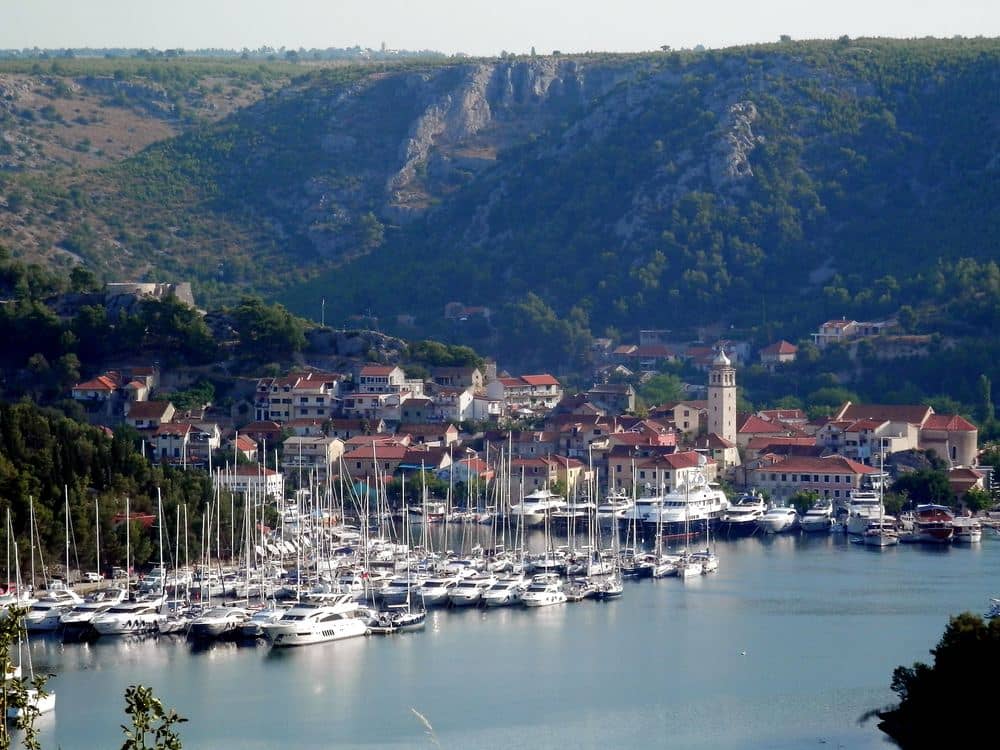
Inside the park there is a restaurant and a few snack stands by the mills, and that is the whole choice until you are back at an entrance. Skradin is the better meal: the taverns along the waterfront serve local wine, prosciutto and fish, and the pier for the park boat is on the same waterfront. Lozovac has a handful of roadside restaurants on the Drniš road that cook lamb and veal under the baking bell. For a night nearby, Skradin is the obvious base, a small town with a marina, apartments and a few hotels, quiet once the day visitors have gone. Šibenik, 17 km away, has far more rooms and the bus and rail connections, and suits a stay where Krka is one day among several.
Common mistakes
Most bad days at Krka come from planning with the wrong version of the park in mind: the summer version with boats and buses in a month when they do not run, or the winter version with an empty boardwalk in a month when the coaches come. The list below covers the errors that cost the most time, and each one is avoidable with a look at the dates and the hours on this page the evening before you go.
- Driving to Skradin in November to take the boat: it does not run, so park in the town and take the footpath along the river instead.
- Arriving at Lozovac in the late morning in August together with every coach from Split and spending the first hour in a queue at the gate.
- Trying to fit Skradinski buk, Visovac and Roški slap into one afternoon: the roads between them are slow and the boats have fixed departures.
- Parking at Skradin in July and expecting to walk straight onto a boat: in high season there is a wait for the next departure, so buy the ticket and then find shade.
- Queueing at the counter in July when the park sells tickets online: buy the evening before on the park's website.
The places, one by one
| Place | What it is | Time needed |
|---|---|---|
| Cathedral of St James | All-stone cathedral, UNESCO listed | 30 minutes |
| Šibenik Fish Market | Morning market for fish and shellfish | 20 minutes |
| Medieval Mediterranean Garden of St Lawrence | Herb garden in a restored cloister | 30 minutes |
| St Michael's Fortress | Oldest fortress, above the old core | 1 hour |
| Barone Fortress | Star-shaped fortress with viewpoint and cafe | 1 hour |
| Banj Beach | Town beach facing the old core | 2 hours to half a day |
| St Anthony Channel Trail | 4.5 km shore walk with viewpoints | 2 hours |
| St Nicholas Fortress | Sea fortress on a reef, UNESCO listed | half a day |
| Jadrija Beach | Bathing place of 1921 with wooden cabins | half a day |
| Zlarin Island | Car-free island with coral museum | half a day |
| Turina | Medieval fortress ruin above Skradin | 1 hour |
| Visovac Monastery | Franciscan monastery on an island | 30 minutes plus the boat |
| Roški Slap | Waterfall with mills and a cave | half a day |
Cathedral of St James
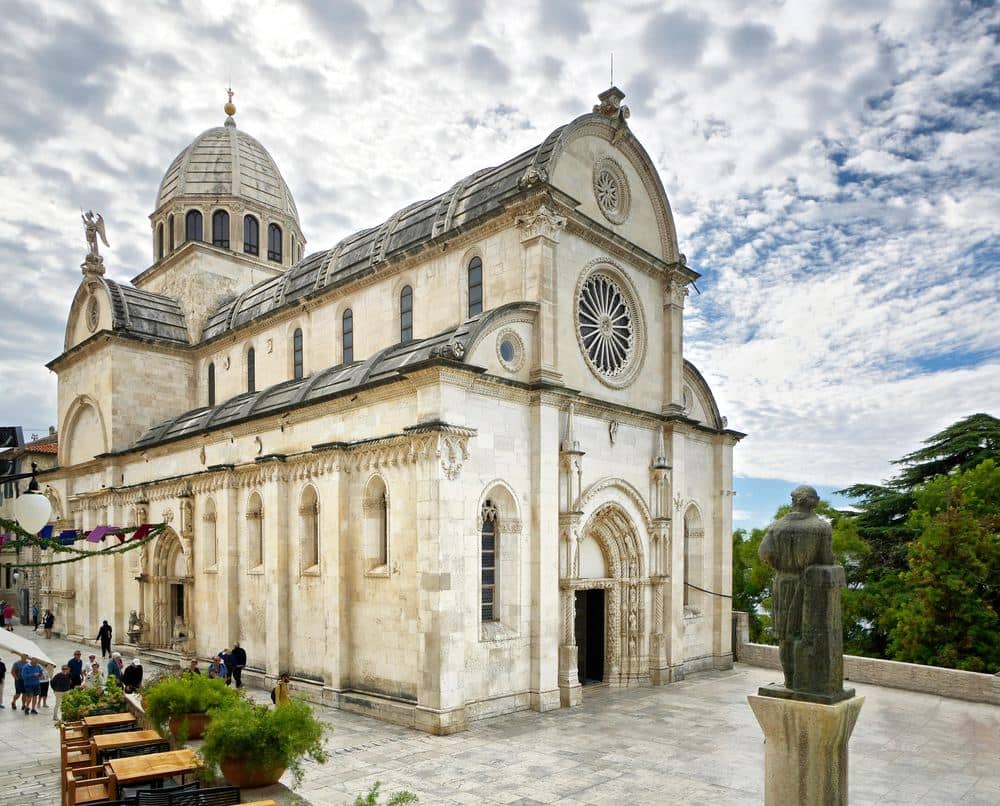
The cathedral stands at the centre of the old core and is the reason most people come to Šibenik. It was built between 1431 and 1536 and is the only large European church raised entirely of stone, without brick, timber or mortar: the slabs were cut with grooves so that they hold one another like assembled furniture. From 1441 the work was led by Juraj Dalmatinac, who devised the dome and the stone vault, and Nikola Firentinac finished it after his death. Walk round the outside first. Along the apses runs a frieze of 71 heads, portraits of real townspeople of the 15th century. Inside, the baptistery below the choir is the finest carving. UNESCO listed the building in 2000. Allow half an hour.
Šibenik Fish Market
A few steps down from the cathedral, beside the town market and below the stairway into the old core, the fish market works every morning except Monday. Fishermen from Zlarin, Prvić and Kaprije bring in the night's catch: sardines and anchovies in the warmer months, sea bream, sea bass, scorpionfish and red mullet all year, squid and cuttlefish once it turns cold. Shellfish come from the beds in Lake Prokljan, where the fresh water of the Krka meets the sea. Prices are set by the kilogram and the fish is cleaned on request. Come before 09:00 for the full choice, since after 11:00 little is left. It is worth a look even if you have no kitchen.
Medieval Mediterranean Garden of St Lawrence
When the lanes get hot, this is where to stop. The garden fills the cloister of the monastery of St Lawrence, which stood neglected and overgrown for centuries until it was restored in 2007 to a design by the landscape architect Dragutin Kiš. It follows the rules of monastic gardening: rectangular beds edged with low box, paths laid in a cross and a well at the centre. In the beds grow the herbs the monks once used, sage, rosemary, lavender, lemon balm and rue. A small cafe in the cloister serves drinks made from the same plants. Entry is cheap, the space is shaded and quiet, and it is the best rest between the cathedral and the climb to the fortresses.
St Michael's Fortress
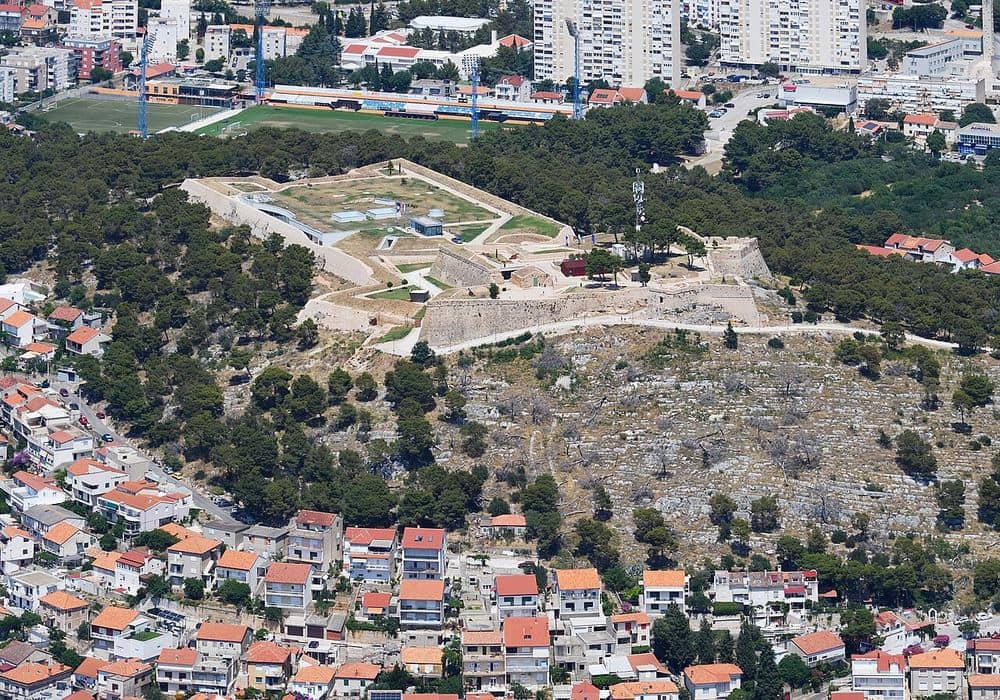
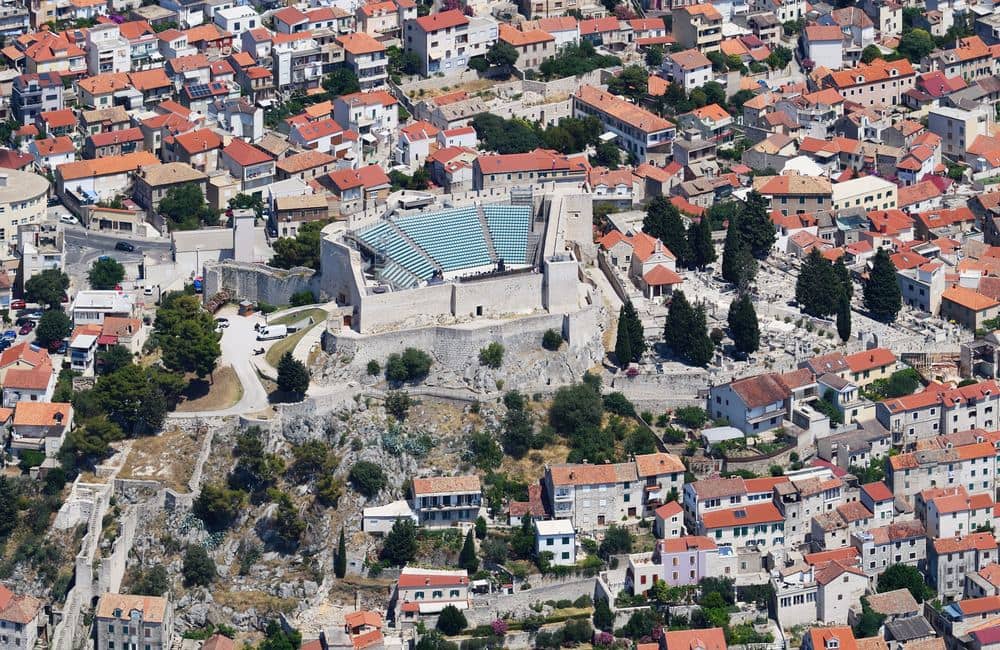
The oldest of the town's four fortresses sits on a rock 70 m above the old core, and the climb up the narrow steps takes about 15 minutes. A stronghold stood here by the 11th century, and Šibenik is first named in the charter of King Petar Krešimir IV of 1066. Unlike the Dalmatian towns of Roman origin, the town grew around this fortress, so the streets below spread toward the sea like a fan. The Venetians rebuilt it over the centuries, and a gunpowder explosion in the 17th century brought down part of the walls. Since the restoration of 2014 the interior holds a summer stage with 1,000 seats, so check whether a concert closes the walls on the evening you plan to go up.
Barone Fortress
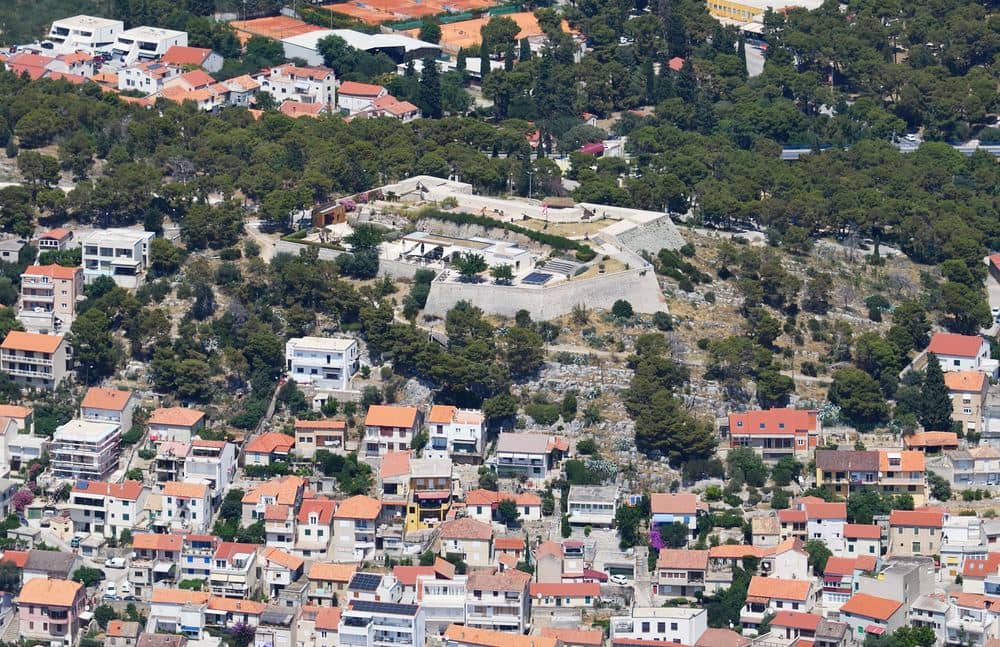
Barone stands on the hill of Vidakuša, east of the old core, 20 minutes' climb from town. It was raised in 1646 in only 2 months, while Šibenik prepared for an Ottoman attack in the Candian War, and took its name from Baron Christoph Martin von Degenfeld, the German commander who led the defence. The following year cannon from this position stopped the army besieging the town. The walls are low and star-shaped, built for artillery, so do not expect towers. Inside, the platform is arranged as a viewpoint with a cafe and an augmented reality display of the siege. From the edge you see the whole town, the channel and the island of Zlarin, which makes it the better choice if you only climb one hill.
Banj Beach
Banj is the town beach, on the northern side of the harbour opposite the old core and a 15-minute walk from Poljana along the shore promenade. It was laid out in 2013 on what had been an unarranged shore and runs about 300 m, with fine pebbles, concrete platforms, showers, cabins and access for people with disabilities. The bay is enclosed, so the sea is calm. What sets it apart is the view: across the water you have the whole outline of the town with the cathedral and St Michael's fortress, which no other beach offers. A bar and sports courts stand beside it. In the afternoon the maestral blows across the bay and takes the edge off the heat.
St Anthony Channel Trail
The channel is the only way into Šibenik harbour: about 2.5 km long, 200 to 300 m wide and nearly 40 m deep, the drowned lower canyon of the Krka. A laid-out interpretive trail of 4.5 km follows the northern shore from the Zablaće area to the cape with the lighthouse. It runs through pine wood and maquis past panels on the plants, the geology and the maritime history, and passes through underground galleries and gun positions the Austro-Hungarian army cut into the rock. From several viewpoints you look straight down on the cruise ships and cargo vessels entering port. The path is level and open all year, and the full round takes 2 hours. There is no water source, so carry your own.
St Nicholas Fortress
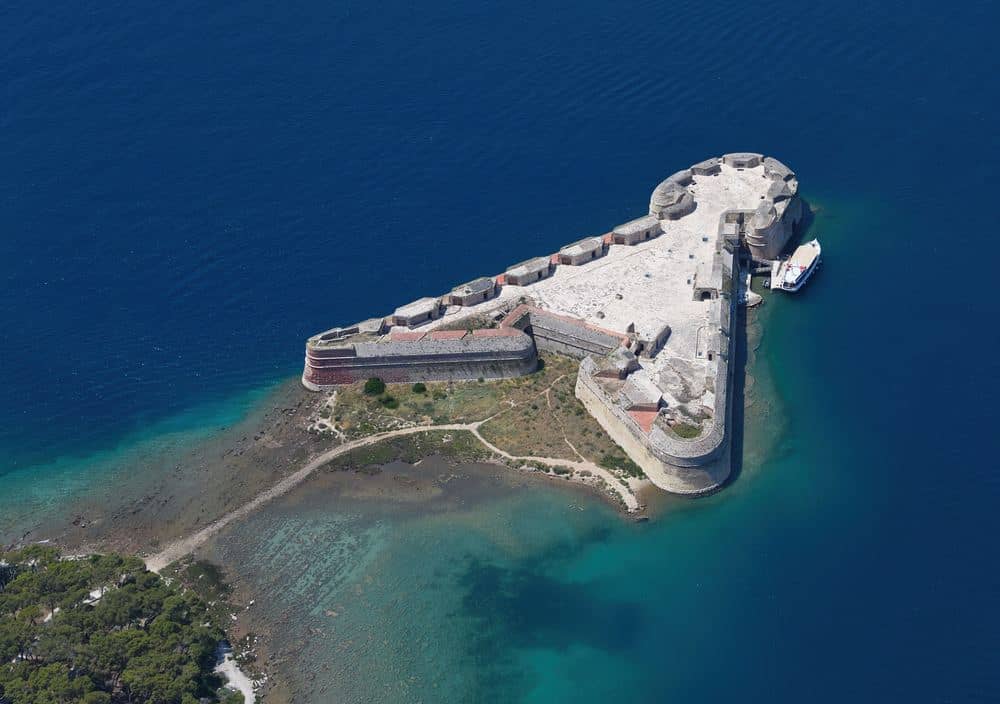
At the seaward end of the channel, on a reef at the entrance, stands the fortress that no enemy ship ever tried to pass. It was built between 1540 and 1547 to the design of the Venetian military engineer Gian Girolamo Sanmicheli, when the Ottomans held the hinterland and Venice feared an attack from the sea. The plan is triangular, in brick and stone on foundations driven into the seabed, and the strongest side, with gun openings on 3 levels, faces the open water. In 2017 it joined the UNESCO list as part of the Venetian defensive works. You reach it by boat from Šibenik harbour or on foot along the channel path, so the two fit into one outing.
Jadrija Beach
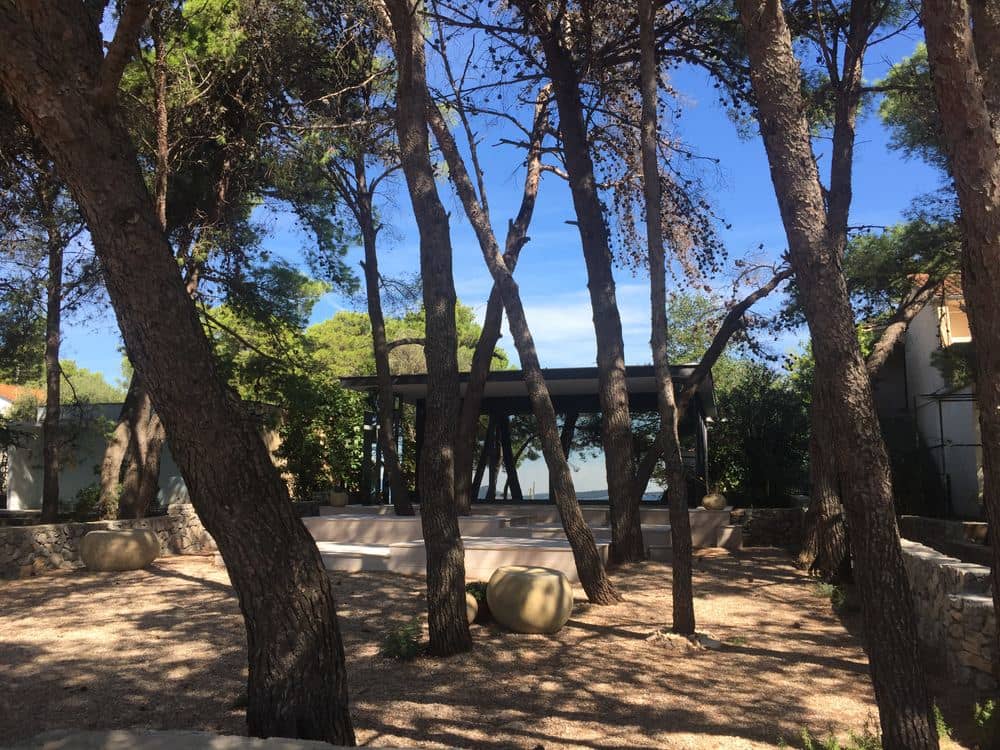
Jadrija lies on the cape at the entrance to the channel, 7 km from the centre, and is the oldest laid-out bathing place on this coast. It was built in 1921, when the people of Šibenik began going to the sea to bathe. You know it by the row of wooden cabins painted white and blue along the shore, protected as a cultural monument and still in use. The beach is pebble and concrete, and the water is clear because the open channel runs past it. A restaurant and a small 19th-century lighthouse stand at the tip of the cape. A town bus and a boat line from Šibenik harbour both take about 15 minutes, and the boat is the nicer way.
Zlarin Island
Zlarin sits just outside the channel, half an hour from Šibenik harbour by boat, with several departures a day. There are no cars: roads were never built, so everything moves by hand or by cart. For centuries the islanders brought up red coral from the Adriatic reefs and worked it into jewellery, a trade that fed the island into the 20th century, and a coral museum in the village keeps the tools and specimens. In 2019 Zlarin became the first Croatian island to ban single-use plastic, so bring a refillable bottle. The settlement is packed around the harbour, stone houses and narrow passages, and the shore is rocky with concrete bathing places. Take a morning boat and come back on an afternoon departure.
Turina
Above Skradin stand the remains of the medieval fortress of Turina. It was raised in the 13th century, when this region was ruled by the Šubić counts of Bribir, the most powerful Croatian noble family of the time, and the site was chosen to control the mouth of the Krka and the road inland: whoever held Turina held the approach to Skradin, then an important port and the seat of a bishopric. It later passed to Venice and was abandoned in the Ottoman wars. Today you see the defensive walls, the stump of a tower and a cistern. A steep path from Skradin reaches the top in about 20 minutes, and the view takes in Lake Prokljan. Wear firm shoes and mind the edges.
Visovac Monastery
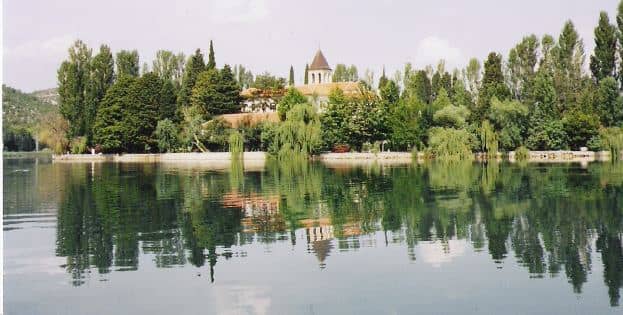
Visovac is an islet in the middle of the lake of the same name on the Krka, and Franciscans have lived on it since 1445. Augustinian hermits lived here before them. The Franciscans came from Bosnia, fleeing the Ottoman advance, and built the monastery and church in 1576. The community has worked without a break since. The building is plain, with a cloister and a garden of cypresses that covers almost the whole island, and the library keeps incunabula, manuscripts and a rare illustrated edition of Aesop's fables printed in the 15th century, one of few surviving copies. You can only get there on a park boat excursion from Skradinski buk, Roški slap, Stinice or Remetić, and only in company: the guided round takes half an hour.
Roški Slap
Roški slap lies on the middle course of the Krka, between Visovac lake and the canyon, where the river drops 25.5 m over 650 m. The upper part is a run of small cascades the local people call necklaces, because they descend in a line like links, and below them the main cataract falls into a wide lake. Along the bank stand old mills that ground grain for the whole hinterland until the mid 20th century, and some still work as a demonstration. Above the falls, at the top of the canyon, lies the Oziđana pećina cave, the last stop on the park trail from Stinice via Roški slap. A road from Skradin and Drniš leads to the falls, and in season the park also brings you by boat from Visovac. It gets a fraction of the crowd at Skradinski buk.
Frequently asked questions
- How much does Krka national park cost?
- For adults, 40 euros from June to September, 20 euros in April, May and October, and 7 euros from November to March. Children aged 7 to 18 and students pay 15, 12 and 4 euros for the same periods. These are the park's 2026 prices for all land locations.
- Can you swim at Skradinski buk?
- No. Swimming below the falls has been prohibited since 2021, in every month of the year.
- Do the boats and shuttle buses run all year?
- No. Boat excursions, the Lozovac shuttle, the Skradin boat and the trips to Visovac and Oziđana pećina run from 1 April to 31 October only. Outside that period you arrive under your own steam and walk the loop.
Official sources
Share this guide
Questions about your trip?