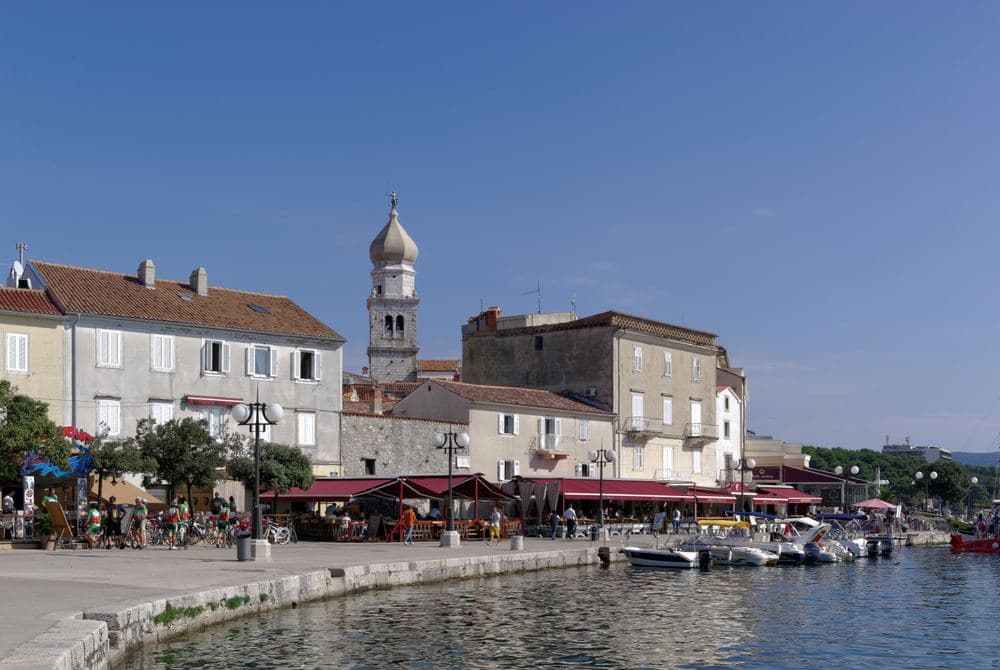
Krk town is the island's capital and its oldest place: a ring of walls with Roman blocks in the foundations, a 12th-century cathedral grown together with the church of St Quirinus under one belfry topped by an angel, and the castle from which the Counts of Krk, later the Frankopans, set out into Croatian history. Two town beaches, the Roman grid of lanes, Vela placa with its loggia, and within half an hour Vrbnik on its cliff, the islet of Košljun, the Biserujka cave and the great pebble arc of Baška. And the bridge: Krk is the big island you reach without a ferry.
Checked: 13 September 2026
Krk is the northernmost large island of the Adriatic and the one with a bridge: two concrete arches of 1980 across the islet of St Mark, the larger one 390 metres in span and the largest concrete arch in the world when it opened, built out from both shores without scaffolding in the sea. The crossing is free. Rijeka airport is on the island at Omišalj, the ferries to Cres (Valbiska to Merag) and, in summer, to Rab (Valbiska to Lopar) leave from its western shore, and the town of Krk sits on the south-western coast, 25 km from the bridge. Stop at the car park before the bridge on the mainland side for the view of the arch; from below it looks impossibly thin.
Inside the walls
The old core is a stone chest with four gates, and the walk around the ring takes half an hour: Roman blocks of ancient Curicta in the foundations, the medieval additions of the Counts of Krk, a Venetian layer of crenellations on top. Enter through the Small Gate onto Vela placa, the main square, where the Renaissance city loggia of the 16th century frames the cafés and a hexagonal cistern lies under glass in the paving. The lanes behind it still follow the grid of the first century, so a Roman town plan would get you around. Two minutes on, the cathedral of the Assumption stands on Roman baths and an early Christian church, a three-nave Romanesque basilica of the 12th century grown together with the older church of St Quirinus, the town's protector, so that two churches share a wall and a belfry with an angel on its top; come an hour before evening mass, when the sun comes through the windows, and photograph the belfry from the pier in the harbour.
Next to the cathedral, on Kamplin square, stands the Frankopan castle: an almost regular quadrangle by the sea with a round tower towards the waterfront and a square one of 1191 towards the square, which also served as a courtroom. From here the Counts of Krk spread a rule that would embrace half of Croatia; after them Venice extended the fort for cannon. The walk on the ramparts gives the best view of the core, the belfry and the open sea towards Cres, and in summer the courtyard is a stage. Half an hour, and with the cathedral beside it the whole story in a hundred metres: cross and sword, bishop and count. Then down to the riva, the promenade beneath the walls where the town breathes: fishermen in the morning, ice cream in the afternoon, the stroll in the evening, and from the pier at its end the frame of walls, angel and castle in one line above the water.
Beaches: Dražica east, Ježevac west
Dražica is the town beach, ten minutes east of the walls along the coastal path: fine shingle and concrete decks, gentle entries, showers, lifeguards and slides in season, and, from the towel, a view across the bay of the belfry with the angel that no other beach on the island has. Every cove further along the path towards the piny cape of Punta di Galetto is quieter than the one before. Ježevac, five minutes west of the walls by the campsite, is the slower side: a long stretch of shingle and slabs with the pine wood coming down to the water, public and open to all, and facing due west, so the sun sets into the sea without an obstacle.
Half an hour out: Vrbnik, Košljun, Biserujka, Baška
Vrbnik stands where towns do not stand, on a cliff fifty metres above the sea on the island's east coast, half an hour from Krk town through the interior. Inside is a tangle of lanes with the Klančić, forty centimetres wide and passed sideways, and around it the Vrbnik field, the only ground where the white žlahtina grape grows; an hour of lanes and an hour in a konoba is the formula, best late in the afternoon when the buses leave. Košljun is a wooded islet in Punat bay, five minutes by boat from Punat, where Franciscans have lived since the 15th century with a church, a cloister and a museum of everything they never threw away, from island costumes to Glagolitic manuscripts; check the last boat back. Biserujka, near Rudine in the north, is a show cave of 110 metres of halls at a constant thirteen degrees, a half-hour guided tour and the island's best rain plan. And Baška, twenty minutes south across the pass, is Vela plaža: almost two kilometres of fine pebble in a great arc beneath bare hills, Blue Flag, full facilities and the Adriatic's biggest August crowd, with room at the eastern end.
Frequently asked questions
- Do I need a ferry to get to Krk?
- No. The Krk bridge of 1980 joins the island to the mainland near Rijeka and is free to cross; Rijeka airport is on the island. Ferries from Krk go onward to Cres all year and to Rab in summer.
- How long does Krk town take?
- Half a day for the walls, Vela placa, the cathedral, the castle and the riva, plus a swim at Dražica or Ježevac. Add Vrbnik, Košljun or Baška for a full day.
- Which is the best beach on Krk?
- Vela plaža in Baška is the island's most celebrated, almost two kilometres of fine pebble with a Blue Flag; in Krk town itself Dražica has the facilities and the view of the belfry, Ježevac the pine shade and the sunset.
Make Croatia Atlas a preferred source
One click and Google shows you our stories more often in Top Stories and in AI answers. It changes your own results only.