A villa from 1844 turned a fishing village into the health resort of an empire. What remains is a twelve-kilometre promenade, parks with plants from the whole monarchy, fishing villages at both ends, concrete beaches and a mountain 1401 metres above it all. Everything in order, with times and the months that pay off.
Checked: 3 September 2026
Opatija takes its name from an abbey: opatija is the Croatian word, and the Benedictine house that stood by St Jacob's church gave the settlement its name long before anyone came here for the sea. The church was first built around 1420 and rebuilt in baroque, and it still sits just back from the waterfront with a Pietà by Ivan Rendić inside. Everything else in town is younger and has one starting point.
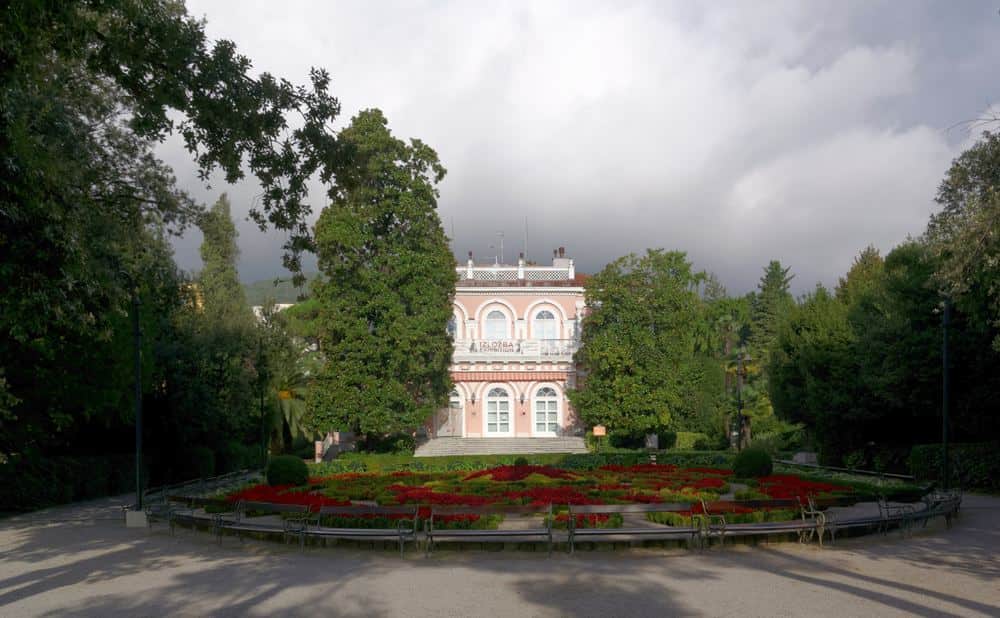
Villa Angiolina, 1844: where the resort begins
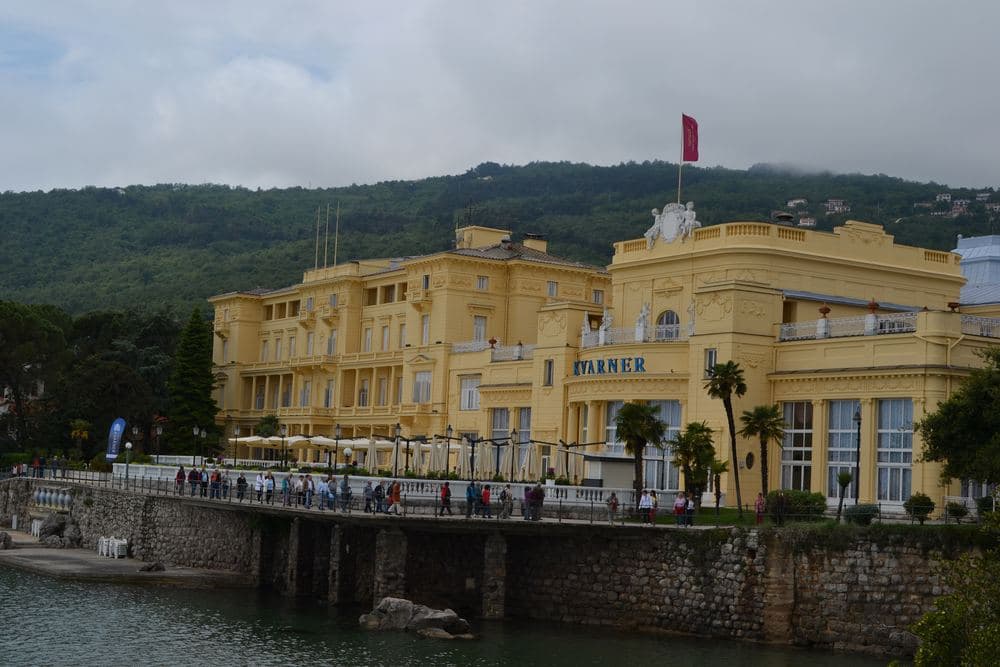
The merchant Iginio Scarpa built a neoclassical villa here in 1844 and named it for his late wife. That single house is the spark: guests came, then hotels followed, then the railway, and within a few decades the fishing hamlet was the winter resort of the Habsburg court. The park around the villa still holds camellias, magnolias and palms brought in from across the empire, and inside is the Croatian Museum of Tourism, which is the most useful half hour in town because it explains what you are walking through. Hotel Kvarner stands above the water in the centre and belongs to the same story: opened in the resort's first decades, it is worth a look from the promenade below even without going in.
The Lungomare, from Volosko to Lovran
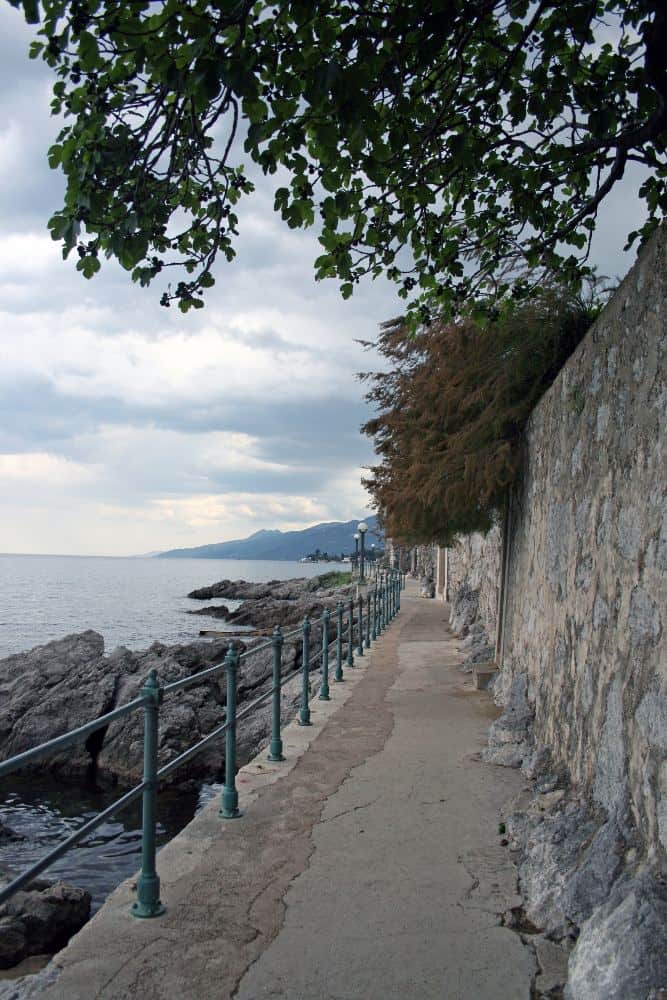
The Franz Joseph promenade runs along the water and links the fishing village of Volosko with Opatija and Lovran. It was laid out for emperors and their guests over a century ago and it still does the one thing that matters: the sea stays on one side the whole way, villas and pines on the other, and there is no road to cross. The northern section leads to Volosko, where the rooftops of the old harbour come into view around the curve and the konobas start. The southern section passes Ičići and Ika and ends in Lovran, whose old town is a compact core of stone lanes above the harbour. Walk it at golden hour and the whole Riviera turns amber. Set into the stone along the way are the bronze stars of the Croatian Walk of Fame, from Nikola Tesla and Ruđer Bošković to Dražen Petrović and Oliver Dragojević.
The Maiden with the Seagull and the beaches
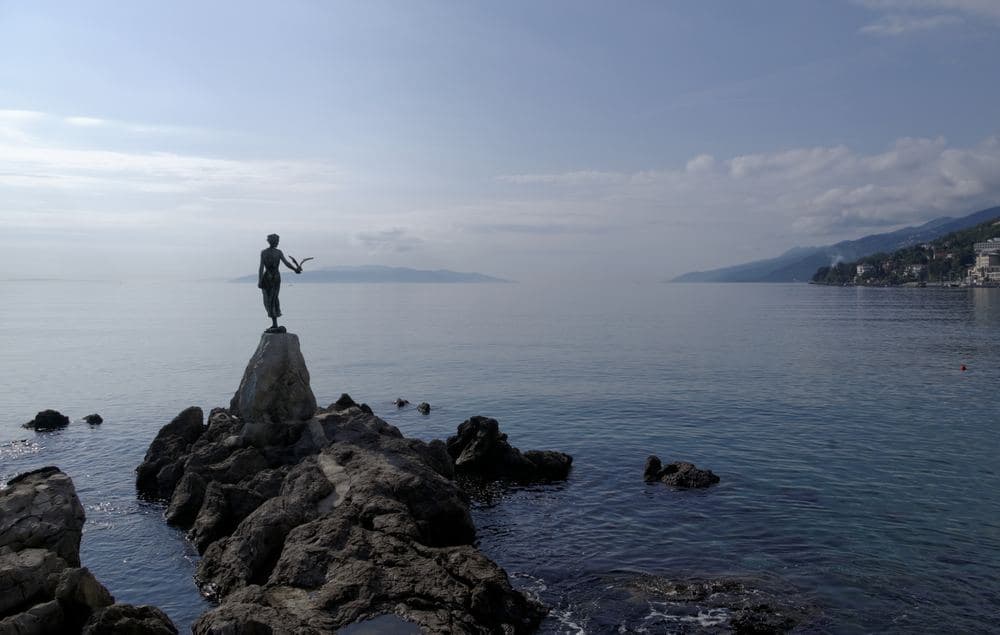
On the rocky shore stands the bronze figure that has been the town's emblem since 1956, a slender girl lifting a seagull towards the sky, by the sculptor Zvonko Car. Behind her the Kvarner bay opens wide, and at sunset the bronze glows against the water. Swimming here means concrete terraces rather than sand. Slatina is the main beach, right on the promenade and busy from mid-morning, mixing swimmers, cafes and the general hum. Volosko is quieter, where the old harbour meets open water, and Črnikovica beyond it is smaller still, little more than rock, sea and some shade. Further south, Ičići sits by the marina, and Medveja and Mošćenička Draga past Lovran are proper day-trip beaches: you go for the afternoon rather than for a quick dip.
Učka: 1401 metres above the promenade
Behind the town the ground rises fast. Vojak, the highest peak of the Učka range at 1401 metres, carries a round stone tower, and from it the view sweeps over the Kvarner islands and Istria; on a clear day it reaches the Alps and Venice. The way up runs through beech forest, and the Poklon visitor centre at the pass is the natural place to start, with a car park and boards to get oriented. Take water and proper shoes, and take a layer as well: the summit breeze is cool even in August, and a warm coastal morning means little up there. For something shorter, the Carmen Sylva forest promenade climbs gently into the woods straight from town, and the hill village of Veprinac sits inland on high ground, its stone lanes opening now and then onto the bay below. Sisol, on the same ridge, is the quieter summit: after the bura, Cres and Krk lie below like a map.
Volosko: where the Lungomare begins
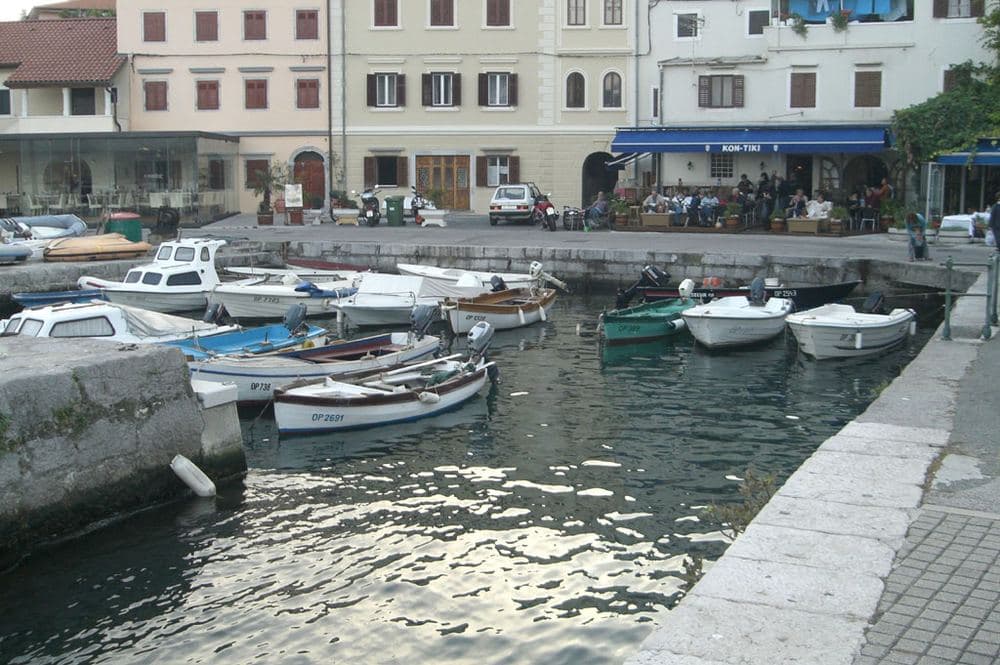
Volosko is the northern end of the promenade and the only place on the riviera older than tourism: a fishing village with a mandrač, the small enclosed harbour where boats were pulled in before the bura, narrow lanes climbing from the sea and houses leaning on one another. Andrija Mohorovičić, the seismologist after whom the boundary between the Earth's crust and mantle is named, was born here, and the density of good restaurants is the highest on the Kvarner: the konobas around the mandrač cook fish bought that morning, and two or three restaurants carry Michelin recommendations. Walk from Opatija, twenty minutes along the Lungomare past Tomaševac and Črnikovica, and book for dinner; in summer there is no waterside table without a reservation. Bus 32 takes you back.
The southern Lungomare: Ičići, Ika, Lovran
From Slatina southwards the promenade passes the Admiral marina, the American Gardens and the hotels of Ičići, home of the ACI marina and the longest beach on the riviera, then Ika, a fishing village with a small harbour and one of the best konobas on the Kvarner, and on to Lovran. The whole southern stretch is an hour and a half on foot, level, by the sea, with swimming spots every few hundred metres. Lovran is the goal: a medieval core with a town gate, the fourteenth-century church of St George with its frescoes and a square where in winter maruni are sold, the chestnuts that gave the Marunada its name. Below the core is the harbour, behind it villas of the same era as Opatija's, only smaller and quieter. Anyone not walking back takes bus 32, every twenty minutes.
The beaches, honestly: where to swim
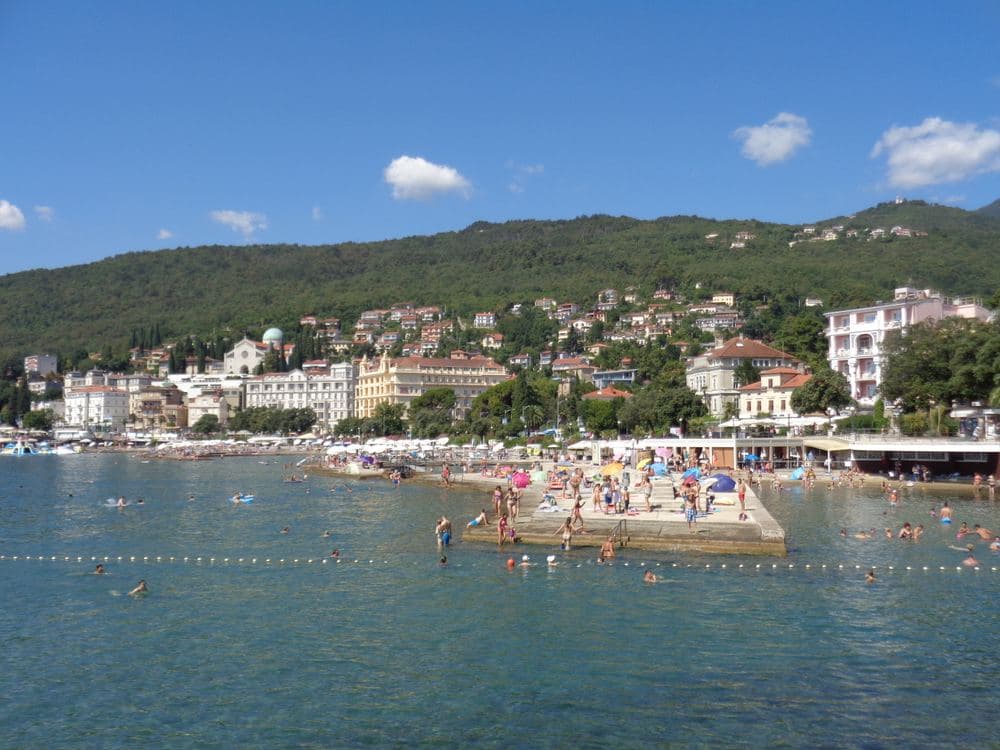
- Slatina: the town beach in the centre, concrete and pebble, sunbeds, showers, cafés, full from eleven. For a quick swim between two walks.
- Lido and Tomaševac: smaller concrete platforms north of the centre, quieter, deep water and ladders. Lido has a club with music in the evening.
- Volosko and Črnikovica: rocks and fine pebbles at the northern end, local swimmers in the morning, no sunbeds.
- Ičići: the longest beach on the riviera, pebble by the marina, gradual entry, good for children, parking by the road.
- Medveja: a proper pebble cove beyond Lovran, half a kilometre of beach, showers, campsite, blue flag. For a whole day, not an hour.
- Mošćenička Draga: pebbles, a fishing harbour, konobas on the beach and a path up the stream to Mošćenice on the hill. The furthest and the finest.
Veprinac, Poklon, Vojak: a day on Učka
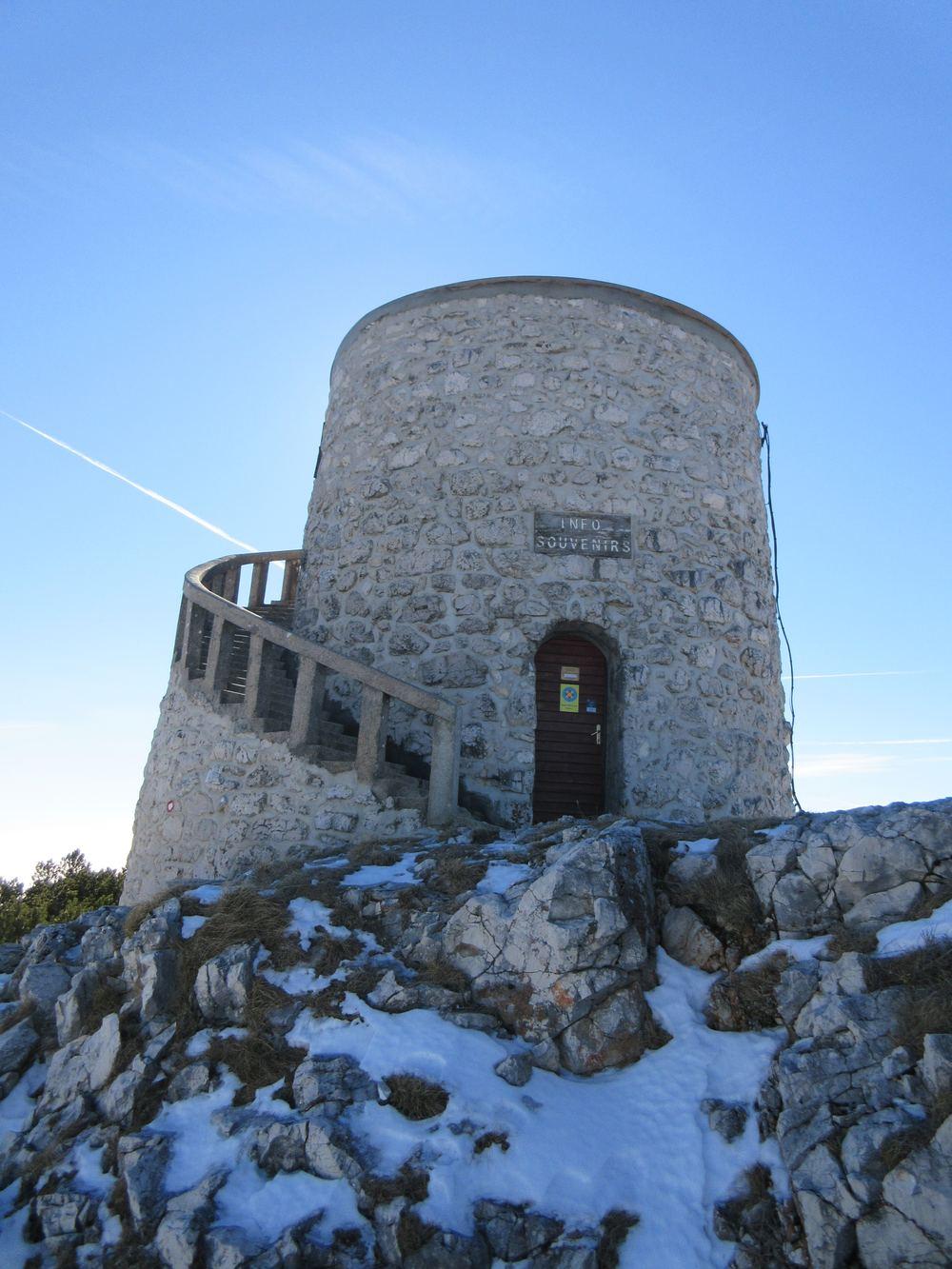
Učka is the reason Opatija has the climate it has, and the best trip you can make from the town without a car. On foot: from the centre along the Carmen Sylva walk into the woods, then the marked trail over Veprinac, a stone village at 519 metres with a church and a view down the whole riviera, to the Poklon pass at 922 metres, where the nature park's visitor centre has an exhibition and a café. From Poklon to Vojak, 1401 metres, is another hour through beech woods; on the summit stands a stone tower from 1911 with Istria, the Kvarner, all the islands and, after a bura, the Alps in view. The whole climb from Opatija takes four to five hours, the descent the same; anyone not wanting the full route drives to Poklon or takes the summer bus and walks only the last hour. Bring water, proper shoes and an extra layer: on the summit it is ten degrees cooler than the beach, even in August.
What to eat
The Kvarner is the border between Istrian and Dalmatian cooking, and Opatija takes the best of both. Kvarner scampi, cooked buzara-style with wine and garlic, are the riviera's signature dish, charged by weight and eaten with the hands. From Istria come truffles in autumn, fuži with game and pršut, from Gorski kotar game and mushrooms, from Lovran maruni and cherries in June. In winter every café has kroštule and fritule, and Opatija has a sweet brand of its own: chocolate, around which a whole festival turns in November. For fish go to Volosko or Ika, for a cheap lunch to the market hall in the centre, where fish is sold downstairs and cooked upstairs. Coffee is taken on the terrace of the Hotel Kvarner, slowly, because that is what the town invented.
A year in Opatija, month by month
- 03. / 04.Camellias and the start of the season
The camellia is the town's symbol and blooms in March across the parks; hotels open, the Lungomare is empty, the sea still cold.
- 06. / 07. / 08.The open-air stage and the Kvarner
Concerts on the open-air stage by the sea, the Kvarner Festival with classical music in villas and churches, the sea at 24 to 27 degrees. The most expensive months.
- 09. / 10.The best time
The sea still warm, no crowds, Učka without the heat, the Marunada in Lovran over three October weekends.
- 11.Chocolate Festival
Three days in early November at the Gervais centre and the Šporer pavilion; cocoa menus in the hotels all month. Our guide has the dates.
- 12. / 01.Advent and New Year
Angiolina park and the villas lit, stalls by Slatina, a rink with the Kvarner behind it, New Year's Eve on the promenade. Mild but wet; bring a raincoat.
Practical: getting there, parking, getting around
By car: from Zagreb on the A6 to Rijeka and the bypass, two hours; from Trieste over Učka, an hour and a half; from Pula through the Učka tunnel, an hour and a quarter. In town parking is problem number one: streets in the centre are metered with two-hour limits and full by ten in the morning in summer, so the Slatina garage by the main beach is the only reliable choice, or the hotel garage. Without a car it is easier: city bus 32 runs the whole riviera from Volosko to Mošćenička Draga every twenty minutes, lines 32 and 34 connect Opatija with Rijeka, and in summer boats from the harbour go to Cres and around the bay. Rijeka airport is on Krk, forty minutes, with seasonal flights; Zagreb, Trieste and Pula fly all year. Trains stop in Rijeka and in Matulji, above the town.
Accommodation: the monarchy-era hotels on the Lungomare, the Kvarner, Imperial and Milenij, for those who want to sleep inside the story; apartments on the slopes above the road for quiet and a view; Ičići and Lovran for families and easy parking. Book by March for July and August. Everything on this page, with map and opening hours, is on the Opatija city page.
Watch
Opatija on video
A short official city film to help you picture the place before you go.
Opatija: Queen of the Adriatic
Frequently asked questions
- Where does the Lungomare start and end?
- It runs along the shore from the fishing village of Volosko in the north, through central Opatija, past Ičići and Ika, to Lovran in the south. You can join it anywhere and turn back whenever you like: the sea is on one side the whole way and there is no road to cross. Volosko for the harbour and konobas, Lovran for the stone lanes of the old town.
- Can you swim in Opatija, and is there sand?
- You can swim, from concrete terraces rather than sand. Slatina in the centre is the main beach and fills from mid-morning. Volosko and Črnikovica to the north are quieter and rockier. For a longer stay by the water, Medveja and Mošćenička Draga past Lovran work better, and they are reached by car or bus rather than on foot.
- Is Učka worth a day from Opatija?
- Yes, if the sky is clear, because the whole point is the view: the Kvarner islands, Istria, and on the best days the Alps and Venice. Start at the Poklon visitor centre by the pass. Take water, proper shoes and a warm layer, since the summit at 1401 metres stays cool and windy even in August. On a hazy day the walk through the beech forest is still pleasant, but the tower gives you nothing.
- How much is entry to Slatina beach?
- Slatina is the town beach and entry is free; you pay for sunbeds and parasols, in summer around 10 to 15 euros a day. The same goes for Lido and Tomaševac. The hotel beaches along the Lungomare charge non-guests.
- Is Opatija good for families with children?
- For older children yes: a car-free Lungomare, the park, Učka, boats to Cres. For small children the concrete terraces are awkward; then choose accommodation in Ičići or Medveja, where the entry is gradual and the beach is pebble.
- What to see in Opatija when it rains?
- The Croatian Museum of Tourism in Villa Angiolina, the exhibitions in the Juraj Šporer pavilion, the cafés of the Kvarner and Imperial hotels, and for half a day Rijeka: the Maritime Museum in the Governor's Palace and the tunnel under the old town.
Make Croatia Atlas a preferred source
One click and Google shows you our stories more often in Top Stories and in AI answers. It changes your own results only.