

Nin is a town of a few hundred people on an islet in a lagoon 15 km north of Zadar, and in the ninth century it was the seat of Croatian princes and bishops. Two stone bridges lead in, the Church of the Holy Cross has been called the smallest cathedral in the world, St Nicholas stands alone on its mound in the fields, and the lagoon around the town gives three things the coast rarely does: sand, warm shallow water and healing mud. Half a day on foot, from the museum to the saltworks to the beach.
Checked: 13 September 2026
Nin lies 15 km north of Zadar, twenty minutes by car or by local bus, on the flat coast that faces the Velebit across the water. The old core sits on an islet in a shallow lagoon and is entered, as centuries ago, over two low stone bridges: the southern one through the Lower Gate leads straight into the main street, the northern one at the Upper Gate into the quieter half. Stop in the middle of either: the lagoon changes colour with the tide, fish are visible from the parapet, and half the town is in one glance. In the ninth century this was Croatia's capital and bishop's seat, and the bronze Prince Branimir at the entrance, sword in one hand and charter in the other, recalls the year 879, when the pope recognised his state.
The smallest cathedral and the coronation mound
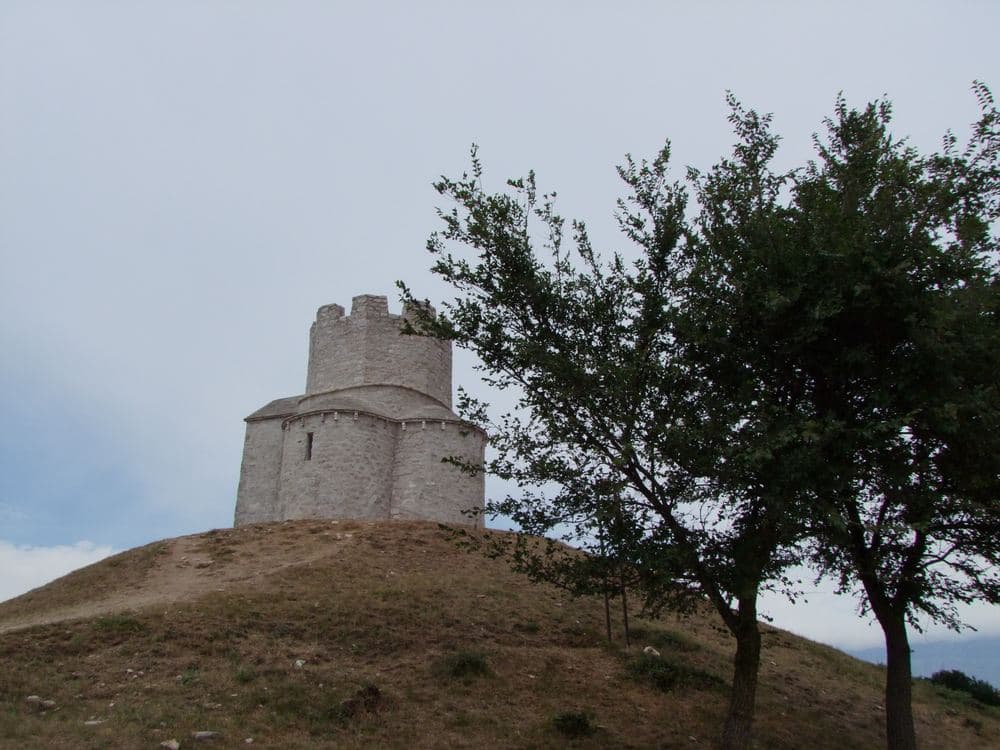
The Church of the Holy Cross is a pre-Romanesque chapel of the ninth century in the grass of the old core, cruciform, domed, with gently curved walls and openings placed so that the sun enters in exact order at solstices and equinoxes, a stone calendar; the English architect Thomas Jackson called it the smallest cathedral in the world and the name stuck. Its lintel carries the name of the county prefect Godečaj, the oldest mention of a Croatian dignitary cut in stone. Ten minutes inside, longer outside at dusk. Five minutes from the road between Nin and Zaton, St Nicholas on the Prahulje mound is the loneliest chapel of Dalmatia: an 11th or 12th-century cube with a dome and the toothed crown it got in Turkish times, where by tradition the crowned Croatian kings showed themselves to the people. The door is usually locked; you come for the whole, chapel, mound, Velebit, best in the golden hour.
Two more stops in the core. The Museum of Nin Antiquities retells three millennia on one floor, from Liburnian Aenona through the Roman municipium to the princes, and its stars are the reconstructions of two early Croatian ships of the 11th century found in the lagoon, the condura; an hour, and the right order is museum first, then the Holy Cross. The Church of St Anselm, the parish church on the site of the ancient cathedral, keeps the treasury of Nin's gold and silver, reliquaries from the ninth century onward and the Gothic statue of Our Lady of Zečevo, which a procession of boats carries to the islet of Zečevo every May.
Salt, mud and sand
South of the town the saltworks turn sea into crystal the way it was done for thousands of years: shallow basins in which sun and bura draw the salt out in summer while the salters gather it by hand, the flower of salt first. A small museum, an educational path between the basins and a shop with salt, salt flower and salt chocolate; an hour, in the morning in summer, since there is no shade over the white basins. North of the town, by Queen's Beach, lies the healing mud: black peloid scooped from marked fields, spread on the skin, dried in the sun for twenty minutes and washed off in the warm shallows, used for centuries against rheumatic and skin troubles, with Roman finds to prove the age of the habit. Free, funny and not for open wounds.
Queen's Beach itself, named after queen Jelena who by tradition came down to the sea here while the court sat in Nin, is kilometres of fine sand in a shallow lagoon with the Velebit straight across the water: sea knee-deep for hundreds of metres and a degree or two warmer than the open beaches, a natural pool for children, seasonal loungers, showers and cafés, and almost no shade, so a parasol is equipment. Twenty minutes on foot from town or by car to the car parks behind. The Ždrijac, the sandy spit that closes the lagoon, has beach on both sides: the inner one smooth as a lake for children, the outer one facing the Velebit channel with the constant wind that makes it the kite and windsurf meeting place of northern Dalmatia.
Frequently asked questions
- How far is Nin from Zadar?
- About 15 km north, twenty minutes by car or by local bus. The old core on the islet, the saltworks and Queen's Beach are all within a twenty-minute walk of each other.
- Why is the Church of the Holy Cross called the smallest cathedral?
- The English architect Thomas Jackson gave the ninth-century chapel that name for its perfect completeness, and it stuck. It was never a cathedral in the formal sense; Nin's bishops sat at the church on the site of today's St Anselm.
- Is the Nin mud free to use?
- Yes. The mud lies in marked fields by Queen's Beach; in summer a seasonal point gives basic instructions, the rest of the year it is simply there. Not for open wounds, and serious complaints belong to a doctor.
Make Croatia Atlas a preferred source
One click and Google shows you our stories more often in Top Stories and in AI answers. It changes your own results only.