The shoreline is maritime domain and belongs to everyone. In early September 2026 an inspection on Vis ordered the immediate removal of an electrified wire fence with which an owner had closed access to a cove. The rule is simpler than it looks.
Checked: 18 October 2026, 19:11
The question comes back every season, usually in front of a fence or a private beach sign. The answer stays the same: every beach in Croatia is maritime domain, open to everyone. The shore is maritime domain, a category the law removes from private ownership and reserves for common use.
The case on Vis
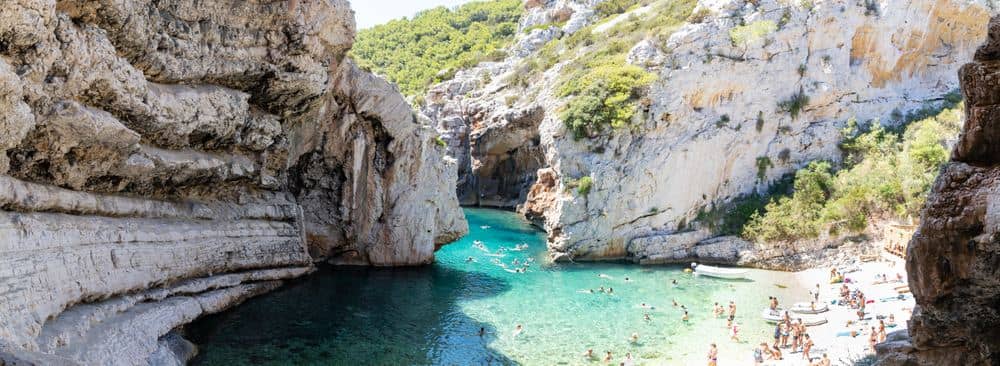
In early September 2026 inspectors from the Split harbourmaster's office, Vis branch, found an electrified wire fence about 160 centimetres high in the Vela Čavojnica cove, set on both sides of the bay so that access to the beach was blocked. A concrete jetty had been built on the shore as well. Immediate removal was ordered, together with a report for obstructing common use of the coast. The owner pleaded ignorance of Croatian rules, which in this case changes nothing.
What the law says
- Maritime domain is governed by the Act on Maritime Domain and Sea Ports. The shore is in common use and cannot be privately owned.
- Under the current framework, fencing off a beach on the basis of a concession is no longer possible, and access to a beach is not charged for.
- Sunbeds, parasols and food service can be charged for. That is a service, not an entrance fee.
- The path to the beach across private land is a separate matter: the beach itself is public, but a route through someone's yard is not automatically a right of way.
If you meet a fence
Do not tear it down yourself and do not get into a confrontation. A report goes to the harbourmaster's office or its local branch, which has jurisdiction over maritime domain, and can also go to the municipal enforcement service. A photograph with the location helps, because the inspection needs to know which plot it is looking at. The Vis case shows this works: report, site visit and removal order fitted into a few days.
What is public and what costs money
The line runs between access and service. Anything that puts you on the shore and into the sea is common use and free: the pebbles, the rocks, the concrete platforms, the ladders and the water itself. Anything that adds comfort can carry a price: a sunbed, a parasol, a locker, a drink brought to your towel. A concession holder who runs the sunbeds on a beach may charge for the sunbeds and for nothing else. If you are asked to pay before you can step onto the shore, or told that the beach is reserved for hotel guests, the request has no legal basis. The table shows how this plays out in the situations you are most likely to meet.
| Situation | Public and free | Can be charged for |
|---|---|---|
| Hotel beach with sunbeds | Shore, sea, ladders, passage along the water | Sunbeds, parasols, towels, drinks |
| Beach club with ropes and music | The pebbles beside the sunbed rows | Sunbeds, often with a minimum spend |
| Campsite on the shore | The shoreline strip in front of the pitches | Passage through the gate on campsite land |
| Town beach with buoys | Everything, the buoys keep boats out | Kiosk food, rented kayaks and pedal boats |
| Island in a national park | The shore once you are inside | The park ticket for the protected area |
| Ferry pier or port basin | Closed to swimmers under port safety rules | Nothing, use the beach next to it |
Hotels, campsites and the shoreline strip
Maritime domain includes a strip of land along the water, at least 6 metres inland from the high-water line and wider where the beach itself is wider. That strip stays in common use whatever stands behind it. A hotel built above a cove owns the building and the land down to the edge of the strip. The concrete platforms, the steps into the sea and the pebbles below are common use like any other shore. You may walk along the strip past the hotel terrace and swim from the same ladders as the guests. Staff who say otherwise are usually repeating what they were told, and a calm reference to maritime domain, pomorsko dobro in Croatian, normally settles it.
Campsites confuse visitors most. The site as a whole is fenced and reception controls who comes through the gate, which is a rule about the campsite's land. The shore in front of the pitches is maritime domain like any other, and along most of the Istrian and Kvarner coast a footpath runs along the water through one campsite after another. Keep to the path at the water's edge and nobody will stop you. Where a cove has no land route at all, arrive by sea. Swimming ashore from a boat or kayak is common use of the water, and landing on the shore is allowed outside port areas and protected zones.
Common mistakes
Most disputes on the shore start with a misread sign or rope. A sign saying private beach, hotel guests only or reserved describes the sunbeds and the service. The shore under them stays public. A line of buoys in the water marks the swimming zone that boats must keep out of, so swimming inside it is the point. A fence is the one thing that should make you reach for the camera and the harbourmaster's address instead of a way over it. The mistakes below are the ones we see every summer.
- Paying a beach club's sunbed price because you took it for an entrance fee. Put your towel on the free pebbles beside the rows instead.
- Turning back at a hotel terrace. The platforms and steps below it are public, walk down and use them.
- Cutting through a garden to reach a cove because the beach is public. The garden is private property, find the route along the shore.
- Swimming off a ferry pier or inside a port basin. Port areas are closed to swimmers on safety grounds and fines are issued.
- Calling 112 about a fence. That number is for emergencies, the harbourmaster's local branch handles maritime domain.
- Trusting a booking review that says private beach. Guests write that when they mean a beach with a hotel above it.
Regional differences
Istria and Kvarner have a long tradition of resort strips. Around Poreč, Rovinj and Umag, and again along the 10 km Lungomare from Volosko through Opatija to Lovran, the shore is mostly rock and concrete platform with hotels and campsites behind it, and a public footpath follows the water almost without a break. Sunbed strips in Crikvenica and Selce sit a few metres from free pebbles. Fences are rare here because the coastal paths have been public for over a century. Dalmatia is different. The beaches are pebble coves, the land behind them is steep and privately owned, and villas built after 1990 sometimes stand directly above a cove with a gate on the only path. Vis is the extreme version of a problem you will see in milder form on Hvar, Brač and around Trogir.
Dubrovnik is where you will most often hear that a beach is reserved. Banje below Ploče has a beach club on one part and free pebbles beside it, and the hotel beaches in Lapad and Babin Kuk are open to anyone arriving on foot along the shore. Inland the same principle covers rivers and lakes, which are water domain and public, though national parks add conservation rules of their own: swimming has been banned at Plitvice since 2006 and at Skradinski buk in Krka since 2021, and neither ban has anything to do with ownership. The Mrežnica and Korana rivers near Karlovac and the Cetina above Omiš are free to swim in wherever no local sign says otherwise.
What to bring to a free beach
The free strip beside the sunbeds has no shade, no showers and no kiosk of its own, so pack for it. A parasol and water shoes matter, because Croatian beaches are pebble or rock and sea urchins live on the rocky ones. Tap water is drinkable everywhere and the public fountains in Dubrovnik, Split and Zadar refill a bottle for nothing. Carry coins and small notes for the kiosk and for island buses, which often take nothing else. Before you walk to a cove, drop a pin on your phone map and take a screenshot. You will need the location to find the way back, and if you do meet a fence it is the detail the harbourmaster's inspectors ask for first.
Frequently asked questions
- Are there private beaches in Croatia?
- No. The shore is maritime domain in common use and cannot be privately owned. A private beach sign carries no legal weight.
- Can a beach charge an entrance fee?
- Not for entry. Sunbeds, parasols and food service yes, because you are paying for a service, not for access to the sea.
- Who do you report a fence blocking a beach to?
- The harbourmaster's office or its local branch, which has jurisdiction over maritime domain, and the municipal enforcement service. A photo with the location speeds things up.
Official sources
Share this guide
Questions about your trip?