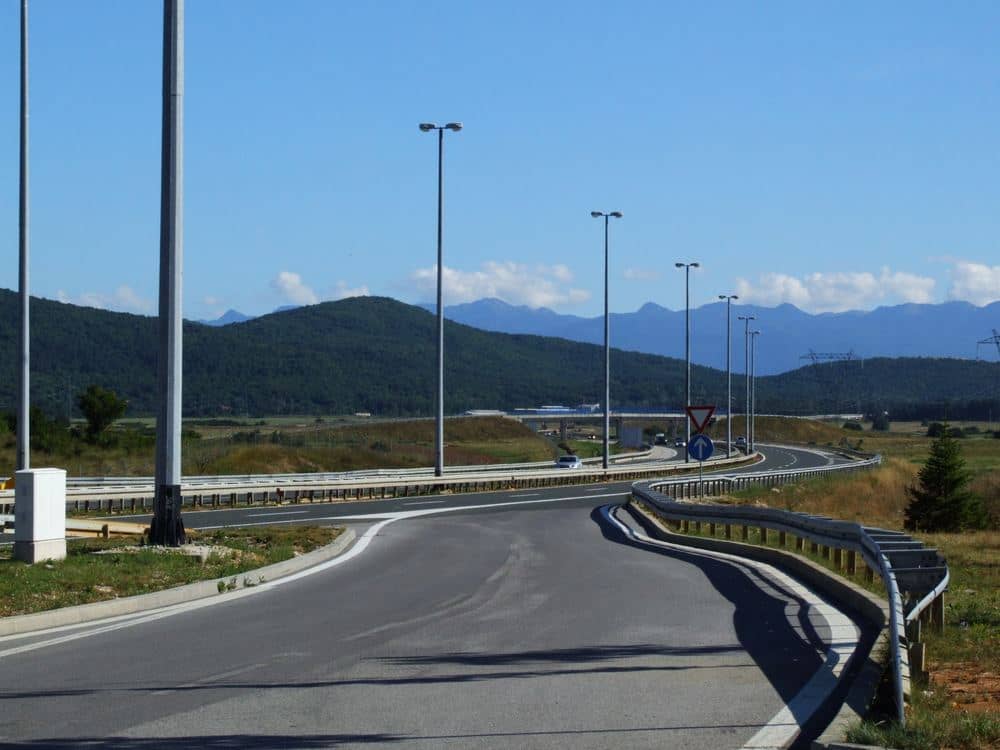
From 15 November to 15 April every car on Croatia's designated winter roads must carry winter equipment, whatever the weather that day. Winter tyres on all wheels, or summer tyres with four millimetres of tread plus chains on board. The fine is 130 euros. Which roads, which vehicles, and the catch for drivers heading to the coast.
Checked: 17 October 2026, 20:00
Croatia's winter rule follows the calendar. From 15 November to 15 April, winter equipment is mandatory on the road sections the government designates as winter sections, and it applies whether the day is snowy or sunny with fifteen degrees, which in Dalmatia it often is. The sections are the ones that matter for anyone arriving by car: the A1 motorway through Lika between Karlovac and the coast, the A6 to Rijeka over Gorski kotar, the D23 over the Vratnik pass to Senj, and the inland roads of Slavonia and the north. The coast itself, from Istria to Dubrovnik, is not a winter section, but almost nobody reaches it without crossing one.
What counts as winter equipment
- Winter tyres marked M+S, M.S., M&S or with the snowflake symbol (3PMSF) on all four wheels, or
- summer tyres with at least four millimetres of tread and snow chains in the car, ready to fit on the driven wheels.
- The rule covers all motor vehicles including motorbikes and foreign-registered cars; only the armed forces are exempt.
- Vehicles over 3.5 tonnes and buses: winter tyres on the drive wheels, or chains or traction devices for the drive wheels.
- Chains and traction devices must be type-approved, and studded tyres are prohibited.
The rule comes from the Decision on the mandatory use of winter equipment on winter sections of public roads, published in the Official Gazette 121/2020 and amended in issues 143/2023 and 36/2025.
Fines and what the police may do
- Driver without winter equipment on a winter section: 130 euros.
- A company or sole trader that orders or allows the use of a vehicle without winter equipment, for example a rental firm: 660 to 1,990 euros, and 190 to 660 euros for the responsible person in the company.
- Ignoring a police order to stop, to fit the equipment or to turn back: 390 to 920 euros and three penalty points; a repeat offence also brings a driving ban of at least six months.
- The police may stop the vehicle on the spot, order chains to be fitted, send you to a road where the vehicle is allowed, or remove the number plates.
The catch for coast-bound drivers
Drivers from Germany and Austria are used to a situational rule, tyres for the conditions, and arrive in a mild December with summer tyres because the coast has none of the conditions. On the winter sections Croatia's rule applies from 15 November to 15 April, whatever the weather. In snow or ice, a vehicle without winter equipment may not drive on any road. If you tow a caravan or drive a camper, the same rule applies to the towing vehicle.
For the current road conditions and closures, HAK's status page and app are the source; our safety page keeps that link together with the emergency numbers. The ENC discounts are in our guide to driving to Croatia.
Where the rule applies, region by region
The winter list is a set of road sections fixed by the transport ministry, and the pattern is simple: everything that climbs. From Zagreb the sections start at the city ring and run south on the A1 to the Maslenica bridge, west on the A6 over Gorski kotar and east on the motorways across Slavonia. South of Maslenica the A1 to Split and Ploče is off the list, and so are the Istrian A8 and A9 and the D8 coast road. Where you land therefore decides how much the rule touches your trip: from Split or Dubrovnik you may never drive a winter section, from Zagreb airport you are on one within minutes.
| Region | Winter section | What it means for you |
|---|---|---|
| Istria | None, the A8, A9 and the coast are off the list | You cross Slovenia to get there, which has its own dates |
| Kvarner | The A6 over Gorski kotar | The snowiest motorway in the country |
| Zadar | The A1 as far as Maslenica | The run into the city is off the list, the bura closes the bridge |
| Split and central Dalmatia | None south of Maslenica, none on the D8 | Day trips to Plitvice or Zagreb bring the rule back |
| Dubrovnik | None, the A1 extension and the Pelješac bridge are off the list | A day trip to Mostar puts you under the Bosnian rule |
| Zagreb and inland | The A1, A2, A3 and A4 around the city, the A3 and A5 across Slavonia | The rule applies from the airport onwards |
The decision lists 839.2 km of motorway, 1,863.3 km of state and county roads and 68.1 km of transit roads to the ports of Vukovar, Osijek and Sisak. Six motorways are on the list, in full or in part.
| Motorway | Section | km |
|---|---|---|
| A1 | Zagreb (Lučko) to Karlovac, Bosiljevo and the Maslenica junction | 242.4 |
| A2 | Macelj border crossing to Krapina and Zagreb (Jankomir) | 61.0 |
| A3 | Bregana border crossing to Zagreb, Slavonski Brod and Bajakovo | 306.0 |
| A4 | Goričan border crossing to Varaždin and Zagreb (Ivanja Reka) | 97.0 |
| A5 | Osijek to Đakovo and the Sredanci junction | 51.8 |
| A6 | Bosiljevo 2 junction to Delnice and Rijeka (Orehovica) | 81.0 |
Not on the list: the A1 south of the Maslenica junction towards Zadar, Šibenik, Split and Ploče, the A7 around Rijeka, the Istrian A8 and A9, and the coastal road D8. Among the 31 listed state roads are the D1 from Zagreb through Karlovac, Plitvice and Knin, the D23 over the Vratnik pass to Senj and the D50 from Žuta Lokva over Otočac and Gospić to Gračac, the old routes south from before the motorway.
Worked examples
Munich to Split in December: Austria wants winter tyres only when the road is snowy or icy, Slovenia demands them on every road from 15 November, and from the border at Bregana the whole route to Maslenica is a winter section. A car on winter tyres that is legal for Slovenia is also legal for Croatia. Croatia asks for 4 mm of tread only on summer tyres with chains. Zagreb airport, Plitvice, then the coast: the rental is on a winter section within minutes, the old D1 road through the lakes sits at around 600 m and keeps its snow for weeks after the coast has dried, and the park costs 10 euros in winter. Split airport with a week in Dalmatia: the runs to Trogir, Omiš, Makarska, Krka and the ferry ports never touch the list. The rule only returns with a day trip to Plitvice or the drive up to Zagreb for the flight home.
Common mistakes
The fine is written on the spot with a receipt, and in snow the officer also turns you back to the last exit. Pay at a post office or bank within the days printed on the ticket for the discounted rate and keep the receipt for the rental company, because an unpaid fine reaches a rental customer months later as a charge on the card with an administration fee on top. The mistakes below are the ones that cost visitors money every winter.
- Reading the Split forecast and arriving from Zagreb on summer tyres: the A1 through Lika is a winter section.
- Chains bought sealed at a motorway shop, never tried on and never checked against the tyre size on the sidewall of the rental.
- Summer tyres with chains on worn tread: the combination only counts with at least 4 mm of tread on all wheels.
- Forgetting the other winter rule: daytime running lights or dipped headlights by day from 1 November to 31 March.
- Assuming the trouble ends on 15 April: Velebit and Gorski kotar see snow into late April and HAK still closes roads.
The neighbours have their own rules
Plenty of visitors drive down in a car hired in Munich, Vienna or Venice, and each border changes the rule. A car on winter tyres for Slovenia or Austria in December meets the Croatian standard, because Croatia asks for 4 mm of tread only on summer tyres with chains. A car hired in Italy in November may not, because fleets in the north often run summer tyres with chains in the boot. Croatia accepts that combination if the tread is at 4 mm and the chains fit the driven wheels, so check both before you leave Italy.
| Country | Period | How it works |
|---|---|---|
| Croatia | 15 November to 15 April | Fixed dates on listed roads, winter tyres, or summer tyres with 4 mm tread plus chains |
| Slovenia | 15 November to 15 March | Fixed dates on every road, winter tyres or summer tyres plus chains, 3 mm tread |
| Austria | 1 November to 15 April | Only in winter conditions, 4 mm tread, chains alone only on snow-covered roads |
| Germany | No fixed dates | Only in winter conditions, winter tyres with the snowflake symbol |
| Italy | Mostly 15 November to 15 April | Set road by road and signed, winter tyres or chains on board |
| Bosnia and Herzegovina | 15 November to 15 April | Fixed dates on every road, winter tyres or summer tyres plus chains |
| Serbia | 1 November to 1 April | M+S tyres on the drive wheels, at least 4 mm |
| Hungary | None | No winter equipment obligation |
Closures that ignore your tyres
Snow and wind shut the road to the coast in winter and neither cares what is on your wheels. Snow closes the A1 and the A6 to all traffic while the ploughs work, usually for hours. The bura, the cold wind that falls off Velebit onto the sea, closes the Maslenica bridge, the Krk bridge and the exposed stretches of the A1 above Zadar in stages, starting with motorbikes and vans with trailers, then campers and high-sided lorries, and at full strength everything. HAK lists the closures by vehicle group, and the old road alongside is often shut at the same time, so there is rarely a diversion. Plan the drive between Zagreb and the coast for the morning, keep the afternoon free, and treat a bura warning as a reason to stay the night.
What to have in the car
A rental collected in Split or Dubrovnik is set up for the coast, so look at the extras before a drive north. The screen wash is often plain water, which freezes at the tunnel exits in Lika, and a bottle of winter wash from any petrol station fixes that. Ask at the desk for an ice scraper and if chains are in the boot, because on many contracts they are an optional extra. Fill the tank before Karlovac, since a closure ahead can mean hours in a queue with the heating running, and pack warm layers, a blanket, water, gloves for the chains and a charged phone with the HAK app.
Frequently asked questions
- Do I need winter tyres to drive to Split or Dubrovnik in December?
- Yes, if you come by road from the north: the A1 through Lika, the A6 over Gorski kotar and the D23 over the Vratnik pass are winter sections, and the obligation applies from 15 November regardless of snow. On the coast the fixed-date rule ends, but in snow or ice winter equipment is required on every road.
- Are all-season tyres accepted?
- Yes if they carry the M+S, M.S. or M&S marking or the snowflake symbol (3PMSF). Chains are then not required to be on board.
- Are summer tyres with chains in the boot enough?
- Yes for vehicles up to 3.5 tonnes, provided the summer tyres have at least 4 mm of tread on all wheels and the chains or traction devices are type-approved and fitted to the drive wheels when the police or the conditions require it.
- How much is the fine?
- 130 euros for the driver. A company or sole trader that orders or allows the use of an unequipped vehicle can be fined 660 to 1,990 euros, and ignoring a police order costs 390 to 920 euros plus penalty points, and a driving ban for a repeat offence.
Official sources
- hak.hr
- hac.hr
- policija.gov.hr
- Official Gazette 121/2020: Decision on the mandatory use of winter equipment on winter sections of public roads
- Official Gazette 36/2025: amendment to the decision
- Ministry of the Interior, 14 November 2025: winter conditions and the obligation to use winter equipment
- Revija HAK, 14 November 2025: winter equipment in Croatia and Europe
- Official Gazette 143/2023: amendment to the decision
Share this guide
Questions about your trip?