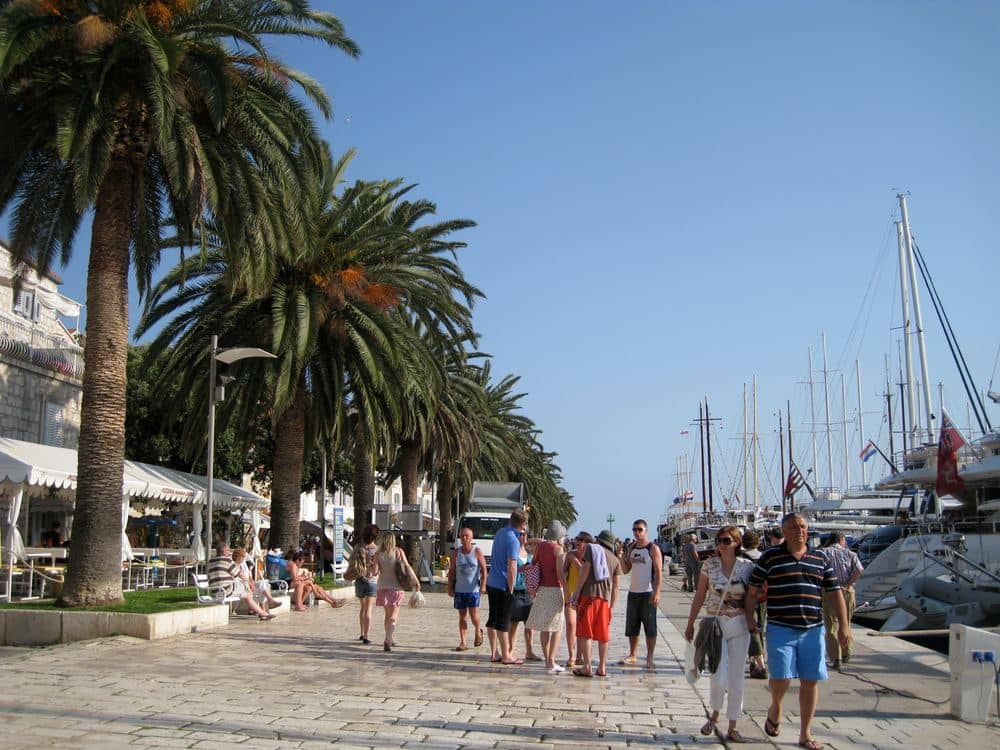
The Adriatic stores the summer. September swims like July, and in the south October still feels like early summer. Where the warmth lasts longest, with real temperatures.
Checked: 18 October 2026, 19:11
The Adriatic holds on to summer long after the first of September. The sea has spent three months storing heat and gives it back slowly: in early September the water is warmer than in June, and along the southern coast people swim well into October. Whoever plans an autumn trip only needs to know one rule: the later the date, the further south you go.
September: the second summer
In the first half of September the whole coast still runs in summer mode: air around 26 to 28 degrees, sea at 23 to 25, every beach bar and ferry line open, only the crowds and the peak prices are gone. It is the safest month for a Croatia trip, from Istria to Dubrovnik.
October: the south holds the warmth
From October the coast splits in two. Istria and the Kvarner cool first, with bura wind and the first rain fronts, and trade the beach for truffle season. Southern Dalmatia keeps going: Dubrovnik, Korčula, Hvar and the Makarska riviera typically hold daytime air above 20 degrees and sea around 21 into the second half of the month. Locals there call October the quiet summer.
| Place | Air in October | Sea in October |
|---|---|---|
| Dubrovnik | approx. 21-22 °C | approx. 21 °C |
| Hvar | approx. 21 °C | approx. 21 °C |
| Split | approx. 20 °C | approx. 20-21 °C |
| Zadar | approx. 19 °C | approx. 19-20 °C |
| Rovinj | approx. 17-18 °C | approx. 18-19 °C |
What autumn costs, what it gives
From the first of October the national parks drop to off-season prices and accommodation falls by a third to a half. Old towns empty out, restaurants on the coast mostly cook until the end of October, and the light turns golden for photography. Two things need planning: ferries switch to the winter timetable with fewer departures, and from late October some island restaurants and beach services close. Book the warmth, not the luck: check the live sea temperature and the forecast a few days before you go.
Getting to the south in autumn
Two airports cover the warm end of the coast, Split and Dubrovnik, and both keep direct flights from the UK and the main European hubs through October. The seasonal routes thin after the middle of the month and several end with the winter schedule change at the end of October, so for a late trip check the flight schedule before you check the sea temperature. From the US, Canada and Australia you connect through a European hub, and flying into Split and out of Dubrovnik, or the other way round, costs little extra and saves the drive back along the coast.
Between the two cities the choice changes with the month. The Krilo catamaran from Split to Dubrovnik takes 4 hours 30 for 45 to 55 euro and runs until 31 October, calling at Hvar and Korčula on the way, which makes it the scenic option for early autumn. The bus takes 3 hours 45 for 12 to 30 euro all year, with no border since the Pelješac bridge opened. A hire car needs about 3 hours and a single toll of 10 euro. There is also a flight, 55 minutes in the air and about 3 hours door to door. From mid-October the bus is the safe choice because it does not depend on the sea: a jugo blowing up the channel cancels the catamaran before anything else.
| Mode | Time | Price | Runs |
|---|---|---|---|
| Krilo catamaran | 4 h 30 | 45 to 55 euro | Until 31 October |
| Bus | 3 h 45 | 12 to 30 euro | All year |
| Hire car over the Pelješac bridge | About 3 h | 10 euro toll plus fuel | All year |
| Flight | 55 min in the air, 3 h door to door | Varies | Check the schedule |
Ferries after the summer timetable
The ferry companies move to the winter timetable at the end of September, and the change matters more than the temperature. The Split to Supetar car ferry, line 631, drops from up to 14 sailings a day to 11 or 12 from 1 October, still 50 minutes and 6.50 euro for a foot passenger, the same fare all year. The Krilo catamaran from Split to Supetar keeps running, 25 minutes for 10 euro, so Brač still works as a half day. The direct Jadrolinija catamaran from Split to Bol runs all year, but only once a day, leaving Split at 16:30 and taking 1 hour 5 minutes, so for a day on Zlatni rat you take the ferry and then the Arriva bus over the ridge, 50 to 60 minutes for about 6 euro, 3 or 4 times a day in winter. From Dubrovnik the catamaran to Korčula runs until 31 October. The Dubrovnik to Bari ferry is no help this autumn: a fault on the ship Dalmacija stopped line 54 on 8 September, and no sailing was left in the 2026 season.
- Check the timetable for your exact date: the winter schedule has fewer departures and the last boat of the day leaves earlier.
- Catamarans cancel in a jugo hours before car ferries do, so keep the car ferry as your fall-back to and from the islands.
- Never take the last boat of the day before a flight: sleep on the mainland the night before you fly.
- Island buses are timed to the ferries, so a missed ferry usually means a missed bus and a long wait in the port.
- Buy catamaran seats online a day ahead, because fewer boats carry the same day's travellers and the afternoon return fills first.
Where to base yourself
Pick the base by how late you travel. Dubrovnik is the warmest city and the one with the fullest autumn schedule of flights, buses and day trips, and the Old Town stays open in the evenings through October. Stay in Lapad for a beach within a walk and a quieter night, in the Old Town for the walls at sunset if you do not mind the stairs. Split works for September and early October: the sandy bay at Bačvice is 10 minutes from the palace, the Brač and Hvar boats leave from the waterfront and the bus station sits next to the ferries. Hvar town keeps its cafes open longest of the islands, and Stari Grad on the same island is quieter and cheaper. The Makarska riviera, Brela and Tučepi above all, suits families with a buggy: fine pebble, pines to the water and promenades that run for kilometres, though some hotels there close in late October.
Beaches for an October swim
Swim in the afternoon. In October the sea holds more heat than the air, so the water feels warmest from about 14:00 to 17:00, after the sun has been on the shallows for a few hours and any morning bura has dropped. From late October the sunbed concessions pack up and the beach bars shut, which leaves you the beach to yourself and nothing to hire, so bring a towel and water shoes for the pebbles. The tourist boats to the outlying coves on Hvar, Korčula and Brač also stop with the season, so stay with the beaches you can walk or bus to. These work through October in the south.
- Banje, Dubrovnik: pebbles under the city walls just outside the Ploče gate, the easiest swim in the city.
- Sveti Jakov, Dubrovnik: a quiet bay east of the Old Town, down a long flight of steps, with the view back to the walls at sunset.
- Šunj on Lopud: real sand in a shallow bay, a 3.40-euro ferry from Gruž (5.40 euro in summer) and a walk or golf cart across the island.
- Bačvice, Split: sand 10 minutes from Diocletian's Palace, where locals play picigin in the shallows well into the autumn.
- Kašjuni, Split: the cleanest water in the city, below Marjan hill and facing Brač, reached by bus or the coast path around the hill.
- Zlatni rat, Bol: pebble and sand 20 minutes on foot from the harbour, with the afternoon maestral easing as the season ends.
Day trips for the cooler days
Autumn is when the day trips from Dubrovnik pay back most, because the border queue and the coach parks are empty. Kotor is 93 km south, across the Montenegrin border: the public bus costs 13 to 30 euro, takes about 2 hours on a clear October day and needs a passport, since Montenegro is outside the EU and Schengen. US, UK, Canadian and Australian passports need no visa for a day visit, the fortress climb costs 15 euro and the boat to Perast's church island starts at 5 euro. Closer to home, bus 10 reaches Cavtat for 4 euro, Ston's walls cost 10 euro and Mostar is about 3 hours away by road. From Split, the 25-minute catamaran to Supetar and the bus over the ridge put you on Zlatni rat by late morning, and Vidova gora at 778 m is a better walk in October than in the heat of August.
Common autumn mistakes
The first mistake is booking Istria or the Kvarner for a beach week in late October and expecting Dubrovnik's weather. The second is trusting a ferry timetable you saw in August. The third is flying home on the day you leave an island: a jugo can hold the boats for a day, so spend the last night on the mainland. Pack for two seasons. Afternoons in the south still call for shorts, but the evenings cool quickly once the sun is down, the stone streets hold the damp after a rain front and a light rain jacket earns its place. Cruise ships call at Dubrovnik until the end of October, so the Old Town is fullest from late morning to mid-afternoon and quietest early and after 17:00. The clocks go back on 25 October 2026, and from then sunset comes before 17:00, which cuts short the beach afternoon you planned around.
Frequently asked questions
- Can you still swim in Croatia in October?
- In the south, yes. Around Dubrovnik, Korčula and Hvar the sea typically holds about 21 degrees into the second half of October. From Zadar northward it becomes a matter of hardiness.
- Where is Croatia warmest in October?
- On the far south of the coast and the southern islands: Dubrovnik and its riviera, Korčula, Hvar, Vis. They gain roughly two to four degrees over Istria in both air and sea.
- Is Istria worth it in autumn at all?
- Yes, just for different reasons: white truffle season in Motovun and Livade, new wine, empty hill towns. Swimming becomes a bonus, not the plan.
Share this guide
Questions about your trip?