

Novalja on the island of Pag is known across Europe for one beach, Zrće, and its clubs. The town behind the beach has two thousand years: a Roman aqueduct cut through the rock under today's streets, three early Christian basilicas, a harbour that was a serious port when the clubs were still pastures. Around it lie the sunken Roman town of Caska, the olive groves of Lun with trees older than a millennium, and beaches that cover the whole range, from the stage of Zrće to the family shallows of Trinćel. How to see it in a day or two, and how to get to Pag.
Checked: 14 September 2026
Pag is reached two ways: over the Pag bridge at the island's southern end, an hour from Zadar, or by the ferry from Prizna on the coast road to Žigljen, a 15-minute crossing that lands 5 km from Novalja and is the shortest way from Rijeka, Zagreb and the north. In summer Jadrolinija's catamaran from Rijeka via Rab also calls at Novalja. The town sits on the island's north-western shore in a deep bay, its harbour the centre of everything, and the beaches of the Pag bay and the Velebit channel within a few kilometres. Zrće is 3 km away; everything below is a different Novalja.
The town: an aqueduct under the streets
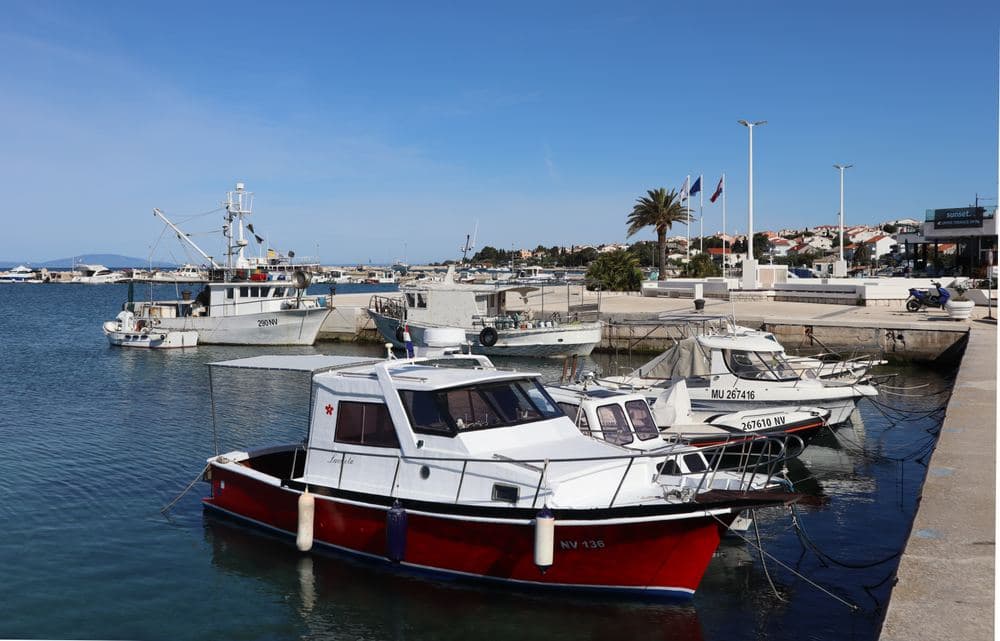
Start on the waterfront, the town's living room, where fishing boats, excursion boats and sailboats tie up at the stone piers and two rows of cafés and taverns run their terraces to the water; the excursion boats to Rab, Lošinj and the hidden coves leave from here, tickets on the pier. Two streets in stands the Church of St Catherine of Alexandria, the parish church on ground that has carried churches since late antiquity, when Novalja with three early Christian basilicas was one of the important religious centres of the northern Adriatic; the basilicas survive in fragments, a mosaic under glass here, an apse in a house's foundation there, and their finest find, the late antique Novalja reliquary, ranks among Croatia's most valuable early Christian objects.
The town's real surprise is under it. Talijanova buza is a Roman aqueduct of the 1st century, a tunnel a man's height cut by chisel through the living rock for more than a kilometre, which carried water from the Novalja field to the ancient harbour; the vertical shafts for air and cleaning still surface in courtyards. Part of it is visited through the City Museum, where you descend straight from the exhibition into the cold, narrow corridor and see the chisel marks two thousand years old; the museum itself keeps the amphorae raised from freighters that sank on the way to Cissa, the coins and tools of Roman Novalja and the island's sheep, olive and salt heritage. Museum and tunnel take an hour, the ticket is symbolic, and in summer the museum keeps evening hours, the smartest slot: air-conditioning instead of heat, the waterfront five steps away afterwards.
Caska: a Roman town under the sea
Five minutes' drive from Novalja, at the bottom of the Pag bay, the hamlet of Caska sits by a shallow sandy cove under which lies ancient Cissa, the settlement that gave the whole island its old name, with villas, a harbour and an aqueduct, until earthquakes and the sea took it. The treasure is seen with a mask and snorkel: in the shallows and a few metres down, walls, foundations and amphora fragments over which archaeologists have been diving for decades. On land remain a Roman column and a late antique tower, with boards along the path. The beach is sandy and warm with knee-deep sea far out, so children who do not care about archaeology are happy too, and a tavern works in summer. Zrće lies just behind the hill, so a day can pair an empire and a club, two thousand years in two coves.
Lun: olive trees older than the town
Half an hour north of Novalja, on a road along the very edge of the sea, the island ends at the cape of Lun, and around the village grows a protected garden of tens of thousands of wild olive trees, many of them more than a thousand years old, the oldest counting their age in a millennium and a half. Silver crowns rise straight out of white karst, kilometres of dry-stone walls braid between them, and sheep still pass through the same gaps as hundreds of years ago. Arranged paths with boards, lookouts and benches make a walk of an hour or two; in summer go early, shade is rare and the stone hot. At the entrance the tasting rooms pour Lun oil, sharper and richer than the tame varieties, and a bottle from Lun is northern Pag's best souvenir.
Beaches: a stage, a family arc, a sandy cove
Zrće has two lives and does both well: by day a wide shingle crescent above turquoise water with loungers, families and water attractions, by night the most famous going-out address on the Adriatic, its festival season running from June to September. Come before noon if you dislike bass; the prices are club prices and peace is not sold in July and August. Straško, fifteen minutes on foot south-west of town along the promenade, is the calm half: nearly two kilometres of shingle in a gentle arc leaning on the pine wood of one of the Adriatic's largest campsites, public, with long safe shallows, shade five steps from the towel and naturists at the far end. Planjka, which everyone calls Trinćel, is Stara Novalja's home beach five minutes north by car: mixed sand and fine shingle, a sea that deepens so slowly that children wade far out, sheltered from the southerly wind, with the Velebit across the channel and the island's best sunsets.
Frequently asked questions
- How do I get to Novalja?
- Over the Pag bridge from the Zadar side, about an hour from Zadar, or by the 15-minute ferry from Prizna on the coast road to Žigljen, 5 km from Novalja, the shortest way from the north. In summer Jadrolinija's catamaran from Rijeka via Rab calls at Novalja.
- Is Novalja only for partying?
- No. Zrće is 3 km outside town; Novalja itself has a Roman aqueduct you can walk into, a museum, early Christian basilicas, the sunken Roman town of Caska nearby and the olive gardens of Lun half an hour north. Straško and Trinćel are quiet family beaches.
- Which beach near Novalja is sandy?
- Caska, a shallow sandy cove five minutes by car with a Roman town under the water, and Planjka-Trinćel at Stara Novalja, mixed sand and fine shingle with a very gentle slope. Zrće and Straško are shingle.
Official sources
Make Croatia Atlas a preferred source
One click and Google shows you our stories more often in Top Stories and in AI answers. It changes your own results only.