

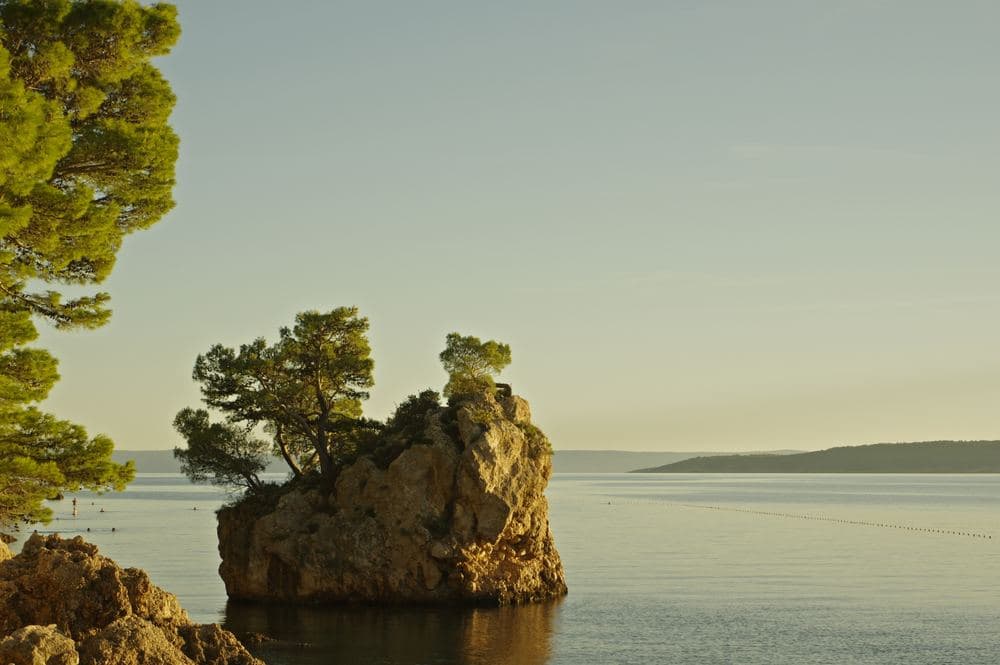
Brela is the beach town of the Makarska riviera that the magazines found first: Punta Rata, a white shingle point under pines, and in front of it the Brela Stone, a lone rock with pines growing from its cracks, the most photographed image of the coast. Behind the postcard lies a kilometres-long promenade under pines from Podrače to Baška Voda, coves the catalogues leave out, cold freshwater springs bubbling from the sea floor, a small harbour that lives all year, and the old village on the Biokovo slope where Brela stood before it came down to the sea.
Checked: 14 September 2026
Brela lies on the coast road 15 km north of Makarska and about 55 km south-east of Split, at the foot of the Biokovo, whose grey wall rises almost 1,500 metres straight behind the beaches. From the A1 you come either through the Zagvozd exit and the Sveti Ilija tunnel to Baška Voda, or over the Dubci pass from the Šestanovac exit; Split airport is about an hour. The town is a string of beaches and pine woods along the shore rather than a centre, which is why the promenade matters more here than any square.
Punta Rata and the Stone
Punta Rata is the beach that put Brela on the world map: a white shingle point pushing into the sea like a tongue, pines descending to the very shore, water so clear the bottom shows at several metres. When foreign magazines ranked Europe's loveliest beaches in the late nineties, Punta Rata stood at the top, and it keeps the name. The shingle is fine, the entry gradual, and the pines give shade three steps from the towel; showers, cabins, loungers and bars line the promenade, without music to drown the sea. In summer come before ten or after four, at midday the point is full. A few dozen metres out stands the Brela Stone, Kamen Brela, a lone rock with pines rooted in its cracks, thirty strokes from the shingle; the sea around it is deeper and colder and fish gather in its shade, so bring a mask. Climbing it is not intended, the stone is slippery and the pines protected. The best frame is from the water or from the point of Punta Rata late in the afternoon, when the western sun lights the pines from below.
The promenade and the coves the catalogues skip
The seaside promenade is Brela's spine: a level path under pines following the coast for kilometres, from Podrače in the south past Punta Rata and on towards Baška Voda, about an hour of easy walking, with benches, showers and entries into the sea every hundred metres, passable with a pram. Morning it is the locals' running route, by day the way to the beaches, in the evening the corso of the whole riviera in the scent of pine and grilled fish. The best coves are the nameless ones between the big beaches, three steps down in a pine's shade. Three have names. Podrače, the southern town beach, has finer shingle than Punta Rata, a long wild belt to the south where there is always room, and the Biokovo rising behind it like a wall. Berulia, north of Punta Rata, carries the town's Roman name and the same clear sea with half the crowd, five minutes' walk away. Stomarica, a small inlet between Podrače and Soline, is the cove locals keep to themselves: shingle, smooth rock slabs for sunbathing, quick depth for jumping, a seasonal bar and a shower, nothing more.
Vrulje: the sea that boils cold
Brela's least known phenomenon is under the water: the vrulje, freshwater springs bursting straight from the sea floor, rain that fell high on the Biokovo, sank through the limestone and came out under the sea. A bather notices them without instruction: in the middle of a warm August sea a cold belt appears like a current from another season, and on the surface a light shimmer shows as if the water were boiling, which is what the name means. Most lie along the shore below Punta Rata and Berulia, and a mask shows the shingle trembling where the spring comes up. They are the reason the sea at Brela never overheats in summer, and the reason Stomarica feels like air-conditioning in August. Children hunt the cold belts; the same water feeds the springs of the Cetina.
Soline and Upper Brela: the town before the postcard
Soline harbour is Brela's heart in the sense the beaches never were: a small port with a dozen boats, a stone waterfront and a row of cafés where the town sits all year. The name comes from the former salt pans, tiny basins in the rock where sea salt dried before tourism; a few hollows remain. Fishermen mend nets, pensioners hold their tables, kids jump off the pier, and in summer the excursion boats leave from here for Bol, Hvar and Zlatni rat. Sit here at nine in the morning before the beaches wake. Then look up: Gornja Brela, Upper Brela, is the old village on the Biokovo slope three hundred metres above the shore, where life was until the middle of the 20th century, in the lee from pirates and near the pastures, with stone houses, small churches and dry walls around little fields. Ten minutes by a narrow road or an hour on foot through the olives; a few family taverns serve lamb and homemade wine, and the terraces take in the whole riviera, from Punta Rata to Brač and Hvar. Below is the sea; up here stands the story.
Frequently asked questions
- Which is the best beach in Brela?
- Punta Rata for the famous white shingle point with the Brela Stone in front of it; Berulia five minutes north for the same sea with half the crowd; Podrače in the south for finer shingle and room; Stomarica for a quiet cove with rock slabs and cold springs.
- Can you climb the Brela Stone?
- No. The rock is slippery and its pines are protected; swimmers circle it, and with a mask you see the fish in its shade. The photograph is best from the water or from the point of Punta Rata late in the afternoon.
- How do I get to Brela?
- On the coast road 15 km north of Makarska and about 55 km from Split; from the A1 through the Zagvozd exit and the Sveti Ilija tunnel to Baška Voda, or over the Dubci pass from Šestanovac. Split airport is about an hour away.
Make Croatia Atlas a preferred source
One click and Google shows you our stories more often in Top Stories and in AI answers. It changes your own results only.