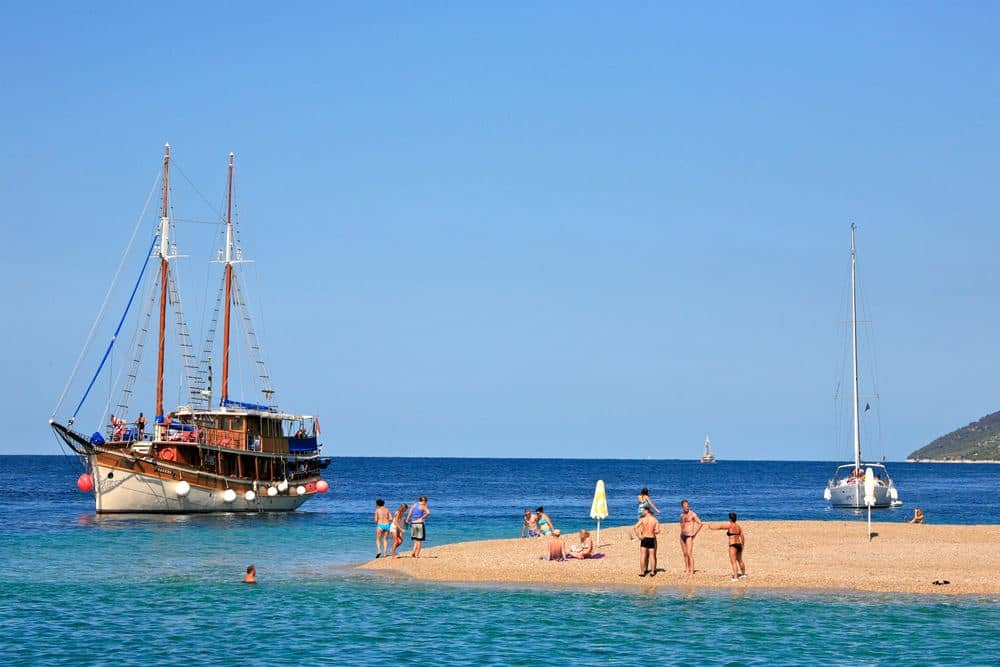
Check the regional DHMZ warning, plan around the heat, respect wind and fire restrictions, and save Croatia's emergency number before leaving for the beach.
Checked: 20 September 2026
A safe beach day in Croatia starts before the swimwear goes into the bag. Open the official DHMZ warning map and select the region where you will actually be, because conditions can differ sharply between Istria, Kvarner and the Dalmatian coast. Read the colour together with the named hazard and its valid period. A heat alert, a strong-wind warning and a thunderstorm warning require different changes. Check once before leaving, then check again before an afternoon swim or boat trip. Forecasts and warnings can change during the day, so a screenshot from the previous evening is not a current safety check.
Build the day around heat, not against it
The Croatian Institute of Public Health advises avoiding direct sun from 10:00 to 17:00, especially for children, pregnant people, older adults and people with chronic conditions. For a beach plan, that means using the cooler morning and later afternoon, taking shade seriously and drinking water regularly rather than waiting for thirst. Wear light clothing, a hat and sunglasses, use UV protection and never leave a child or animal in a parked vehicle. If anyone feels weak, dizzy, unusually thirsty or develops a strong headache, move to a cooler place and follow the official health guidance. Seek professional help when symptoms are serious or do not improve.
- Weather: read the DHMZ region, hazard, colour and valid period. Follow a lifeguard, harbour authority or local closure even when the beach still looks calm.
- Wind and sea: reconsider swimming, paddling and small-boat plans when the relevant coastal or marine warning is active. Do not treat an inflatable as transport.
- Heat: carry enough drinking water, use shade, protect skin and eyes, and move strenuous walking or sport out of the hottest part of the day.
- Fire: never light a fire in an open area and never discard a cigarette butt in nature. Report smoke or fire immediately to 112 or 193.
- Emergency: save 112 before the trip. It works around the clock and supports multiple languages; use it for a genuine emergency and describe your location clearly.
Make changing the plan a normal decision
Safety planning is not about predicting every problem. It is a short routine that tells you when a shaded breakfast, museum visit or later swim is the better holiday. At the beach, identify the easiest exit, note a landmark or beach name that you could give to emergency services and keep a charged phone out of direct sun. If an official warning escalates, smoke appears, the wind builds or local staff close access, leave early and calmly. Croatia's Civil Protection Directorate stresses timely information and responsible behaviour because simple choices prevent many dangerous situations. The best checklist is the one that changes what you do.
A worked example from Split in July
You are staying in Split in the middle of July. At 07:00 the DHMZ map shows an orange heat warning for the Dalmatian coast until the evening and nothing for wind or thunderstorms. Breakfast comes from the bakery, open since 06:00, and you are in the water at Kašjuni by 08:00. By 10:30 the pebbles are hot and the shade under the pines is taken, so you walk back into town, eat lunch indoors and spend the hottest hours in the palace cellars or an air-conditioned museum. At 16:00 you check the map again. If the warning is unchanged, the evening swim starts at 17:30 and runs until the light goes, which in July is after 20:00. If a yellow thunderstorm warning has appeared for the early evening, you swim at 16:30 instead and eat indoors while it passes.
What to bring
Croatian beaches are pebble, rock or concrete far more often than sand, and many have no shade beyond a strip of pines and a row of paid parasols. Every beach is public by law, so you can lay a towel next to the sunbeds without paying. Tap water is drinkable everywhere in Croatia and the public fountains in Split, Zadar and Dubrovnik refill a bottle for free. Small cash covers a parasol, an island bus or a beach kiosk that does not take cards.
- Water shoes: the pebbles are too hot to cross barefoot by noon and sea urchins sit on every rocky shore just below the waterline.
- A parasol or a sarong to tie between pine branches, because natural shade is scarce on most Dalmatian and Istrian beaches.
- A refillable bottle of at least 1 litre per person, plus a hat, sunglasses and a long-sleeved shirt for the hours near the water.
- A power bank, the phone kept in the bag out of the sun, and a Croatian SIM or eSIM, about 10 euro for 10 days at any Tisak kiosk.
- Tweezers, plasters and antiseptic for urchin spines and cuts from rock entries.
How the regions differ
The DHMZ map splits the coast into regions because the hazards differ. Istria and Kvarner sit closest to the Alps and get the afternoon thunderstorms that build over the mountains and break over the sea. Kvarner is also the bura corridor, where the wind drops off the mountains behind Rijeka and Senj and closes the Krk Bridge to some vehicles. Dalmatia has the heat and the fire risk, with wildfires in the karst hinterland behind Šibenik, Split and Makarska in most summers. Inland, the rivers are cold, the lakes at Plitvice are closed to swimming and hail comes with the summer storms.
| Region | Typical beach | Main summer hazard | Extra check |
|---|---|---|---|
| Istria | rock platforms, concrete with ladders | afternoon thunderstorms, slippery rock | afternoon thunderstorm warning |
| Kvarner | pebble, concrete, sand at Lopar on Rab | bura gusts, ferry and bridge closures | wind warning, Krk Bridge status |
| Northern Dalmatia | pebble, sand at Nin and Sakarun | heat, hinterland fires, jugo swell | heat warning, fire restrictions |
| Central Dalmatia and islands | pebble coves with steep access | heat, bura under Biokovo, sea urchins | marine warning before a boat trip |
| Dubrovnik | small pebble coves and rock | heat in the Old Town, jugo waves at Banje | heat warning, Lokrum boat status |
| Inland rivers and lakes | river beaches on the Mrežnica and Korana | cold water, current after rain, hail | thunderstorm warning, no swimming at Plitvice |
Bura, jugo and maestral
The Adriatic has 3 winds that shape a beach day. The bura is a cold, dry north-easterly that falls from the mountains in gusts and can arrive within an hour, strongest in Kvarner, below Velebit and along the Makarska riviera under Biokovo. It cancels catamarans, closes the Krk Bridge to high-sided vehicles and, because it blows from the land out to sea, carries inflatables, paddleboards and tired swimmers away from the shore. The jugo is a warm, humid south-easterly that builds over 1 or 2 days, pushes swell onto south-facing beaches, brings rain and lasts. The maestral is the friendly one, a north-westerly sea breeze on settled summer afternoons that cools the beach, dies at sunset and never appears as a warning.
Common mistakes
Most trouble on a Croatian beach starts with a small decision made in the heat. The sea is calm, warm and clear on most summer days, which is exactly why people relax. Lifeguards are rare: a Blue Flag on the mast is an environmental award for water quality and facilities and does not guarantee a lifeguard on duty, and only some managed town beaches post one, usually in July and August. On the rest of the coast you are your own lifeguard, and the errors below fill the pharmacies and health centres every summer.
- Jumping from rocks or a boat without swimming the spot first, because clear water looks deeper than it is.
- Taking an inflatable or paddleboard out when the wind blows from the land, which is what the bura does.
- Entering the sea from rocks barefoot: urchin spines break off under the skin and end the day at a pharmacy.
- Parking a hot car on dry grass or pine needles above a beach in July, since the exhaust can start a fire.
- Booking the last catamaran back on a day with an active wind warning and a flight the next morning: catamarans are cancelled before car ferries.
Where to get help on the coast
A pharmacy, ljekarna in Croatian and marked with a green cross, is the first stop for sunburn, dehydration, urchin spines and insect bites. Every coastal town and the larger islands have a health centre, dom zdravlja, and many resorts run a tourist clinic in summer. Hospitals are in Pula, Rijeka, Zadar, Šibenik, Split and Dubrovnik, and serious cases from Hvar, Brač, Vis or Korčula reach Split by boat or helicopter, which takes time. UK visitors can use a GHIC in the state system. Visitors from the US, Canada and Australia pay at the point of treatment and claim from travel insurance, so carry the policy number with the passport.
Frequently asked questions
- Which weather warning should I check before a Croatian beach day?
- Use the official DHMZ warning map and select your actual region. Read the warning colour, hazard and valid period together, then check the marine warning if swimming, paddling or boating is part of the plan. Recheck later because warnings can change during the day.
- What is Croatia's emergency number for tourists?
- Call 112 for a genuine emergency. Croatia's Civil Protection Directorate states that the number is available 24 hours a day and in multiple languages. Smoke or fire can also be reported on 193. Give a clear location, landmark or beach name.
Official sources
Share this guide
Questions about your trip?