Sand ten minutes from the palace at Bačvice, the cleanest water and the island view at Kašjuni, shade at Bene, families at Žnjan and Firule, quiet at Trstenik and Sustipan. Twelve beaches in the city and two outside it, with the bus to each, sunbed prices, sea temperatures and the right beach for each kind of day.
Checked: 15 September 2026
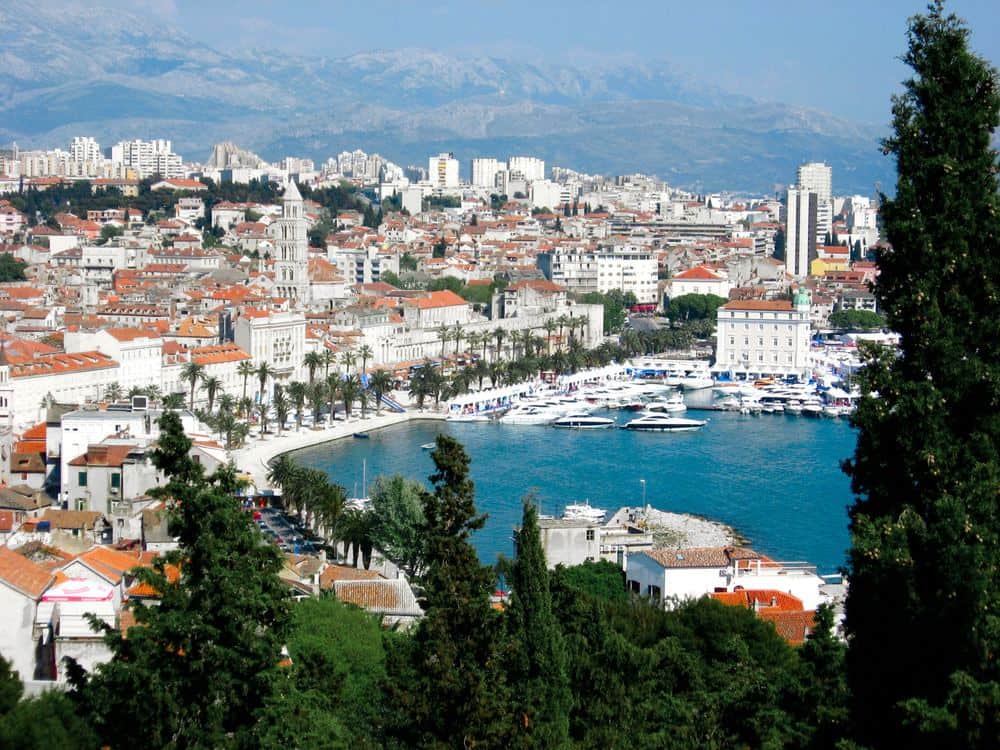
Split is a city with beaches in it, which is rarer than it sounds on this coast. Ten minutes from Diocletian's Palace there is sand, forty minutes' walk around Marjan hill there are pine-shaded pebble coves with the islands in view, and along the eastern shore there is a string of family beaches with parking, playgrounds and cafes. The city's own people swim from May to October and a few of them all year, and the beach you choose says something about who you are: Bačvice for the young and the picigin players, Kašjuni for the view, Žnjan for families with a car, Bene for shade and quiet, Firule for small children. This guide covers the twelve beaches worth knowing in Split and the two nearest ones outside it, with how to get there on foot or by bus, what each costs, and which one to pick for which day.
The beaches at a glance
| Beach | Type | From the Old Town | Best for |
|---|---|---|---|
| Bačvice | Sand, shallow | 10 min on foot | Picigin, young crowd, small children |
| Ovčice | Pebble | 15 min on foot | Calmer neighbour of Bačvice |
| Firule | Sand and pebble, sheltered | 20 min on foot | Toddlers, tennis club next door |
| Trstenik | Pebble, easy entry | Bus 8, 15 min | Families, cafe, few crowds |
| Žnjan | Pebble, long | Bus 8 or 17, 20 min | Families with a car, facilities, playgrounds |
| Kašjuni | Pebble, deep water | Bus 12, 20 min, or walk 40 | The view, the water quality, sunbeds |
| Kaštelet | Pebble, small | Bus 12, 20 min | Next to Kašjuni, quieter, ivan Meštrović's chapel above |
| Bene | Pebble and rock, pine shade | Bus 12 to the end, then walk | Shade, families, tennis courts, no crowds |
| Jezinac | Pebble, tiny | Marjan coast road, 25 min | Old Split families, no facilities |
| Kaštelet and Meštrović coves | Rock platforms | Marjan coast road | Swimming off the rocks |
| Sustipan | Rock | 15 min west of the Riva | Cliff swimming under the cypresses |
| Duilovo | Pebble | Bus 17, 25 min | Local, end of the eastern shore |
Bačvice: the sandy heart of the city
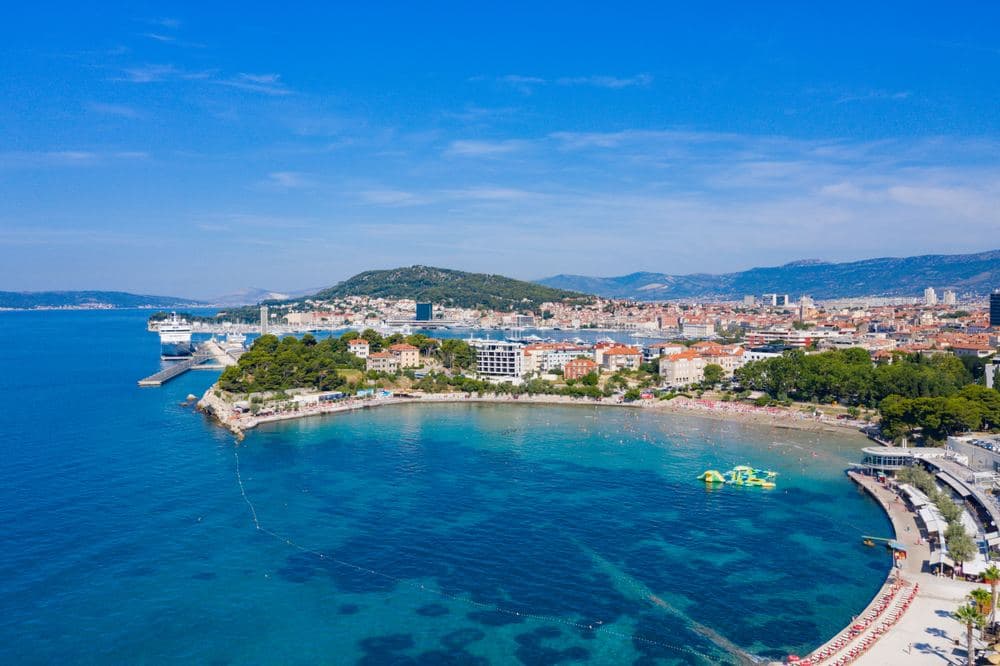
Bačvice is the beach Split was built around: a horseshoe of fine sand ten minutes east of the ferry port, so shallow that you can walk out a hundred metres and still stand, which is what makes it the home of picigin, the local game in which five people in the water keep a small ball off the surface with slaps and dives. There is a game at Bačvice every day of the year, including New Year's Day. The beach has a Blue Flag, showers, changing cabins, a lifeguard in season, a row of cafes and clubs on the terrace above that stay open until the small hours, and, in August, more people per square metre than anywhere else in Dalmatia. The water is cleaner than its reputation. Sunbeds cost 10 to 15 euro for two. Go before nine for the sand and after seven for the picigin and the sunset over the ferries. The cove next door, Ovčice, is a pebble version of the same thing with half the noise.
Firule and Trstenik: for small children
Firule, a further ten minutes east along the shore path past the tennis club where Goran Ivanišević learned to play, is a small sheltered bay of sand and fine pebbles with water that stays knee-deep for a long way, which is why it has been the beach of Split's mothers for a century. There is a cafe, a small playground and shade from the trees behind. Trstenik, the next bay east and reachable by bus 8 from the market, is bigger and pebbly, with an easy entry, a beach bar, sunbeds and a promenade, still uncrowded even in August because the visitors have not found it. Both are free apart from the sunbeds.
Žnjan: the family beach with parking
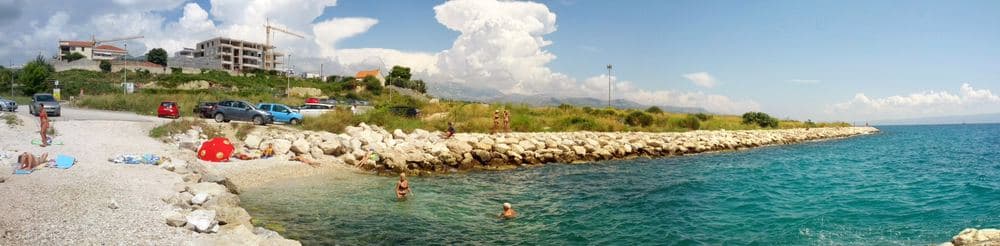
Žnjan is the eastern end of the city's shore, a kilometre of pebble beach in front of the new hotels and apartment blocks, rebuilt between 2023 and 2026 with a promenade, playgrounds, showers, a dozen cafes, lifeguards and, decisively for families with a car, a large car park. It is the beach for children who want activities: pedal boats, inflatable slides in the water, an ice cream every fifty metres. It is also the beach with the least character, and the water in front of the busiest sections is not the city's clearest. Bus 8 and bus 17 from the centre take 20 minutes. Sunbeds 15 to 20 euro for two, most of the beach free.
Kašjuni: the beautiful one
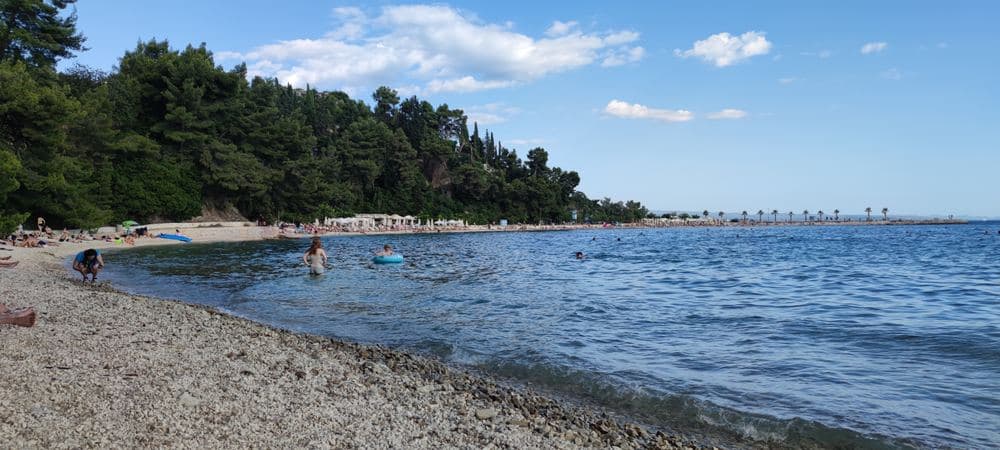
Kašjuni is on the south side of Marjan hill, a deep bay of small pebbles with the pines coming down to the water, the islands of Šolta and Brač across the channel and, on a clear day, Vis behind them. The water is the cleanest in the city because the bay faces the open sea and has no river or harbour near it, and it gets deep within a few metres, which suits swimmers and not toddlers. There is a beach bar with a terrace, sunbeds at 20 to 25 euro for two, showers and changing cabins, and a naturist section at the western end. Bus 12 from the Riva stops above the beach, or you walk: 40 minutes from the centre along the Marjan coast road, past the Meštrović gallery, with the sea on your left the whole way. It is busy from eleven to five in July and August and lovely at seven in the evening, when the light comes across the water from Šolta.
Kaštelet, Bene and the Marjan coves
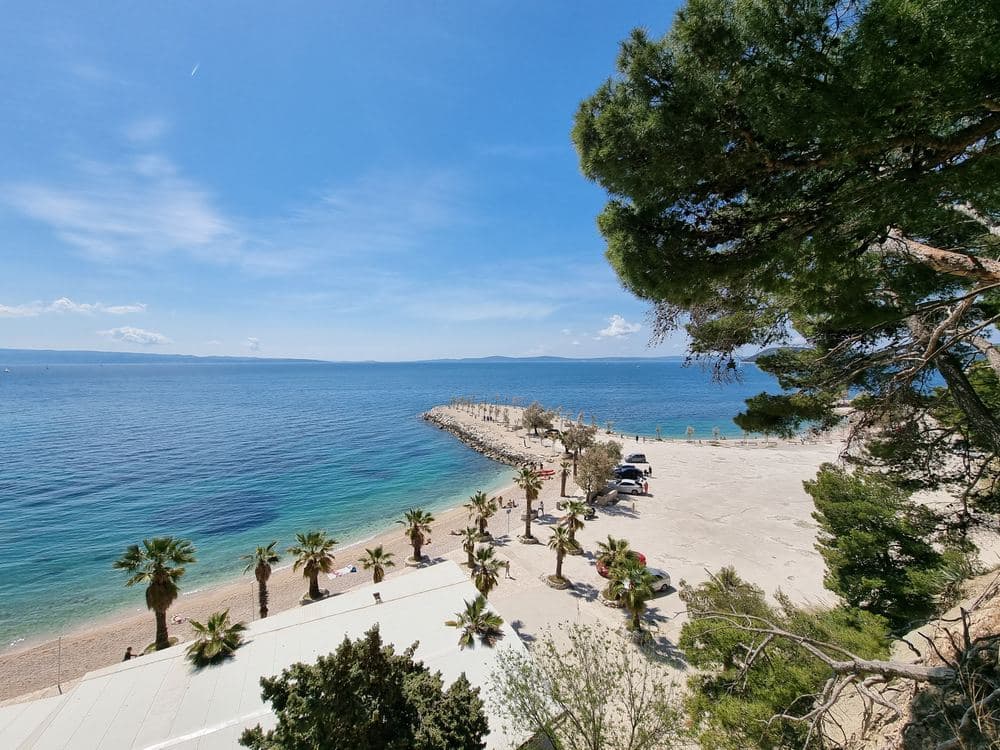
Kaštelet is the small pebble beach next to Kašjuni, below the Kaštelet chapel where Ivan Meštrović carved his wooden Stations of the Cross; it shares the water and the bus stop and has a fraction of the people. Bene, at the western tip of Marjan where bus 12 ends, is the beach for shade: pines to the water's edge, pebble coves and rock platforms, a restaurant, tennis courts and a children's playground in the forest, and a sea that faces north towards Trogir, cooler and calmer than the south side. Between them, all along the Marjan coast road, are rock platforms and steps into the sea that the city's older swimmers have used for generations, each with its regulars and none with a name on a map. Jezinac, a tiny pebble cove at the eastern end of the road, is the most local of all.
Sustipan: swimming under the cypresses
Sustipan is the peninsula at the western end of the Riva, past the marina, a park of cypresses on the site of a monastery and the city's old cemetery, with a rock shore below it. The swimming is off the rocks and the ladders, in deep clear water with the whole of Split and the ferries in view, fifteen minutes from the palace. There is no sand, no bar and no sunbed, which is why the people who swim here are the people who live here. Bring a towel, water shoes and something to eat.
Outside the city: Kaštela, Stobreč, Podstrana
Two beaches just outside Split are worth the bus. Stobreč, 8 kilometres east where the Žrnovnica river meets the sea, has a wide pebble beach with a campsite, shallow water and the river mouth to explore, on bus 25 in 25 minutes. Podstrana, the next town, has the beach in front of the Le Meridien Lav hotel, long and pebbly with facilities, and quieter coves beyond it. To the west, the seven villages of Kaštela on the bay towards Trogir have small town beaches and a promenade that runs for kilometres, on bus 37 from the Split bus station, with Kaštel Štafilić's beach next to the airport for a last swim before a flight.
Picigin: the game you will see at Bačvice
Picigin was invented at Bačvice in 1908 by students back from Prague, who adapted water polo to a beach too shallow to swim in. Five players stand in knee-deep water and keep a small ball, originally a peeled tennis ball, in the air with open-hand hits, diving full length into the shallows to reach it; there are no points, no teams and no winners, only the length of the rally. The city protected it as intangible cultural heritage in 2008, a world championship is played at Bačvice every June, and a group of pensioners plays every morning of the year, including in a January bura. Visitors are welcome to watch from the terrace and, if they can dive without hurting themselves, to join a friendly game.
Beach etiquette and the rules
- Every beach in Croatia is public maritime domain: nobody can charge for access, only for sunbeds, and you can lay a towel on any free stretch.
- Swimming areas are marked with buoys; boats and jet skis may not enter, and the taxi boats at Bačvice use the jetty, not the beach.
- Naturism is legal on marked sections, at Kašjuni's western end and on the far Marjan rocks, and nowhere else in the city.
- Dogs are allowed on the marked dog beach at Kaštelet and nowhere else; the fine is real and enforced in summer.
- Glass and open fires are banned on the beaches; the Marjan park is a fire zone from June to September.
- Cliff jumping at Sustipan and the Marjan platforms is at your own risk and the ladders are the only safe way out.
The beaches month by month
| Month | Sea | What it is like |
|---|---|---|
| May | 19 to 20 °C | Locals swim, sunbeds not yet out, Kašjuni empty and perfect |
| June | 23 °C | The best month: warm sea, half the crowd, long evenings at Bačvice |
| July and August | 25 to 27 °C | Full from eleven to five everywhere; early and late are the hours |
| September | 23 °C | The second best month, with warm sea and the city back at work |
| October | 20 to 21 °C | Swimming in the first half, Bačvice and Kašjuni until the last warm day |
| November to April | 13 to 17 °C | Picigin players and the winter swimming club at Bačvice only |
Beaches within an hour with a car
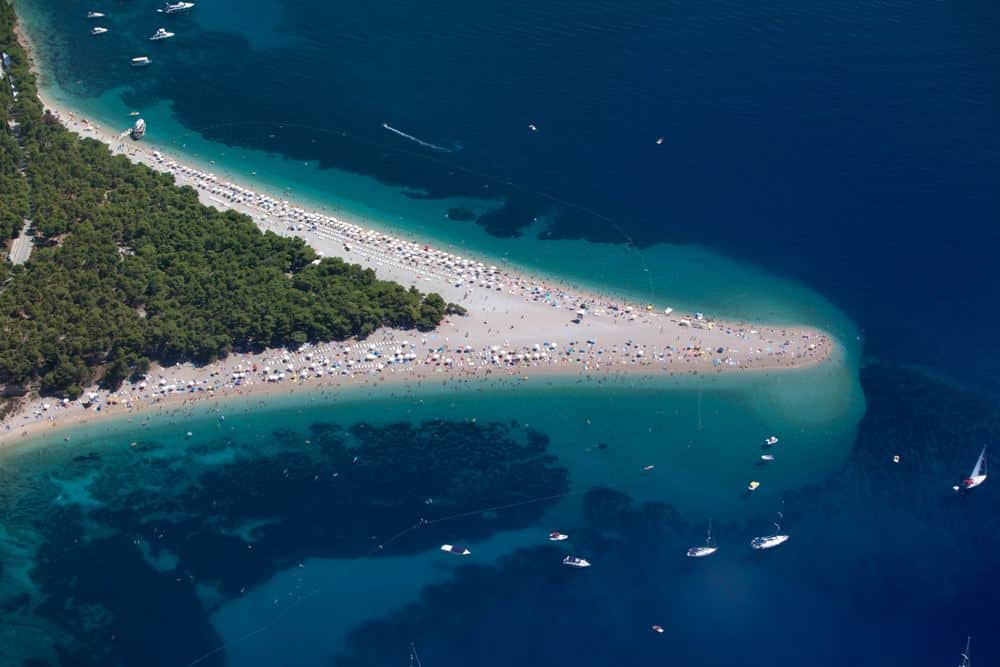
Split's own beaches are good; the ones within an hour are better. Kaštela's seven villages on the bay towards the airport have small pebble beaches and a promenade, 20 minutes west. Omiš, 25 kilometres east at the mouth of the Cetina canyon, has a long sandy beach in the town and the coves of the Omiš Riviera beyond it. The Makarska Riviera starts an hour south with Brela and Punta Rata, the finest pebble beach on the mainland under the Biokovo mountain. And the ferry to Brač puts Zlatni rat, the most photographed beach in the country, two hours from the Riva by boat and bus. Each has a guide on Croatia Atlas, linked below.
Which beach on which day
- First day, no plan: Bačvice at eight in the morning, then the palace, then back at seven for the picigin.
- Hot August afternoon: Bene for the shade, or Kašjuni after five.
- With a toddler: Firule or Bačvice in the morning, Žnjan if you have a car.
- Best water, best view: Kašjuni, and walk there along the Marjan road.
- No crowds at all: Trstenik, Jezinac or the Marjan rock platforms.
- Swim with the city in front of you: Sustipan at sunset.
- Boat day: the taxi boats from the Riva to the Blue Lagoon at Krknjaši or to Šolta, in our Blue Cave and Blue Lagoon guide.
Practical notes
- Sea temperature: 23 degrees in June and September, 25 to 27 in July and August, 20 in the first half of October.
- Water shoes for every beach except Bačvice and Firule; sea urchins on the Marjan rocks.
- Sunbeds are a concession on part of each beach; the rest is free by law. Bring a mat.
- Buses: 12 for Kašjuni, Kaštelet and Bene from the Riva; 8 and 17 for Trstenik and Žnjan from the centre; 25 for Stobreč; tickets 1.60 euro at kiosks, 2 euro from the driver.
- The jugo wind brings waves and murky water to the south-facing beaches for a day; Bene on the north side stays calm.
- Blue Flag beaches in 2026: Bačvice, Kašjuni, Trstenik, Žnjan.
Watch
Split on video
A short official city film to help you picture the place before you go.
It’s joy! It’s Split!
Frequently asked questions
- What is the best beach in Split?
- Kašjuni on the south side of Marjan for the water and the view, Bačvice for sand ten minutes from the Old Town, Bene for shade and quiet. Bus 12 from the Riva reaches Kašjuni and Bene in 20 minutes.
- Does Split have a sandy beach?
- Yes, Bačvice, a shallow sandy bay ten minutes east of the ferry port, and the smaller Firule a little further along. Every other beach in the city is pebble or rock.
- Which Split beach is best for children?
- Firule for toddlers, with knee-deep water and shade; Bačvice for small children in the morning; Žnjan for older children, with playgrounds, water slides, cafes and a car park.
- How do I get to Kašjuni beach?
- Bus 12 from the Riva to the stop above the beach, 20 minutes, or a 40-minute walk along the Marjan coast road past the Meštrović gallery. Sunbeds cost 20 to 25 euro for two; the beach itself is free.
- Can you swim in Split in October?
- Yes in the first half of the month, when the sea is still 20 to 21 degrees. Kašjuni and Bačvice have swimmers until the last warm day, and the locals at Bačvice play picigin all year.
Official sources
Make Croatia Atlas a preferred source
One click and Google shows you our stories more often in Top Stories and in AI answers. It changes your own results only.