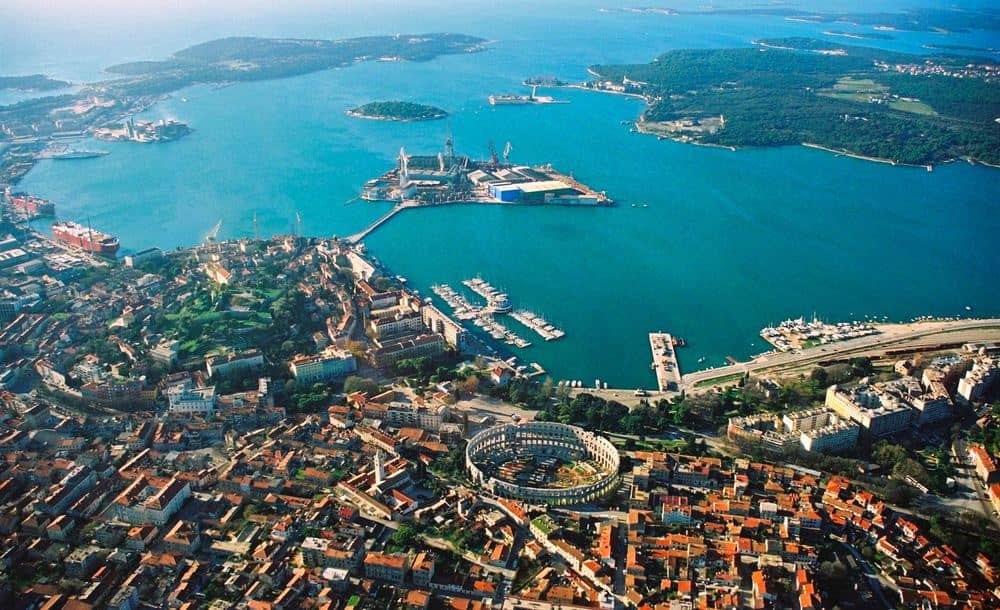
Pula keeps an almost complete Roman amphitheatre by its harbour, its main square has been the Forum for two millennia, and a ring of Austrian forts circles the town. This guide sorts what deserves your time, and where the beaches are.
Checked: 21 September 2026
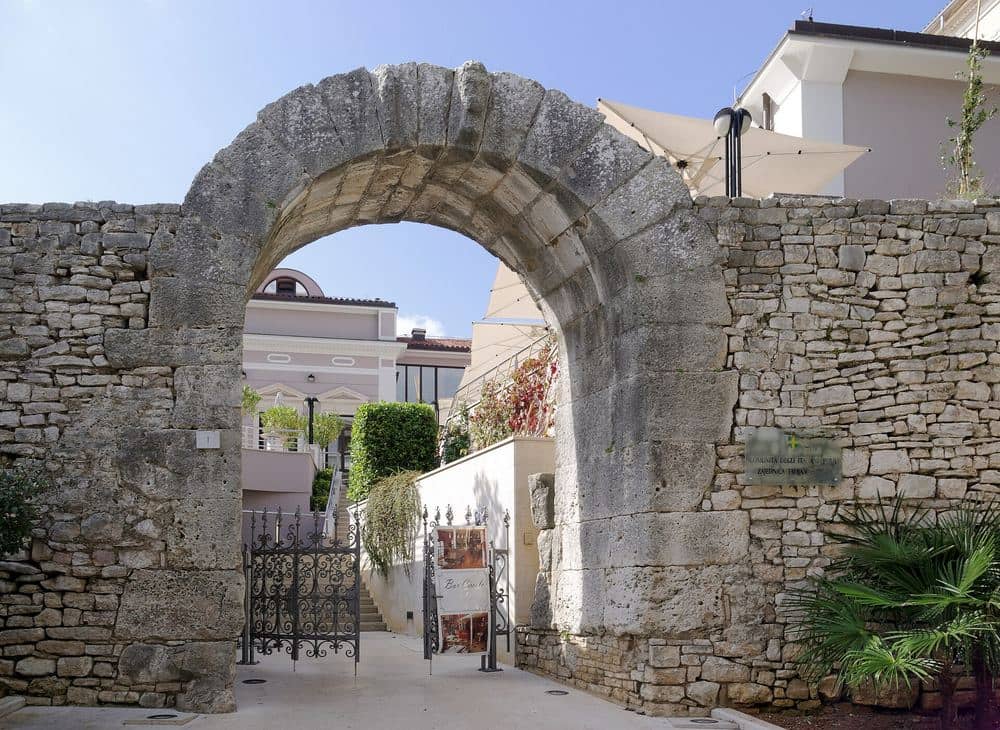
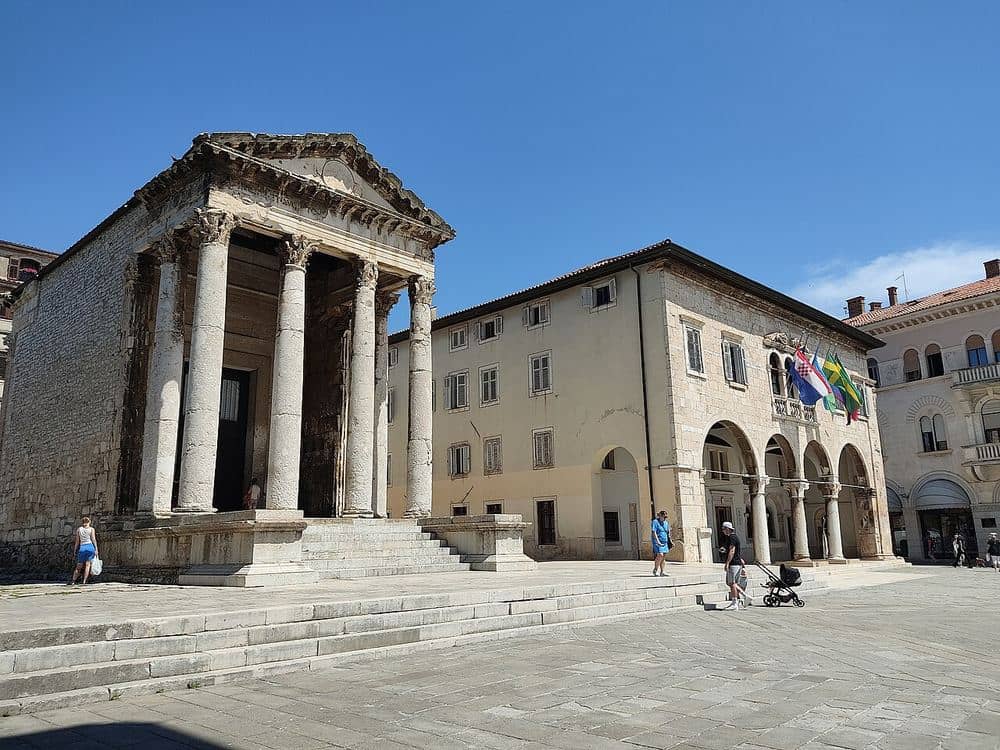
Pula treats its antiquity as everyday equipment. The Forum is still the main square, with the Temple of Augustus at its head and a town hall beside it that has carried Roman spolia in its walls since the Middle Ages. The evening stroll passes through the Arch of the Sergii, and the Arena by the harbour, one of the six largest surviving amphitheatres of the Roman world, fills each summer with concerts and Croatia's oldest film festival. A second layer sits on top: as the main naval port of Austria-Hungary, Pula gained a ring of 19th century fortresses that now lies half overgrown above the beaches.
Roman Pula in one morning
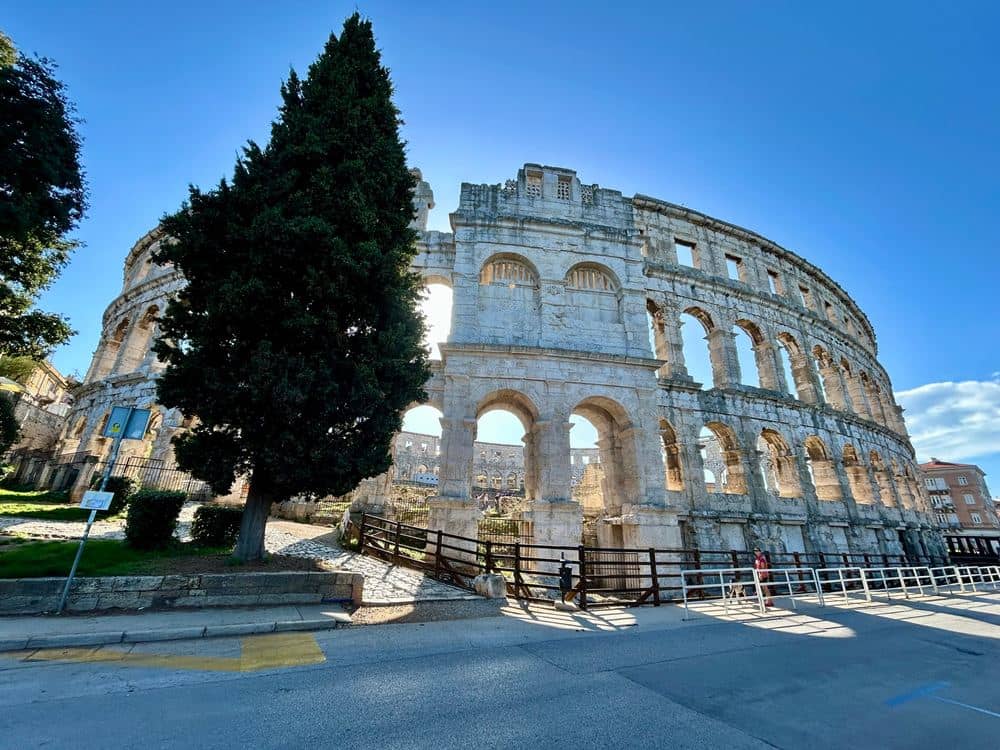
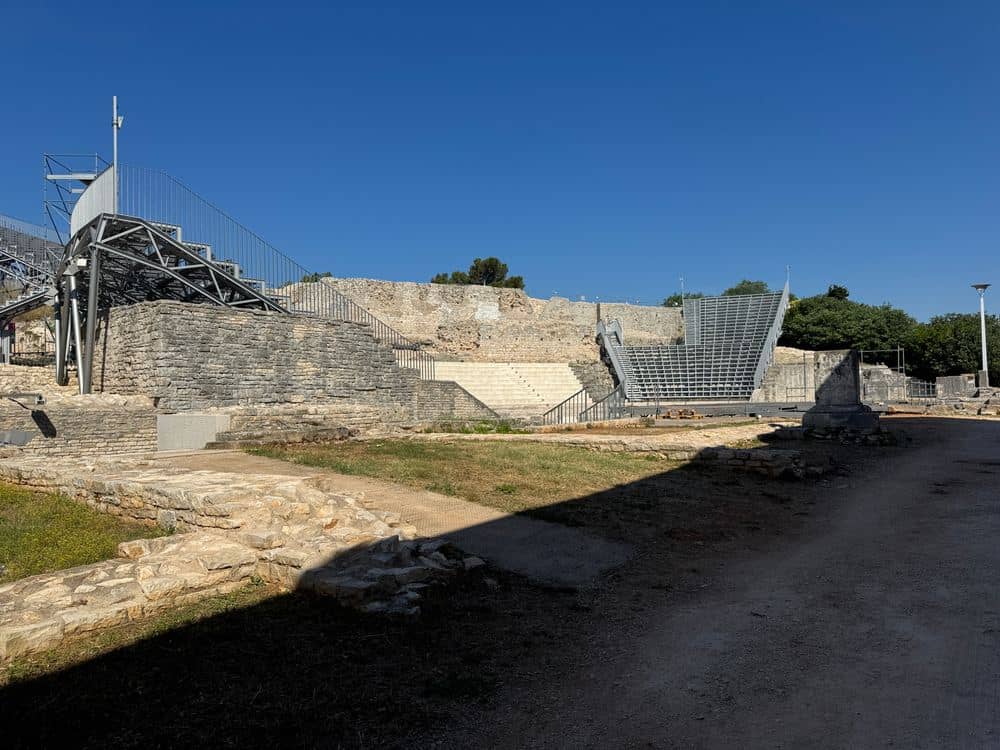
The circuit starts at the Arena, whose outer ring stands with all four stair towers. In the basement, where sets and cages once waited, an exhibition tells of amphorae, oil and wine, the real riches of Roman Istria. From the amphitheatre it is five minutes to the Gate of Hercules, the oldest surviving town gate, and to the Twin Gates, behind which the Small Roman Theatre sits in the hillside. Along Kandlerova you reach the Forum with the Temple of Augustus, hit by a bomb in the Second World War and raised again stone by stone. The finish is the floor mosaic of the Punishment of Dirce, which surfaced beneath a residential courtyard after a bombing raid and lies there behind a railing, free to visit.
- Zerostrasse, a First World War tunnel system, passes beneath the castle hill and stays cool even in high summer. On top, the Venetian Kaštel holds the Historical Museum of Istria and the best all-round view in town.
- After dark the Lighting Giants come on: the illuminated shipyard cranes across from the Riva, a work by lighting designer Dean Skira. The best view is from the waterfront promenade.
- For the Brijuni islands the park boat leaves from Fažana, twenty minutes north by car. The main island holds the remains of Roman villas, a safari park descended from Tito's state gifts and dinosaur footprints in the shore rock, all manageable by rented bike.
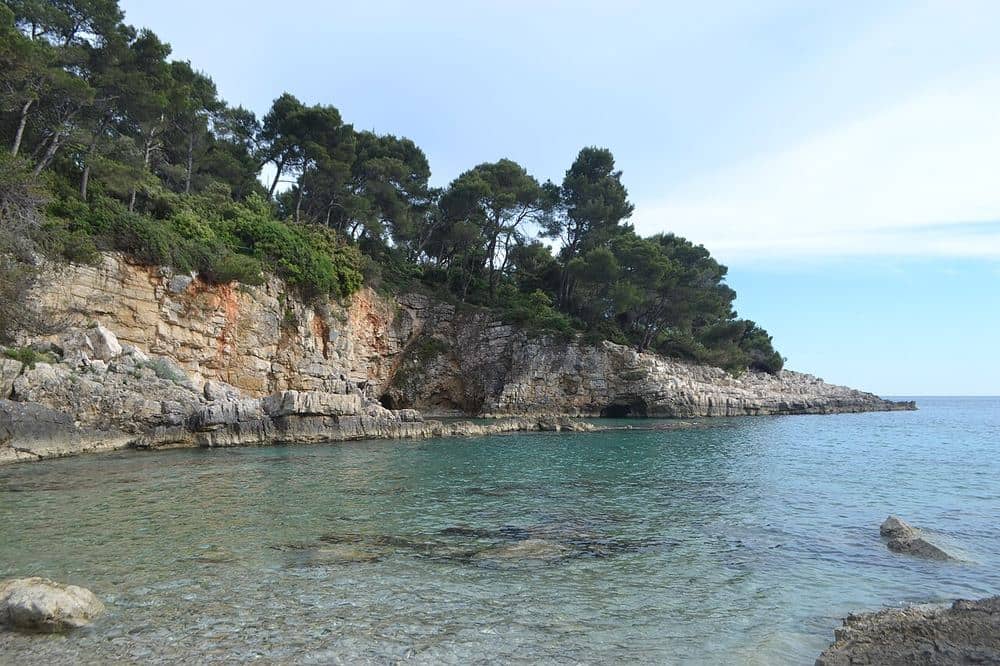
- Cape Kamenjak near Premantura closes Istria off to the south: low cliffs for jumping, coves with calm water and a cliff path above the open sea. Entry is charged per car, arriving by bike is free.
The fortress ring and the beaches
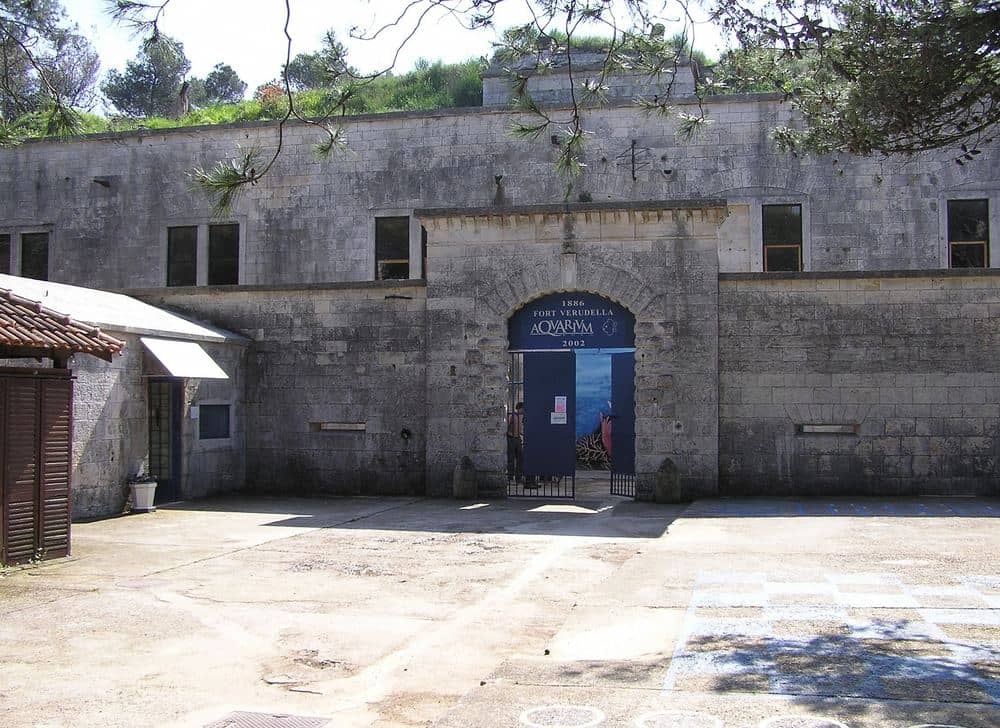
Dozens of works survive from Austrian Pula. Fort Punta Christo above Štinjan bay is the largest and now hosts festivals, Fort Bourguignon and Fort Verudela sit right by the swimming coves, and Fort Verudela houses the city aquarium. If the era genuinely interests you, walk the Naval Cemetery in the Stoja district, where the imperial navy buried its dead from every crown land. The beaches are on the Verudela peninsula and along the coast to the south: Hawaii under its rock ledge, Ambrela as a gently shelving family bay, Valkane with step-free access, plus the pines of Stoja and the Šijana city forest for shade.
“Pula parks its evening traffic beside a temple from the age of Augustus and watches films in a Roman amphitheatre. That matter-of-factness is the real sight.”
Practical notes: the Roman centre is flat and walkable in half a day, and an hour covers the Arena including the basement. The town is officially bilingual, street signs also carry the Italian names, and Pola is the same place. In July and August check the events calendar before visiting the Arena, since sightseeing closes early on concert and festival evenings. As a base, Verudela works best with the beach at your door, the centre is forty minutes on foot along the water or a city bus away.
Getting to Pula
Pula Airport lies about 6 km north-east of the centre near Valtura, with year-round flights from Zagreb and seasonal direct routes from the UK. A shuttle bus timed to flights runs to the bus station, and taxis wait outside. The bus station is a 5 minute walk from the Arena, with coaches from Rijeka, Zagreb, Trieste and Ljubljana. By car you arrive on the tolled Istrian Y motorway, with no passport checks at the Slovenian border since Croatia joined Schengen. In summer fast catamarans link the harbour with Venice and with Mali Lošinj and Zadar.
| From | Distance | Driving time |
|---|---|---|
| Rovinj | 35 km | 40 minutes |
| Rijeka | 100 km | 1 hour 30 minutes |
| Trieste | 120 km | 2 hours |
| Ljubljana | 220 km | 3 hours |
| Zagreb | 270 km | 3 hours |
| Venice | 290 km | 4 hours |
Parking and getting around
The old town is mostly pedestrian, so park once and walk. The largest car park is at Karolina by the harbour, a few minutes from the Forum, and there are paid car parks around the Arena. City buses leave from Giardini beside the Arch of the Sergii, with regular runs to Verudela, Stoja and the Šijana forest, and you buy the ticket from the driver or at a kiosk. For the beaches a bicycle is easiest: the Lungomare coastal path from Valkane to Stoja is flat and shaded by pines.
When to go
April and May bring mild days, open museums and empty Roman streets, though the sea is still cold. June is the best balance: warm water, long evenings and the first Arena concerts before the crowds. July and August are the peak, with the film festival taking over the amphitheatre in July. September keeps the sea warm and clears the tour groups. October suits the forts and Kamenjak. Between November and March the Arena keeps short hours, many beach hotels close and only 2 boats a day cross to Brijuni.
Where to stay
Beyond Verudela and the centre, a few places suit particular plans. Stoja, south-west of the centre, has a large campsite on its peninsula with beaches on 3 sides and a city bus into town. Pješčana Uvala and Veruda, around the marina, hold family apartments and restaurants a short walk from Valsaline cove. Fažana, 8 km north, is a small fishing town with the Brijuni pier at its centre, so an early boat is easy. Premantura and Medulin, 10 km south, put Cape Kamenjak and Medulin's sandy Bijeca beach at your door.
Pula with children
The Aquarium in Fort Verudela is the best wet-weather card: pools set into the fort's stone corridors and a sea turtle rescue centre on the roof. Ambrela is the shallow shingle beach for small children, and the rock ledges elsewhere call for water shoes. Zerostrasse is a cool break on a hot afternoon, and children usually prefer the Arena basement to the seating. Max City on the northern edge of town has a cinema and a food court for rainy days.
Mistakes to avoid
Most of Pula's traps come from timing and from expectations shaped by other coasts. Nearly every beach is shingle or rock, so sandals that can get wet are worth more than a beach towel. Brijuni boats sell out in summer, so book the day before and allow time for the drive to Fažana. Istrian roads fill on Saturdays in July and August, when the queue at the Učka tunnel can add an hour to the drive from Rijeka. The motorway toll is paid at barriers, by card or in cash.
- Kamenjak's cliff path at midday: no shade, and the per-car entry fee applies even for a short stop.
- Looking for a ticket desk at the Small Roman Theatre: it is open air, free and usually empty.
- Mixing up the forts: the aquarium is in Fort Verudela, and Fort Bourguignon is a bare round tower above Valsaline.
- Saving the Dirce mosaic for daytime: the courtyard is open at any hour and fits after dinner.
The places, one by one
| Place | What it is | Time needed |
|---|---|---|
| Pula Arena | Roman amphitheatre, 1st century | 1 hour |
| Archaeological Museum of Istria | Regional archaeology museum by the Twin Gates | 1 to 2 hours |
| Sacred Hearts Museum | Exhibition space in a converted church | 1 hour |
| Communal Palace | Medieval town hall on the Forum, built onto a Roman temple | 15 minutes |
| Cathedral of the Assumption | Waterfront cathedral with early Christian mosaics | 15 to 30 minutes |
| Church and Monastery of St Francis | Gothic church and cloister below the Kaštel | 30 minutes |
| House of Istrian Olive Oil | Olive oil museum with tasting | 1 hour |
| Fort Monvidal | Unmanaged Austrian fort and viewpoint above town | 1 hour |
| Naval Park | Austro-Hungarian navy garden with exotic trees | 30 minutes |
| Gortanova Uvala Beach | Sheltered cove on the Lungomare | 1 to 2 hours |
| Valsaline Beach | Calm shingle cove with diving centre | half a day |
| Verudela Canyon | Sheltered channel for SUP, kayak and walks | 1 to 2 hours |
| Svjetionik Rt Verudica | Lighthouse and sunset point at the tip of Verudela | 1 hour |
Pula Arena
The amphitheatre went up in the 1st century, begun under Augustus and finished under Vespasian, and it held around 20,000 spectators for the games. The outer wall of white Istrian stone still carries all 3 orders of architecture, so from the street it looks like a stadium waiting for tonight's programme. That programme exists: the film festival has run here every July since 1954, and summer concerts play on a stage under the open sky. Arrive in the morning before the cruise groups come ashore, or buy a ticket for an evening event, when the lit building gathers thousands of people again. Tickets for a daytime visit are sold at the gate.
Archaeological Museum of Istria
Founded in 1902, the museum holds what the whole peninsula has yielded from the ground, from prehistory to the Middle Ages. The core of the display is the material from Nesactium, the Histrian capital that fell to Rome in 177 BC after a long siege, followed by Roman Pula in stone, glass and ceramics, grave stelae, early Christian fragments and Lombard and Slavic finds. The building beside the Twin Gates has been through a long renewal, so check the current opening hours and which halls are open before you go. Its value is context: after 90 minutes here the Arena, the temples and the mosaic stop being separate attractions and become one city. The Small Roman Theatre sits directly behind the building.
Sacred Hearts Museum
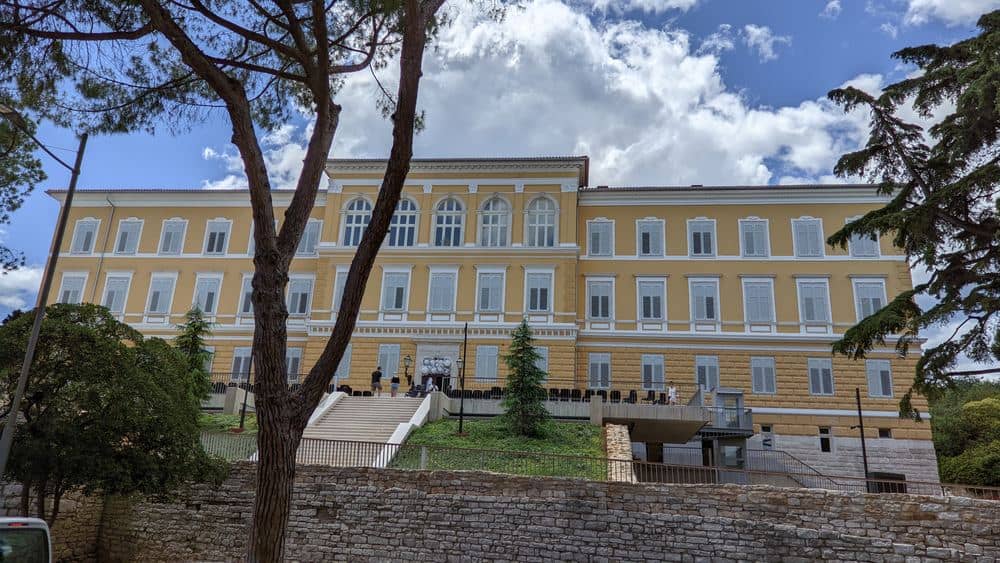
The church of the Sacred Hearts, built at the start of the 20th century and closed for decades, reopened in 2011 as an exhibition space of the Archaeological Museum of Istria. The conversion won architecture prizes: the plain facade with its rose window stayed, and inside you get a tall nave without an altar, a gallery on steel legs and raw stone against clean glass. The programme changes through the year, from archaeological themes to contemporary shows, so check what is on. The ticket is affordable, an hour is enough, and the hall is air conditioned. You find it on Sergijevaca, halfway between the Arch of the Sergii and the Forum.
Communal Palace
Pula has governed itself from this building on the Forum since the 13th century, and the date 1296 carved on the front marks its present shape, which makes it the oldest town hall in Croatia still in use. Walk around the back: the rear wall is the cella of the temple of Diana, the twin of the Temple of Augustus, which medieval builders simply kept as a wall. The front collected layers along the way, Romanesque biforas, a Renaissance loggia and a Venetian lion. The city offices are still inside, so visitors enter only the ground floor loggia. The best view is from the middle of the square, where temple and town hall share one frame.
Cathedral of the Assumption
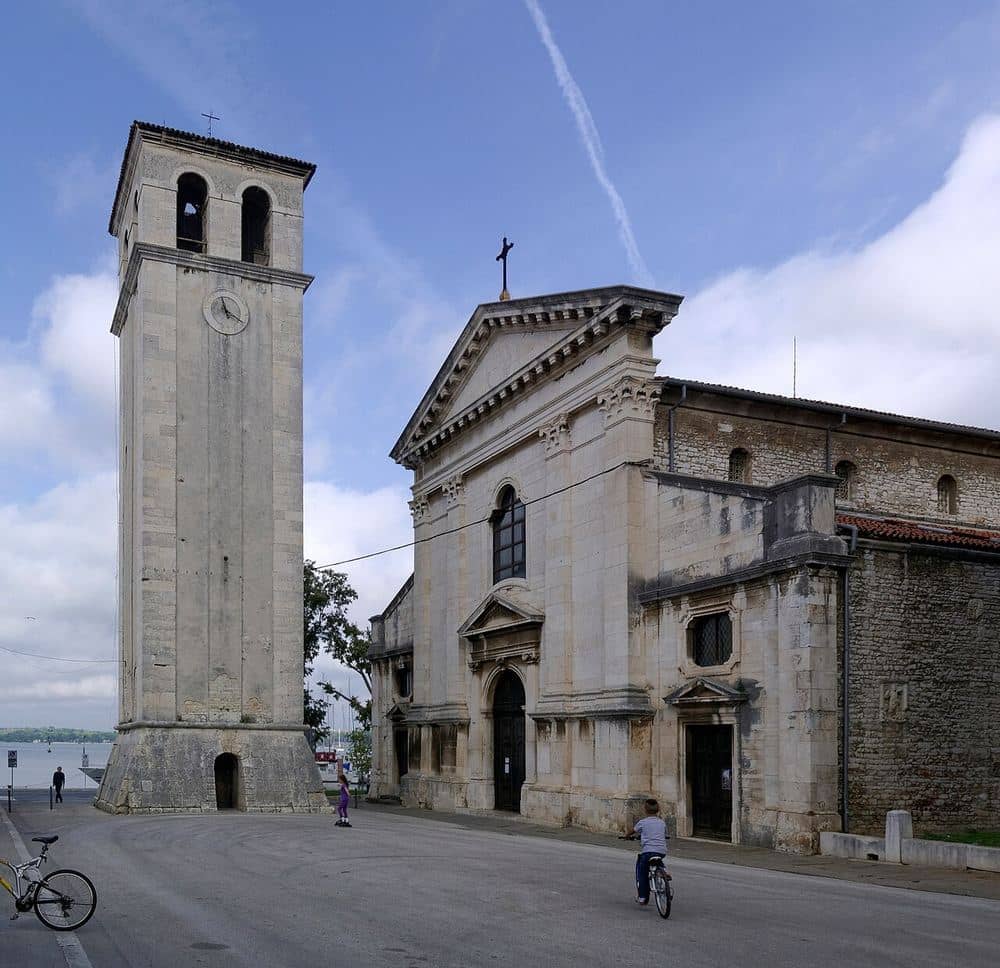
The cathedral stands on the waterfront where Christians met during the persecutions, and the first basilicas rose here in the 4th and 5th centuries. Their mosaic floors show through glass openings near the altar. The present church took shape over centuries, with a Renaissance front from the early 17th century and Roman and early Christian fragments built into the walls. The belfry beside it went up in the 17th and 18th centuries, largely with stone taken from the Arena. Inside are 3 naves, early Christian sarcophagi and a baptistery. It is the working cathedral of the diocese of Poreč and Pula, so plan around the masses. Entry is free, and the church lies on the direct way from the Riva up to the Kaštel.
Church and Monastery of St Francis
The Franciscans built this Gothic church of yellow Istrian stone on the slope below the Kaštel at the start of the 14th century. The capitals of the portal carry carved leaves and a rose, and the single nave holds a gilded wooden polyptych of the 15th century on the high altar. Beside the church the cloister opens around a garden, with Roman and medieval fragments stacked along the walls as a lapidarium. The monastery is still Franciscan, so visits follow the friars' rhythm and the masses, and entry is a small donation. The church stands on the footpath that climbs from the Forum to the fortress, and a bench in the cloister is the quietest place in town to wait out the midday heat.
House of Istrian Olive Oil
This private museum in the centre tells the story of Istrian oil across 2,000 years, from the Roman amphorae that carried it around the empire to the modern mills that put the peninsula at the top of world rankings. The display runs through presses and tools, the centuries when oil served as money, medicine and lamp fuel, and the current varieties such as buža and istarska bjelica. Everything is bilingual, and the visit takes about 45 minutes. It ends with a guided tasting included in the ticket, where you learn why good young oil stings the throat and how to tell excellent from average. Go before lunch, while your palate is fresh. The shop beside the museum sells oils from small producers, the most useful souvenir Pula offers.
Fort Monvidal
Monvidal holds the north-eastern corner of the fortress ring: a circular fort of the second half of the 19th century on the hill of the same name, with casemates around a central courtyard and an artillery platform on the roof. The town has grown up to its foot, so you reach it by an ordinary street, about 15 minutes' climb from the centre, and from the ramparts you look straight into the courtyards of the quarter. Entry is free and nobody manages the site, which means dark corridors, the odd opening in the floor and graffiti. Bring a torch and closed shoes, and keep children close. Go up before sunset for the view over the roofs to the harbour and the Arena from an unusual angle.
Naval Park
Pula's oldest public garden lies a short walk south of the old town. It was laid out in the second half of the 19th century for the officers and families of the Austro-Hungarian navy, beside the casino and the command's apartments. The sailors brought back trees from around the world, and huge Himalayan cedars and Mediterranean pines still mark the park from a distance. Today it is neighbourhood greenery with a playground, paths and benches in deep shade, and the surrounding buildings keep their imperial elegance, so a walk through it doubles as a small architecture tour. Take it as the next chapter after the Arsenal and the waterfront: this is where the fleet rested. It remains the calmest place in town to read a book.
Gortanova Uvala Beach
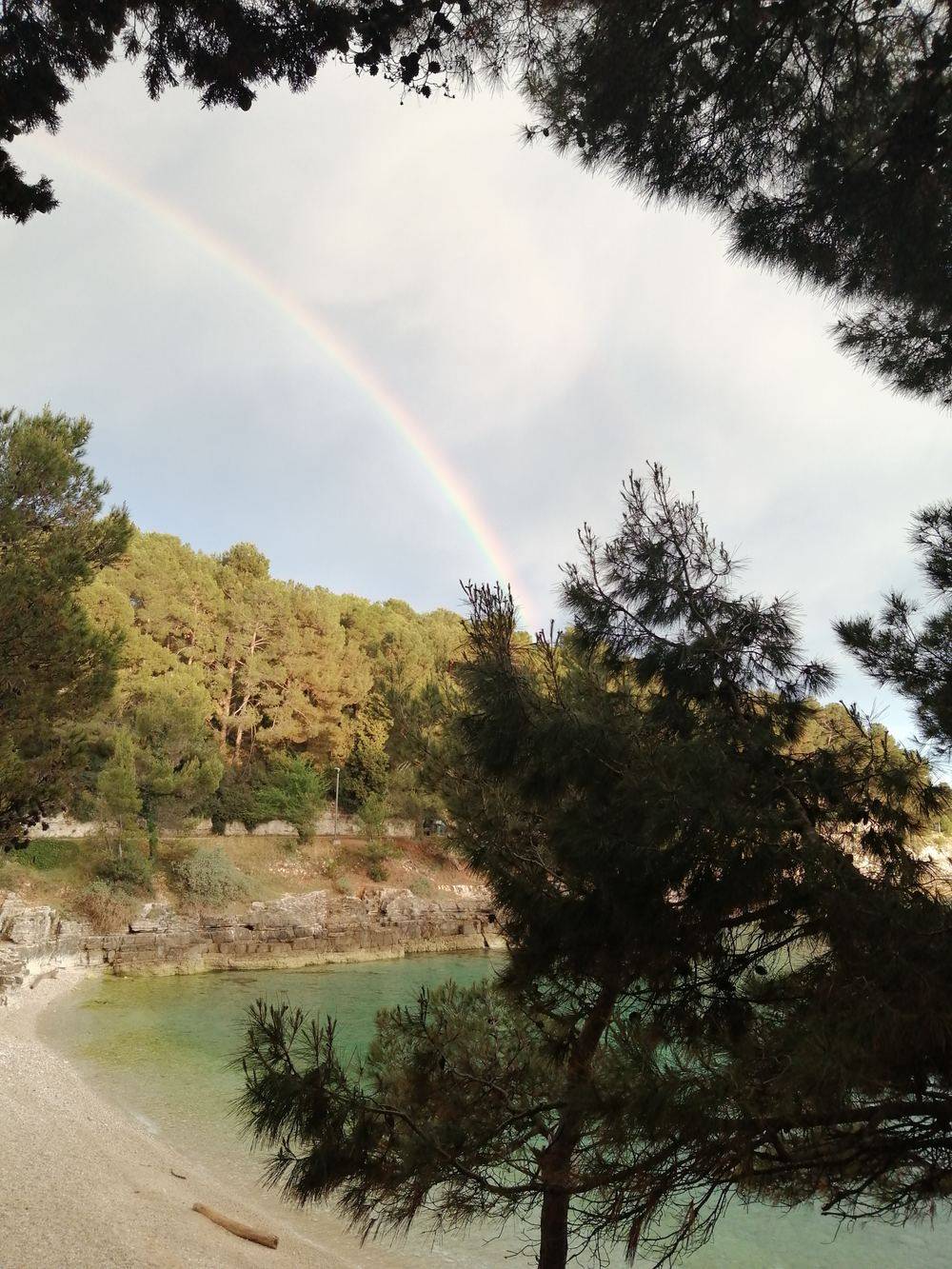
Halfway along the Lungomare between Valkane and Stoja, this deeply cut cove has stone slabs on one side and shingle on the other, with pines that bring their shade almost to the water. It is named after Vladimir Gortan, an Istrian anti-fascist executed in 1929, and his monument stands above the bay. Sheltered from most winds, the cove works like a natural pool: families take the shallow side and swimmers cut laps across the other. People jump from the surrounding rocks and play cards under the trees, and the only facilities are a shower and a café nearby. The walk from the centre takes under 30 minutes. Late afternoon is the best time, when the low sun turns the water golden.
Valsaline Beach
Valsaline is a shingle cove at the entrance to the Veruda channel, sheltered from the open sea, so the water is often flat even when the maestral, the afternoon wind, blows outside. The entry is gentle and the shallows long, which is why local families favour it and why it suits first swimming strokes. A diving centre works from the cove, and a walkway leads from here around the channel to the marina. Facilities cover the basics, a shower, a café and sunbeds on part of the beach, with pines growing almost out of the shingle for shade. You reach it by city bus towards Veruda or by bicycle. The round Fort Bourguignon is a short climb into the wood behind the bay, a good break between swims.
Verudela Canyon
The Veruda channel is a narrow arm of sea running north between Verudela and the mainland to Veruda marina, one of the largest on the Adriatic. Sheltered from every wind, the water is often smooth as oil, which makes it the easiest place around Pula to hire a SUP or kayak, even as a beginner: there are almost no waves and the backdrop is rock, pine and boats. Divers work the edges and sailboats leave from here for the open sea. Without a boat, walk the loop from Valsaline along the water to the marina, then take a coffee overlooking the berths. If you jump from the rocks, check the depth and your way out first. At dusk the channel goes quiet and golden.
Svjetionik Rt Verudica
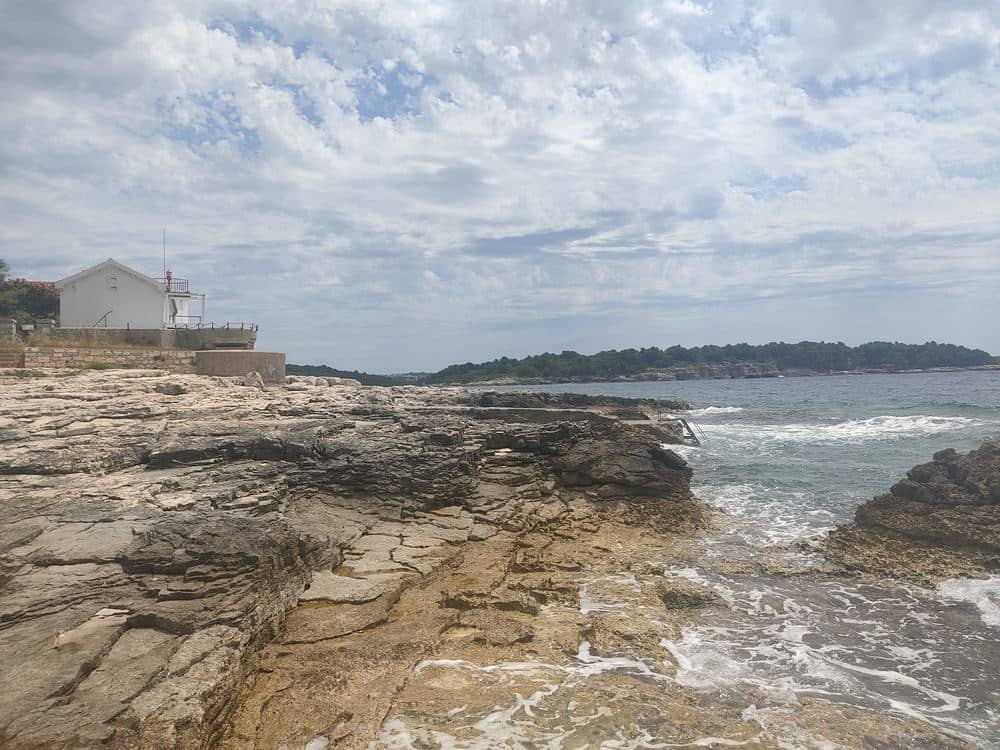
The white lighthouse on Cape Verudica marks the entry to the Veruda channel, the strip of sea between the mainland and the islet of Veruda through which sailboats thread to the marina. It dates from Austro-Hungarian days, when the naval port marked every approach, and it still runs automatically. The reward is the frame: white tower, turquoise channel, the marina's masts on one side and open sea on the other, with Brijuni on the horizon on clear evenings. You reach it on the seaside path from the Verudela beaches, over rocks and through pine wood, about 5 minutes from the hotel pools. There are no facilities on the cape, so bring water and food. Locals jump from the rocks here in summer, and sunset draws a small crowd.
Frequently asked questions
- Is the Pula Arena worth going inside?
- Yes, above all for the basement: an exhibition there shows amphorae and presses from Istria's oil and wine economy, and you stand in the passages that once carried gladiators and stage sets. An hour covers the whole building. Sightseeing closes early on concert and festival evenings, so check the calendar in summer.
- Is one day enough for Pula?
- For the Roman centre, yes: Arena, Forum, Arch of the Sergii, Gate of Hercules and the mosaic fit into half a day, with the Kaštel and Zerostrasse filling the afternoon. Brijuni or Cape Kamenjak turn it into a second day, and anyone taking the Verudela beaches seriously stays longer anyway.
Share this guide
Questions about your trip?