Ten euros for adults, five for students, and an exhibition in the underground passages that most visitors walk past. What the ticket covers and which hour of the day is worth planning for.
Checked: 17 October 2026, 20:00
Pula's amphitheatre was built in the first century, when the town was a Roman colony, and it is the only one left anywhere with all four side towers still standing. That is the detail worth knowing before you go in, because from the outside the towers are what you are looking at, and from the inside they are the part that explains how the awning over the arena was rigged.
Tickets
| Visitor | Ticket |
|---|---|
| Adults | 10 € |
| Pupils and students | 5 € |
Tickets are sold at the box office and online. In October the Arena is open 8:00 to 19:00, from November to March 9:00 to 17:00 and from June to August 8:00 to 22:00. The ticket office closes one hour earlier. The amphitheatre is still a working venue: concerts and the film festival take over the arena floor in summer, and on those days the visiting hours change or the site closes early. Checking the programme before a fixed plan saves the wasted walk.
The part most visitors miss
In the amphitheatre's subterranean chamber the museum keeps a permanent exhibition on olive oil and wine production in Roman Istria, with reconstructed presses and amphorae. It is included in the same ticket. Most people circle the arena floor, photograph the towers and leave without going down, which is why the underground is the quietest part of the building even in August.
When to go
The arena floor is open stone with no shade at all, which decides the timing for you between June and September: the first hour after opening or the last two before closing. In the middle of the day the interior holds the heat and there is nowhere to step out of it. Outside the summer the question turns around, and midday is the pleasant slot.
Getting to the Arena
The Arena stands at the northern edge of the old town on Flavijevska street, between the harbour and the main road in from the north, so almost every way into Pula delivers you close to it. Pula airport lies about 6 km north-east of the town near Valtura, with a shuttle bus and taxis to the centre. The bus station is a 5-minute walk from the amphitheatre, which makes the coach the simplest arrival from Rijeka, Zagreb, Trieste or Ljubljana. By car the motorway down the Istrian peninsula ends at Pula, and the paid car parks around the Arena are the sensible place to stop: the streets beyond are narrow and largely pedestrian. From a cruise ship the passenger quay on the Riva puts you 5 minutes from the Forum and another 10 to 12 minutes from the Arena along the flat waterfront.
| Destination | Distance | On foot |
|---|---|---|
| Twin Gates and Gate of Hercules | 320 m | 5 minutes |
| Small Roman Theatre | 430 m | 7 minutes |
| Kaštel, uphill from the theatre | about 550 m | 12 minutes |
| Forum and Temple of Augustus | about 750 m | 10 to 12 minutes |
| Arch of the Sergii | 600 m | 10 minutes |
| Bus station | short walk | 5 minutes |
| Passenger port on the Riva | via the Forum | about 15 minutes |
What to look for inside
The building went up in stages between the reigns of Augustus and Vespasian, in white Istrian stone, and held around 23,000 spectators. It ranks among the 6 largest Roman amphitheatres still standing, and for the condition of its outer wall it has no equal: the outer wall stands around the whole ellipse, with four levels on the seaward side and only the two upper levels on the eastern side, where the ground is higher. In 1583 the Grand Council of Venice decided to take the outer wall down stone by stone and ship it to Venice. Senator Gabriele Emo opposed the plan, and a stone plaque on the northwest tower thanks him for it. Walk the outer corridor once before you step onto the floor, because the towers only make sense from there, where you see how the stairs inside them fed the upper rows. The seating itself is mostly gone. The stone tiers were quarried for centuries, and at the beginning of the 18th century more than 70 carved seat steps went into the foundations of the cathedral bell tower. What you walk on today is the open floor and the temporary stands put up for events.
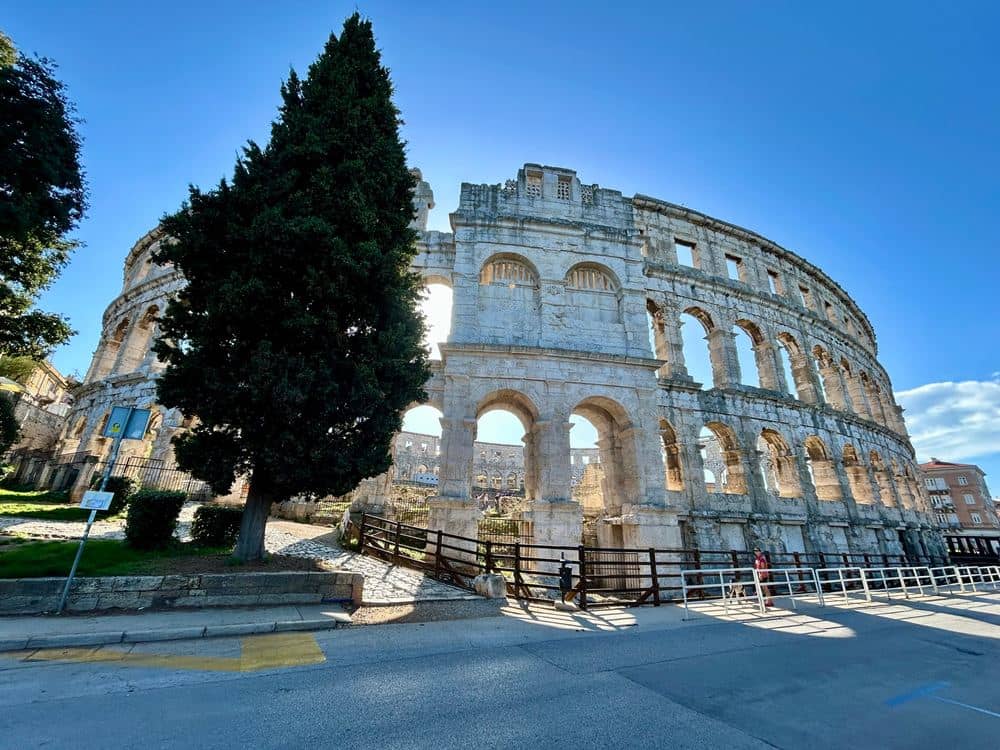
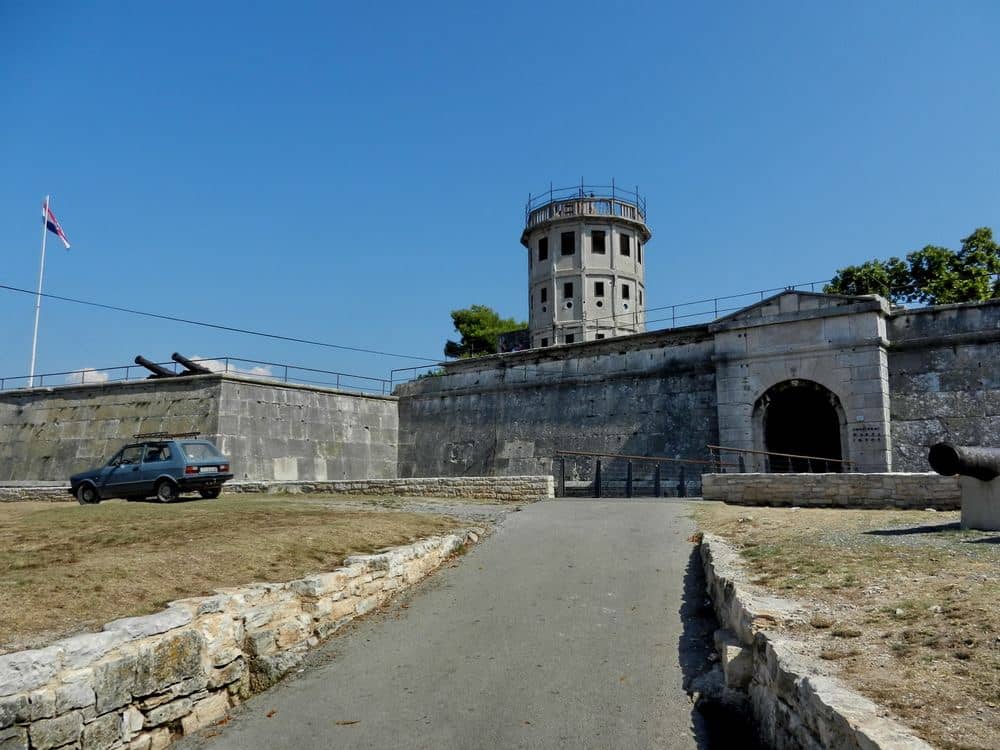
You need no ticket for the outside, and the outside is where the ellipse reads best. Flavijevska street runs along the harbour side and shows the full length of the wall with the towers at both ends. For the view from above, climb to the Kaštel, the Venetian fortress on the hill behind the old town: the path round its ramparts is the only spot in Pula that holds the Arena, the harbour and the shipyard cranes in one frame, and the hour before sunset gives the warmest light on the stone.
Evenings in the Arena
The Arena still does the job it was built for. Since 1954 it has hosted the Pula Film Festival, the oldest in Croatia, usually in July. Screenings take place on the arena floor under the open sky, and through the summer concerts fill the same space. An evening event is the best way to see the building lit, and it removes the heat problem at the same time. Tickets for concerts and screenings are sold by the organisers and are separate from the sightseeing ticket. On event days the daytime visit is cut short, so if you want both, do the sightseeing on a quiet day and come back for the show.
The Roman corner next door
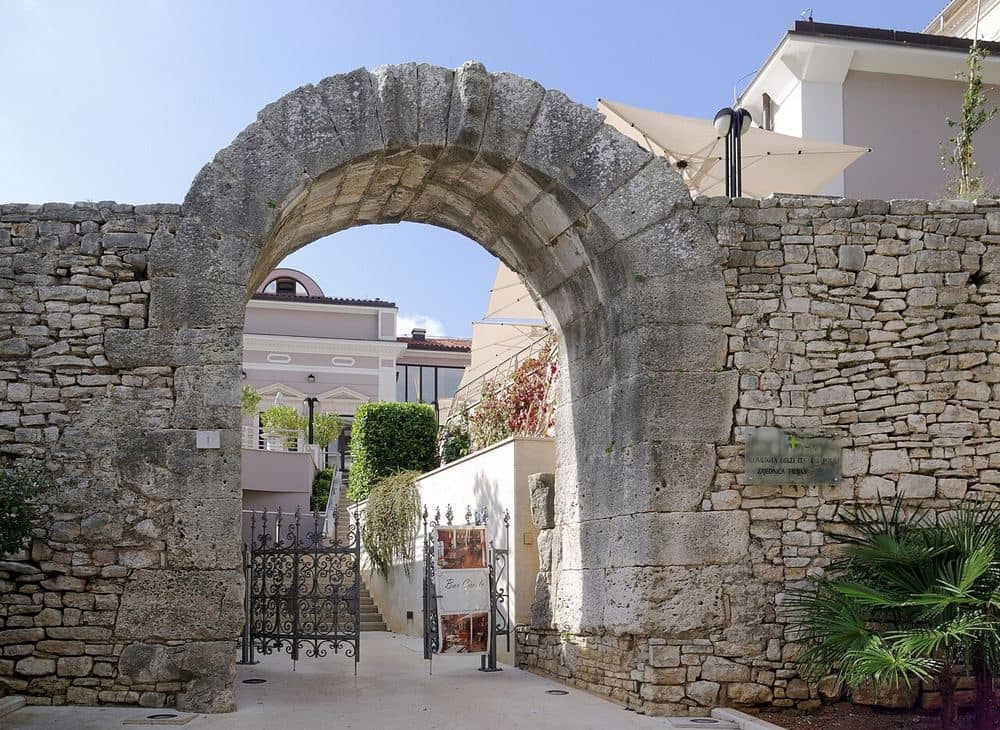
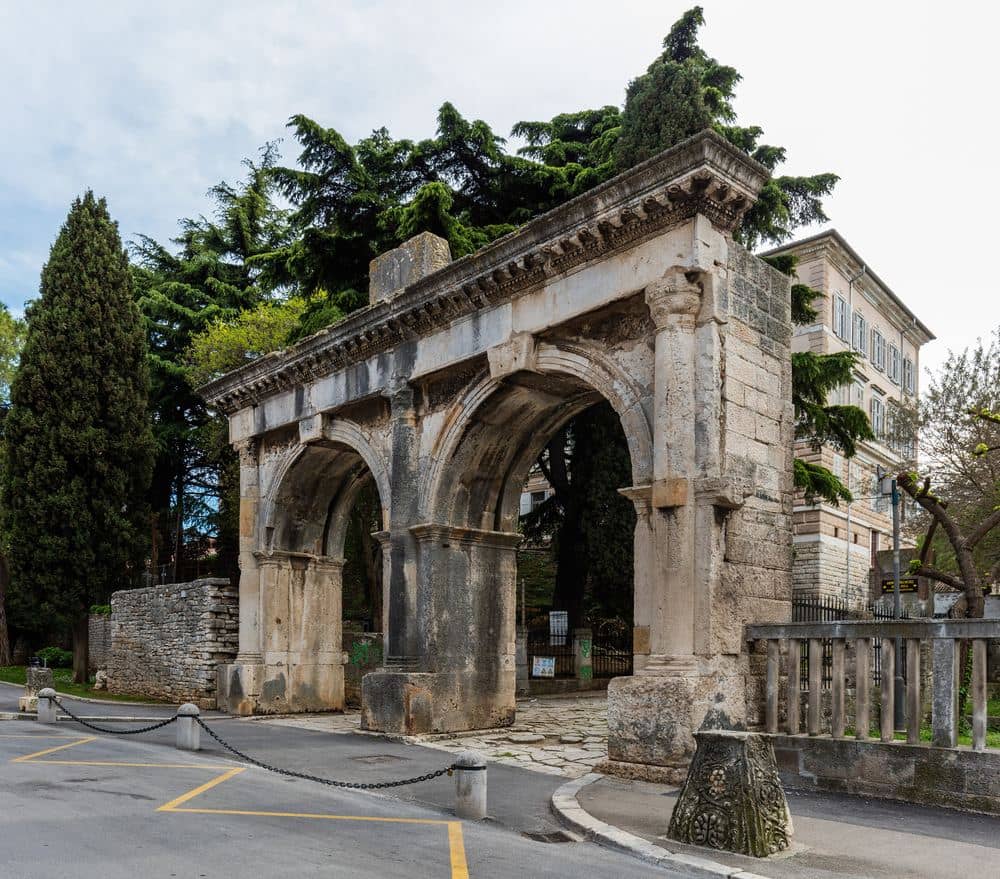
Most visitors walk from the Arena straight to the Forum along the waterfront and miss the densest Roman corner in town. Turn instead along Carrarina street: after 320 m you reach the Twin Gates, a double arch of the 2nd century with a stretch of the Roman town wall beside it, and the Gate of Hercules, the oldest monument in Pula, raised between 47 and 44 BC, with the founders' names carved above a worn head of Hercules at the top of the arch. Through the Twin Gates lies the courtyard of the Archaeological Museum of Istria, and 110 m behind it the Small Roman Theatre sits in the hillside, free of charge, but visits have to be arranged in advance with the Archaeological Museum by e-mail. The entrance to Zerostrasse, the First World War tunnels under the Kaštel hill, is by the same gates, and the tunnels hold about 16 degrees all summer.
With children
The Arena works for children in a short dose. The floor is open and level, the outer corridor is a ring they can run round, and the underground gives them something concrete to look at, reconstructed presses and amphorae in the coolest part of the building. Go first thing and keep it to an hour. Tito Park, on the waterfront between the Arena and the Forum, has shade, benches and ice cream for the break afterwards. For the rest of the day the best family address is Aquarium Pula inside Fort Verudela on the Verudela peninsula, a city bus ride away, with a touch pool, a sea turtle rescue centre and a roof terrace over the bay. Ambrela beach beside it shelves gently and has lifeguards in summer.
Where to stay
For the Arena itself, stay in the centre: anywhere in the old town or near the bus station puts the amphitheatre, the Forum and the evening walk under the Arch of the Sergii within 10 minutes on foot, and you can return for the underground at the quiet hour without any transport. The Verudela peninsula south of the centre holds the hotels and the main beaches and suits a longer stay with children, but the centre is 40 minutes along the water or a city bus away. Campers go to Stoja, on its own cape 15 minutes from the centre by bicycle along the Lungomare. If Brijuni is the main event of the trip, Fažana, about 20 minutes north by car, puts you beside the boat pier.
Common mistakes
Most of the wasted time at the Arena comes from a few repeatable errors, and the ones below turn up in almost every summer week. The visit itself is short: an hour covers the interior and the underground, and the kilometre of Roman monuments around it costs mostly nothing. Plan the Arena around the heat and the event calendar, then let the rest of the old town fill the day, and keep Brijuni or Cape Kamenjak for a separate one.
- Assuming the Brijuni boat leaves from Pula: it sails from the pier in Fažana, about 20 minutes north by car, and in summer it pays to book in advance.
- Driving into the old town to look for parking: use the paid car parks around the Arena or the garage in City Mall on the Riva.
- Paying for the inside and skipping the outside: the full ellipse with all 4 towers reads best from Flavijevska street, which costs nothing.
- Going straight from the Arena to the Forum: the Twin Gates, the Gate of Hercules and the Small Roman Theatre are 320 m the other way.
- Entering Zerostrasse in beachwear: the tunnels hold about 16 degrees all summer, against 30 outside, so carry a layer.
- Missing the Dirce mosaic: a 3rd century Roman floor in a courtyard off Sergijevaca street, open and free at any hour.
The places, one by one
| Place | What it is | Time needed |
|---|---|---|
| Arch of the Sergii | Roman triumphal arch of 27 BC | 15 minutes |
| Roman Forum | Main square since Roman times | 30 minutes |
| Temple of Augustus | Roman temple of 2 BC to AD 14 | 15 minutes |
| Cathedral of the Assumption | Cathedral over 4th century basilicas | 15 minutes |
| Church and Monastery of St Francis | Gothic church with cloister | 30 minutes |
| Archaeological Museum of Istria | Regional archaeology museum | 1 to 2 hours |
| House of Istrian Olive Oil | Olive oil museum with tasting | 1 hour |
| Lighting Giants | Illuminated shipyard cranes | 30 minutes |
| Valkane Beach | Town beach at the start of the Lungomare | 1 to 2 hours |
| Hawaii Beach (Verudela) | Shingle cove under a cliff | 2 to 3 hours |
| Rt Kamenjak Cliff Trail | Cliff paths at the southern tip of Istria | half a day |
| Fort Punta Christo | Largest fort of the Austro-Hungarian ring | 1 to 2 hours |
| Brijuni National Park | Island national park off Fažana | half a day |
Arch of the Sergii
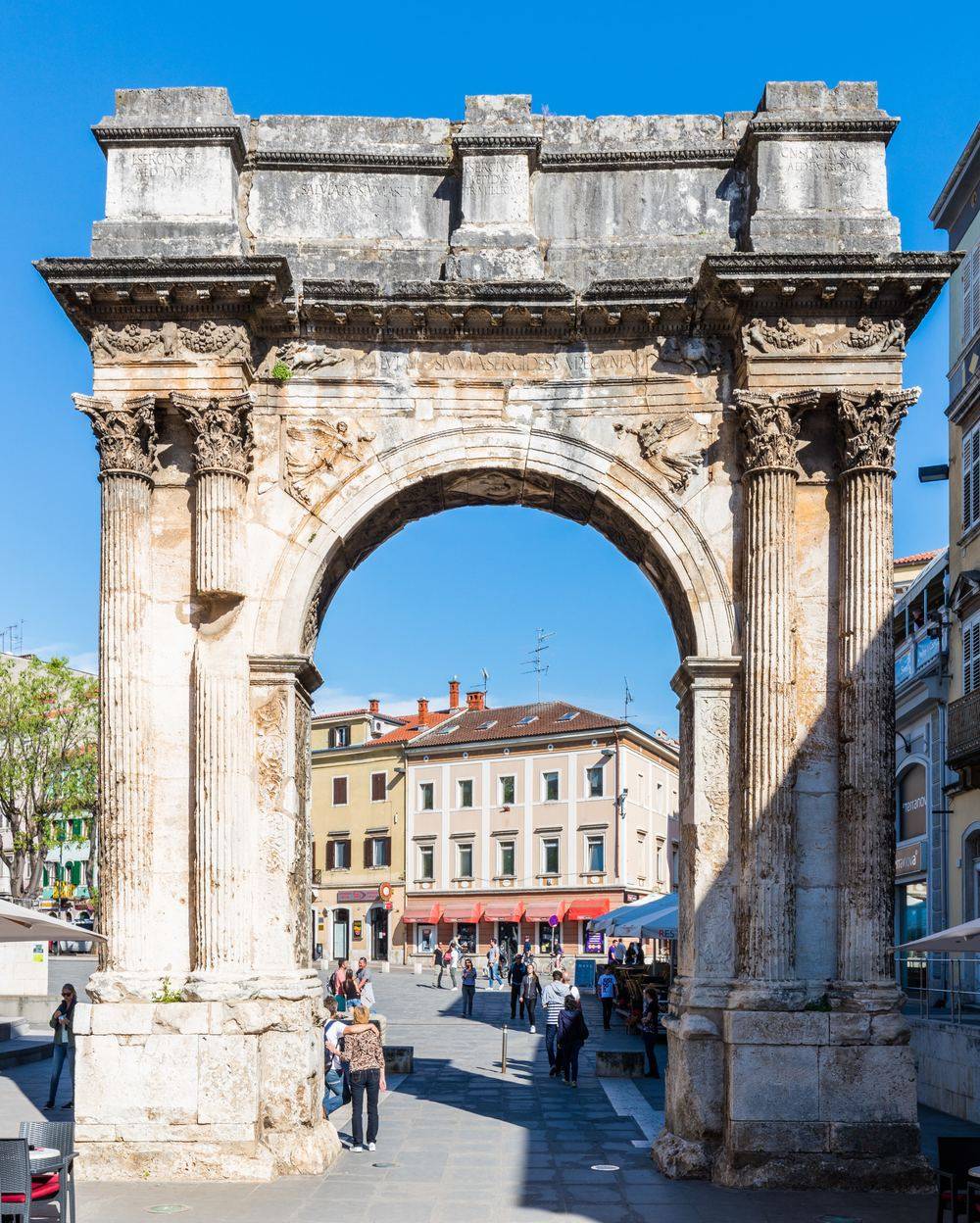
The arch stands at the start of Sergijevaca street, the main pedestrian street. Salvia Postuma Sergia paid for it around 27 BC in honour of 3 men of her family who held high office, and the inscription still names them. The town gate beside it was demolished in the 19th century, so it now stands free, with Corinthian columns, reliefs of weapons and victory wreaths and a coffered vault with an eagle. Michelangelo drew it in the 16th century. James Joyce taught English in Pula in 1904 and sat at the café beside it, and a bronze Joyce now sits at a table 5 steps away. Walk through it, and come back after dark, when the lighting brings out the depth of the reliefs.
Roman Forum
The Forum has been the main square since the Roman colony of Pola, when 3 temples stood on it, and it still is. The Temple of Augustus stands at full height on one side. Beside it the Communal Palace, the city hall since the 13th century and dated 1296 on its front, has the back wall of the temple of Diana built into it. The rest of the square is cafés with parasols, the tourist information office and foot traffic. Glass panels in the paving show mosaics and foundations from the Roman layer beneath. Start a tour here with a morning coffee before the tour groups arrive: the Arch of the Sergii, the cathedral and the Kaštel are each 5 minutes on foot.
Temple of Augustus
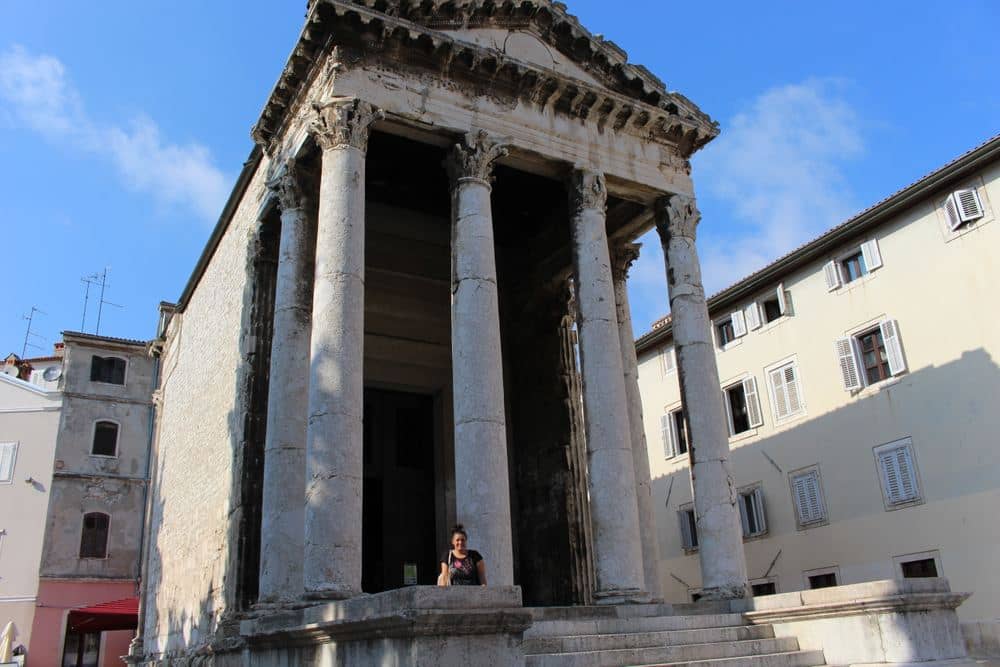
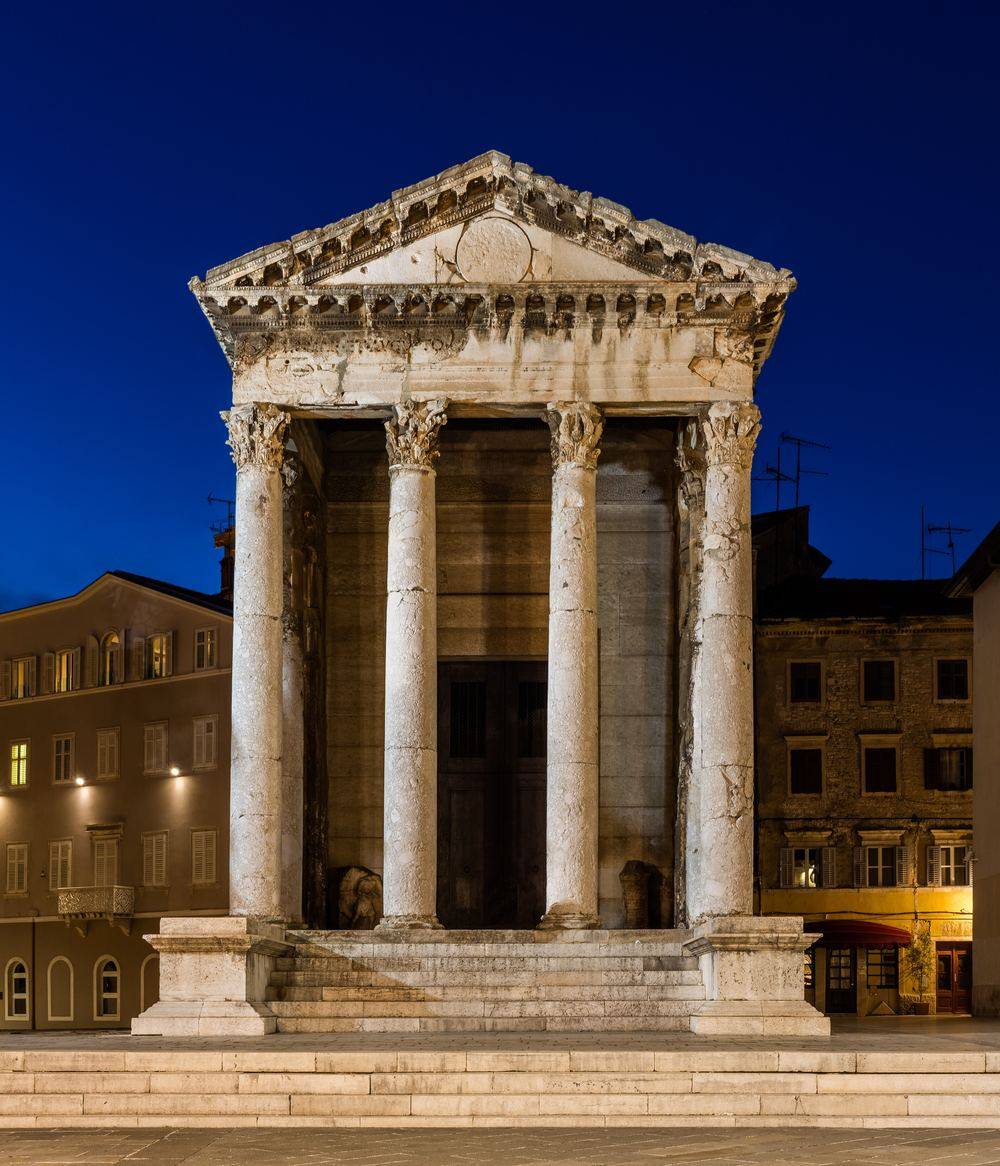
The temple was raised between 2 BC and AD 14 as a shrine of the cult of Roma and Augustus, and it is one of the most complete Roman temples outside Italy. A porch of 4 Corinthian columns carries the pediment. Over 2,000 years it served as a church, a granary and a lapidarium, and in 1944 an Allied bomb hit it directly and blew it apart. After the war it was reassembled stone by stone by anastylosis, so its completeness is partly the restorers' work. Inside is a small collection of ancient bronze and stone sculpture, but the cella with its original proportions is the main exhibit. The visit takes about 15 minutes for a small ticket. Afternoon light falls on the front across the Forum.
Cathedral of the Assumption
The cathedral stands just off the waterfront, on a site where Christians gathered in the times of persecution. The first basilicas went up in the 4th and 5th centuries, and their mosaic floors show through glass openings in the floor of the present church near the altar. The building was assembled over centuries and has a late Renaissance front from the early 16th century, with ancient and early Christian fragments built into the walls. The interior has 3 naves, early Christian sarcophagi and a baptistery. This is the working cathedral of the diocese of Poreč and Pula, so sightseeing gives way to masses. Entry is free and 10 minutes is enough. It lies on the route from the Riva to the fortress.
Church and Monastery of St Francis
On the footpath that climbs from the Forum to the Kaštel stands the Franciscan church of St Francis, begun early in the 14th century. It is Gothic, in yellow Istrian stone, and the portal capitals carry carved leaves and a rose. Inside there is a single nave, a wooden ceiling and light from the south, and on the high altar a gilded wooden polyptych of the 15th century. Beside the church a cloister of arcades surrounds a garden, with Roman and medieval fragments stacked along the walls as a lapidarium. The monastery is still Franciscan, so visits follow the masses, and entry is by a small donation. A bench in the cloister is a good place to wait out the midday heat.
Archaeological Museum of Istria
The museum, founded in 1902, holds what the whole peninsula has yielded from the ground, from prehistory to the Middle Ages. Its centrepiece is the material from Nesactium, the Histrian capital that fell to Rome in 177 BC after a long siege. Around it are Roman Pula in stone, glass and ceramics, grave stelae, early Christian and early medieval fragments with interlace, and Lombard and Slavic finds. The museum building by the Twin Gates is currently closed to visitors for renovation while a new permanent exhibition is prepared, so check the museum's website for the reopening before you plan a visit. The museum's value is context: after it the Arena, the temples and the mosaics fit together as one town.
House of Istrian Olive Oil
This private museum in the centre is about a single product, and it covers 2,000 years of it, from the Roman amphorae in which Istrian oil travelled the empire to the modern mills that put Istria at the top of world olive growing. The display runs through ancient presses and tools to today's varieties such as buža and istarska bjelica. Everything is labelled in 2 languages, and the visit takes about 45 minutes. It ends with a guided tasting included in the ticket, where you learn how oil is tasted and why fresh young oil stings the throat. Go before lunch, when your palate is sharp. The shop beside it sells oils from small Istrian producers, a souvenir that gets used.
Lighting Giants
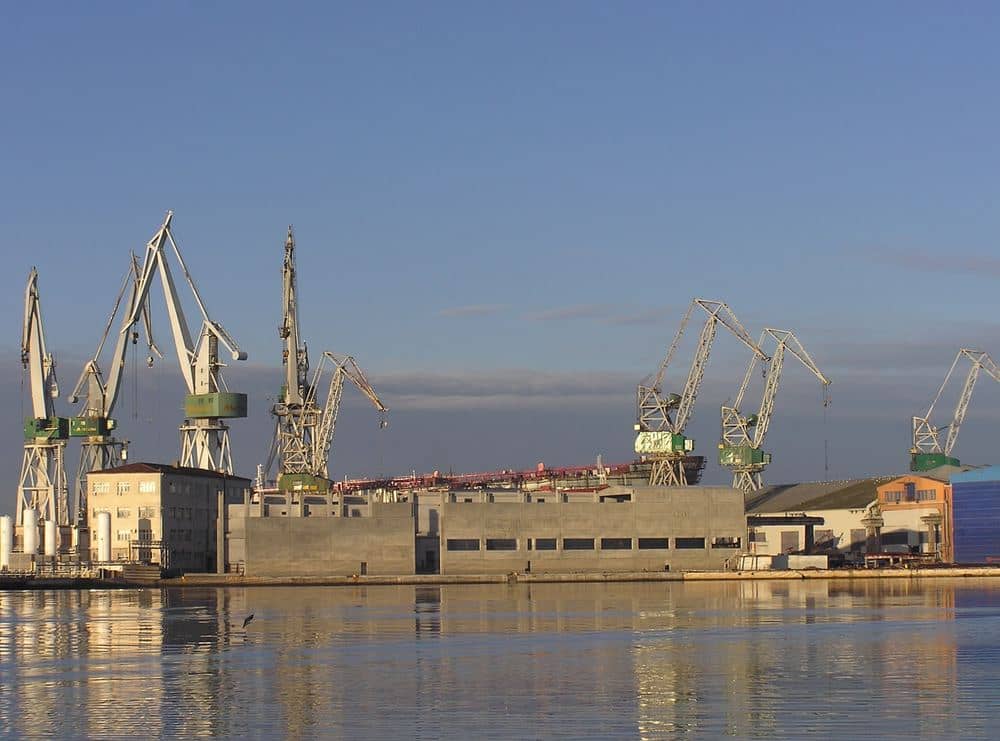
After dark the 8 cranes of the Uljanik shipyard across the harbour light up in changing colours. The lighting designer Dean Skira created the installation in 2014, and it is the largest light installation on the Adriatic. The programme runs from dusk and changes through the hour, from gold to violet to the full spectrum, doubled in the water of the bay. The shipyard dates from 1856, when it was founded for the Austro-Hungarian war harbour, and it ranks among the world's oldest shipyards in continuous operation. There is no ticket. Watch from the benches on the waterfront promenade in the first hour after sunset, around 21:00 in summer. Photographers should come early in the evening, before harbour traffic breaks the reflection.
Valkane Beach
Valkane is the town beach, 10 minutes from the centre at the start of the Lungomare promenade, and the people swimming here mostly live in Pula. The shore is a mix of concrete sunning decks, stone slabs and shingle entries, and the sea is clean despite the closeness of the town. Facilities are urban: showers, cabins, lifeguards in summer, a café and sports grounds at the back. Valkane is also the most accessible beach in Pula, with ramps and a hoist for people with disabilities. From here the Lungomare runs for kilometres along the shore towards Stoja, so a walk and a swim combine easily into an afternoon. Come at 19:00 in summer, when half the town is in the water.
Hawaii Beach (Verudela)
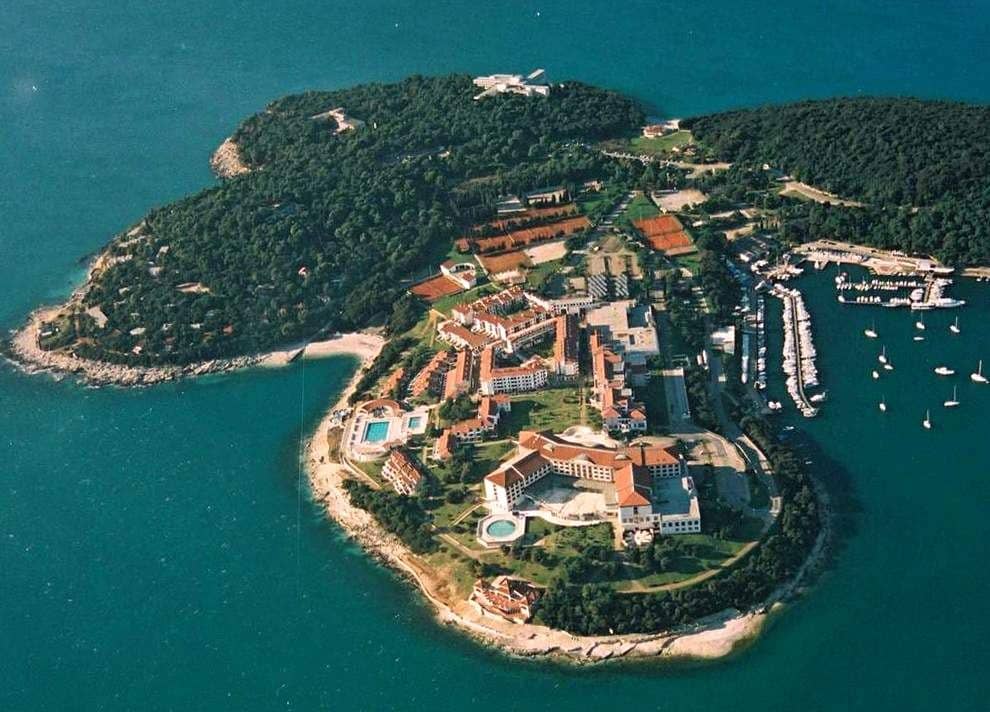
Havajka, officially Hawaii, is a small cove under a cliff by the hotel cape on Verudela, about 100 m of fine shingle with turquoise water over a white bottom and a few rocks to jump from. You reach it by steps from the Verudela promenade. The beach fills quickly: mornings belong to families, afternoons to jumpers and music from backpacks. Facilities are a shower, sunbed hire on part of the beach and a café on the rock above, so bring everything else. The sea deepens fast, which suits swimmers better than small children. Come before 10:00 or after 17:00, because at peak time there is no room. Water shoes help on the rocks, and the cliff above gives the best view of the colours.
Rt Kamenjak Cliff Trail
Cape Kamenjak, the southern tip of Istria beyond Premantura, is about 30 minutes from Pula. It is a protected landscape, and kilometres of gravel tracks run along the top of white cliffs through low maquis and dry-stone walls, with a view that reaches Cres and across the Kvarner on clear days. Locals jump from the cliffs at the southern end, which is best left to people who know where the bottom is safe. There is no shade and no water on the trail, so carry a hat, litres of water and firm shoes, and walk early or towards evening in summer. Cars pay to enter the protected area. Walkers and cyclists enter free from Premantura. A safari bar sits in the greenery, and the sea is the cleanest near Pula.
Fort Punta Christo
Fort Punta Christo stands on the cape above Štinjan and was built at the end of the 19th century to guard the entrance to Pula harbour. It is the largest fort of the Austro-Hungarian ring, with dozens of rooms and gun positions around inner courtyards. Electronic music festivals have made it known across Europe, and hundreds of thousands of dancers have passed through its casemates. Outside festival dates you can walk the ramparts, with views to the Brijuni islands and the harbour mouth, and find a bar at the top when the season allows. It is half wild, so wear good shoes and use your phone torch in the darker corners. You reach it by car or bicycle via Štinjan, and the low evening sun turns the stone golden.
Brijuni National Park
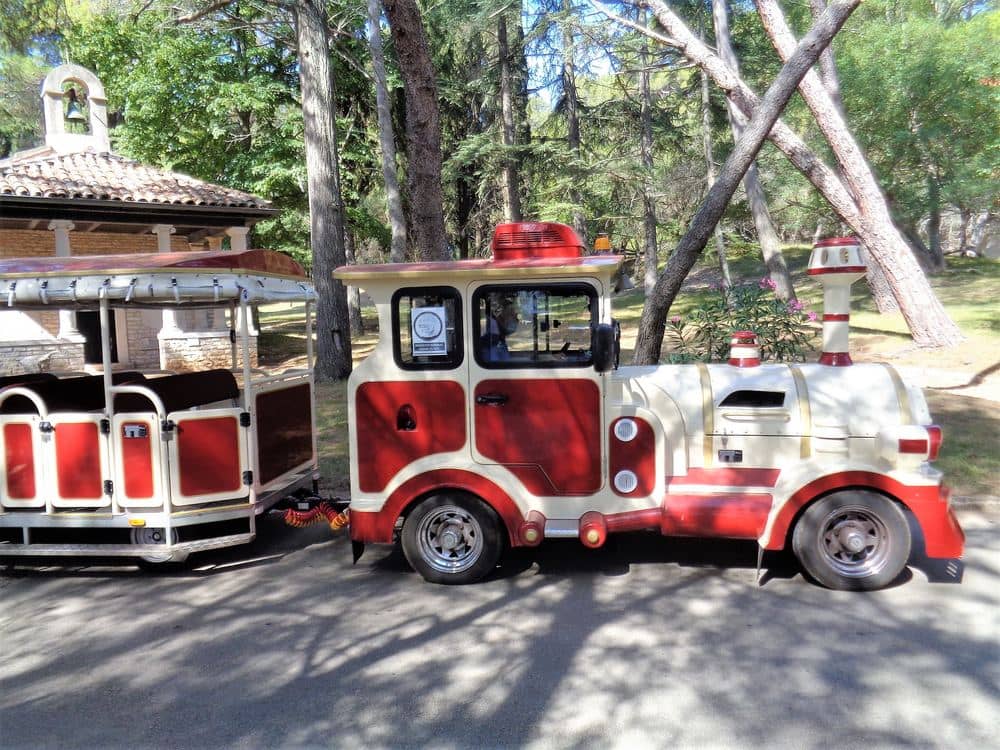
Brijuni is a group of 14 islands off Fažana, a national park since 1983. For 30 years before that Veli Brijun was the summer residence of Josip Broz Tito. From that period remain the safari park with zebras, llamas and other gifts from non-aligned friends, white deer grazing beside the paths and a museum of photographs. Older layers survive: the remains of a Roman villa lie in Verige bay on the western shore, and dinosaur footprints from the Cretaceous are pressed into the rock at several spots. The standard visit from Fažana includes a ride on the tourist train, the museum and free time, so count on half a day. A hired bicycle or electric buggy lets you set your own pace. Shade is scarce, so bring a hat.
Frequently asked questions
- How much does the Arena of Pula cost?
- Ten euros for adults and five for pupils and students, according to the Archaeological Museum of Istria. The same ticket includes the permanent exhibition in the underground passages.
- What is under the amphitheatre?
- A subterranean chamber that now holds a permanent exhibition on olive oil and wine production in Istria, with reconstructed presses and amphorae. It is part of the standard ticket.
- Is the arena open during concerts?
- Not normally. The amphitheatre is still an active venue, and on concert and festival days the visiting hours are shortened or the site closes to visitors. Check the programme before fixing a date.
Official sources
Share this guide
Questions about your trip?