Vis was a closed military island until 1989, and that is precisely why it still looks the way it does. Two towns, one ancient Greek layer and a coast you reach by boat or not at all.
Checked: 21 September 2026
Vis is the furthest inhabited Croatian island from the mainland, about 45 kilometres out, and for four decades it was a Yugoslav military zone closed to foreign visitors. That closure did what no preservation order could: it kept the hotels away until 1989. What you see today is an island with two real towns rather than a resort strip, a Greek foundation older than any other city on the Adriatic, and a coastline where the best places still have no road to them.
Vis town: Issa underneath, Kut alongside
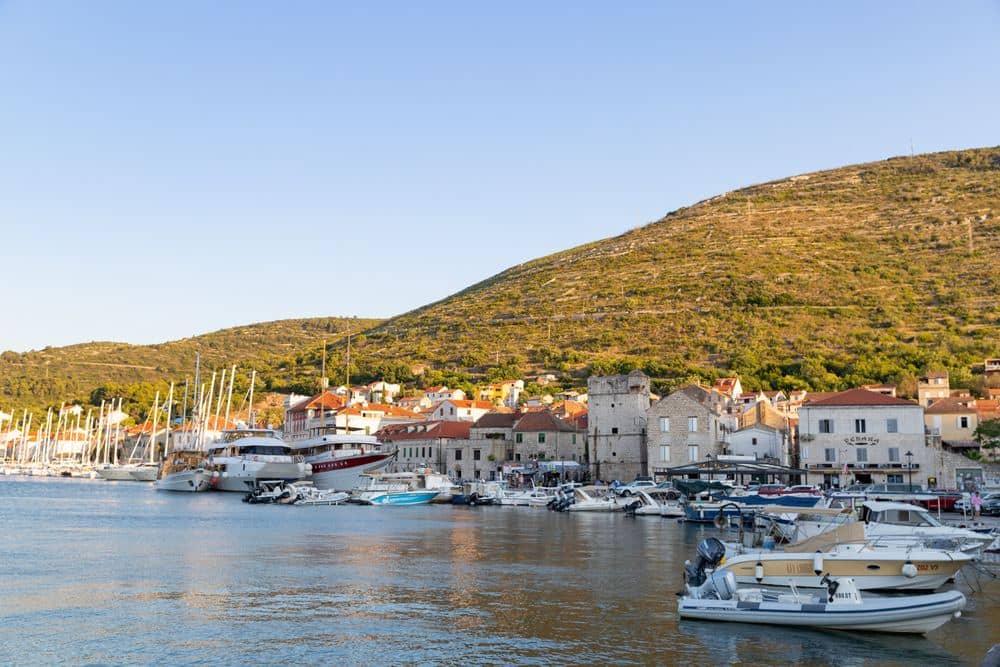
Greek settlers from Syracuse founded Issa here in 397 BC, which makes it the oldest urban settlement on the eastern Adriatic. The remains are modest and scattered rather than monumental: sections of wall, a theatre outline under the Franciscan monastery on the Prirovo peninsula, and the finds gathered in the archaeological museum in the old Austrian battery. Walk the bay eastwards into Kut, the quarter of sixteenth and seventeenth century captains' houses, and you cross about two thousand years in twenty minutes. Kut is also where the town still feels lived in rather than serviced.
- Book the car ferry from Split well ahead in July and August, or come as a foot passenger and rent a scooter on the island.
- Stiniva cannot be reached by a normal boat landing and the descent on foot is steep and rough. Wear real shoes or take an organised boat.
- The Blue Cave on Biševo is best between roughly eleven and one, when the light enters. Queues are managed and can be long, so go early in the window.
- Cash is still useful in Komiža and at the smaller beach bars. Not every place takes cards, especially outside the main season.
Fort George and what the military left behind
The British built Fort George above the harbour in 1813, during their brief occupation of the island, and it is now restored and open with a bar and a view over the bay. It is the easiest of the island's military layers to visit. The rest is stranger and more interesting: submarine tunnels cut into the rock at Parja, artillery positions along the coast, and Tito's cave on Mount Hum, the command post used by the Partisan leadership in 1944. Hum itself is the island's high point and the drive up is worth it at the end of the day even if you skip the cave.
Komiža is the other half of the island
Ten kilometres across the island, Komiža faces west and works completely differently from Vis town. This was a fishing settlement, and the falkuša, the local sailing boat built for the run out to the fishing grounds around Biševo, is its symbol. The fishing museum sits in the Venetian tower on the waterfront and takes half an hour. Stay for the sunset, because Komiža gets it and Vis town does not. Most visitors sleep on one side and never properly see the other; if you have two nights, split them.
“The army closed Vis for forty years and accidentally saved it. Everything people like about the island now is what nobody was allowed to build on.”
Two nights is the minimum that makes the ferry worth it. Day one for Vis town, Issa and the fort, day two for Komiža and a boat out to Stiniva, Biševo or the caves. Add the beaches as you go: Stončica for shallow water and families, Srebrna for stones and clear depth, Rukavac and Milna for the south coast. Nothing on Vis needs to be rushed, and the island is not built for it anyway.
Getting around the island
The ferry lands in the centre of Vis town and everything starts from that pier. A local bus crosses to Komiža and is timed to the ferry, which is enough if you sleep in one of the towns and use boats for the coast. For the south coast bays you need your own wheels. Desks near the pier rent scooters and small cars, and in July and August it pays to reserve before you sail. The roads are narrow, climb steeply out of both towns and never follow the shore: to reach Rukavac or Milna from Vis town you drive inland over the saddle and down again. Cycling works in spring and autumn, but the climbs are long and there is little shade.
More beaches and how to choose
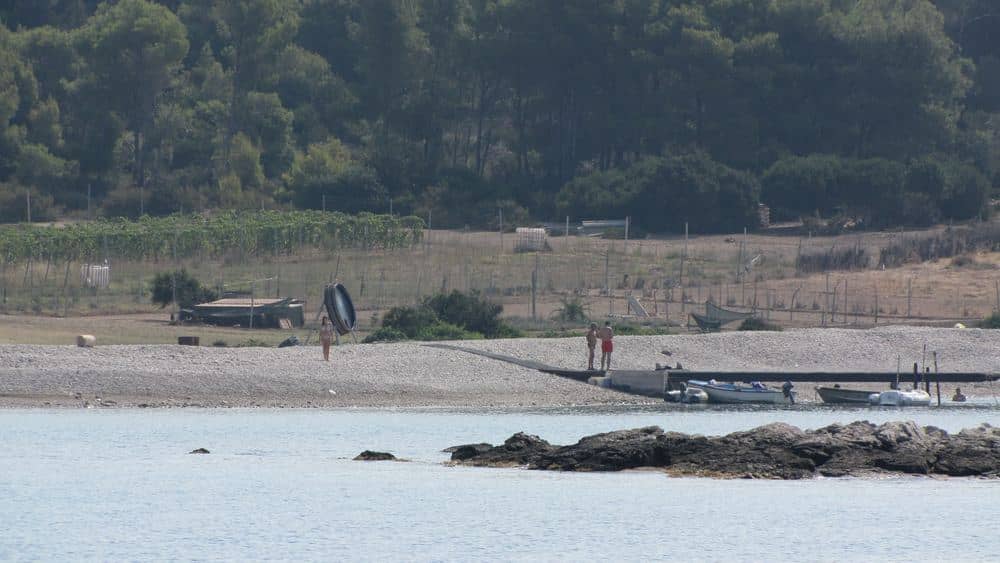
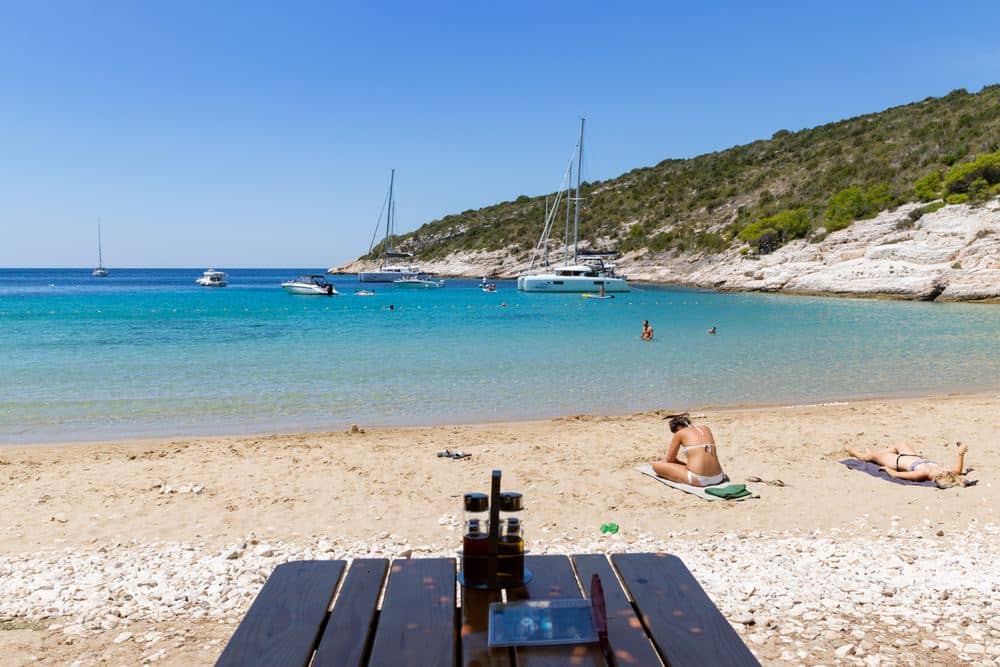
Stončica, Srebrna, Rukavac and Milna are the names everyone knows, and the rest of the coast fills in around them. Nearest to the pier is Zmorac on the western side of the harbour, a few minutes on foot and fine for a first swim. Grandovac, just east of Kut, has pines that shade the shingle for most of the day, which is rare here. On the south coast Tepluš faces the open sea and runs colder and clearer than the sheltered bays, while Barjoška beside it has pale shingle, a gentle slope and the tiny cove used in 2017 for the second Mamma Mia film. The Budikovac lagoon, a waist-deep strip of sand between 2 islets off the south-east coast, is a boat stop with no road to it.
| Beach | Where | Shore | Best for |
|---|---|---|---|
| Zmorac | west side of Vis harbour | fine shingle, concrete platforms | a swim on arrival day |
| Grandovac | just east of Kut | shingle under pines | shade, staying in town |
| Zaglav | east coast, between Milna and Stončica | shingle, sheltered by capes | calm sea when the wind blows |
| Tepluš | south coast, near Rukavac | narrow shingle, open sea | strong swimmers, clear water |
| Barjoška | south coast, west of Rukavac | pale shingle, gentle slope | families, the Mamma Mia cove |
| Budikovac | islet off the south-east coast | sand, waist deep | wading, by boat only |
| Porat | south-west Biševo | sand, shallow | pairing with the Blue Cave |
Green Cave, Budikovac and Biševo
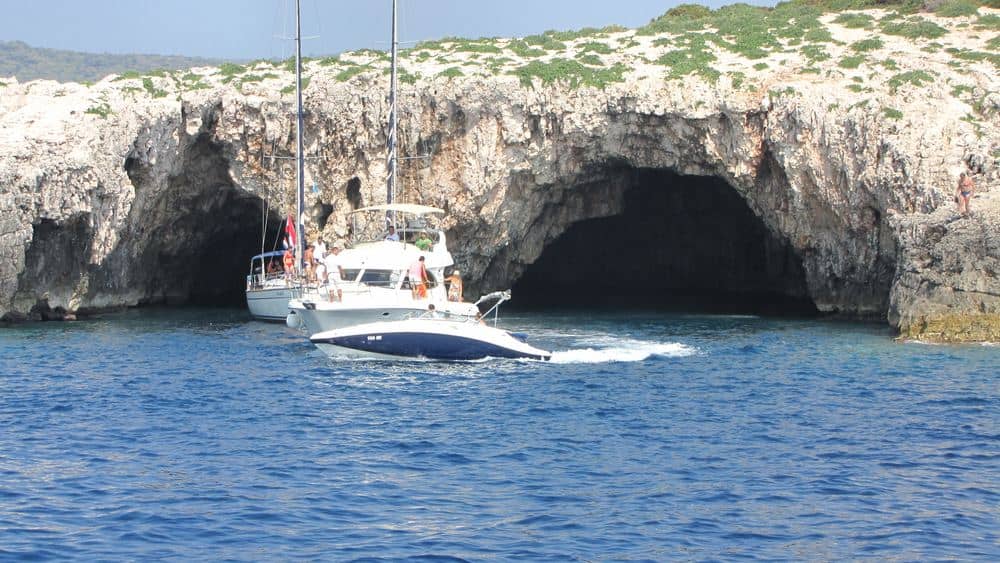
The Green Cave on Ravnik, the low islet off the south coast, needs less planning than the Blue Cave. Light enters through a hole in the roof, falls straight onto the water and turns it green, and around midday a bright column reaches the bottom. Boats from Rukavac and Vis town get there in minutes, often on the same run as Budikovac and Stiniva. Biševo has more than its cave: steep shores with further sea caves, vineyards of plavac, some 50 residents in summer and, at Porat on the south-western side, the island's only real sandy beach, shallow and sheltered. Pair the Blue Cave in its morning window with an afternoon at Porat and the crossing earns its time.
When to go, month by month
May and June suit most visitors: the sea is warm enough by early June, the boats to Biševo and Stiniva are running and both towns are still calm. July and August are full, ferry car places sell out and the south coast bays fill by late morning. September is the month islanders will tell you to come, with the sea at its warmest, the boats still going and the fields picking grapes and figs. October still works for the fort, Hum and Kut, but boat trips depend on the weather and the smaller beach bars close. Between November and April the island runs on its ferry, its 2 towns and a few taverns, which suits walkers and quiet stays.
Where to stay on Vis
Vis town splits into Luka, the western half around the pier, and Kut, the eastern quarter of stone captains' houses. Luka is the practical choice if you arrive late or leave early on the ferry, with the bus stop and rental desks at hand. Kut is quieter, has the better lanes for an evening walk and puts Grandovac a short walk away. Komiža suits anyone whose main aim is the Blue Cave, since the excursion boats to Biševo leave from its waterfront. Rukavac and Milna on the south coast are for people with a car who want to walk to the water and do not mind driving to dinner. Families with small children usually stay in town and drive out to Stončica for the sand.
Common mistakes
Most of what goes wrong on Vis comes from treating it like a mainland resort. The island has no coastal road, no airport, one link to the mainland and a coast that works on wind and light. Plan the boat days first, because they are the ones the weather can take away, and keep the fort, Kut, Hum and the morning markets in Vis town and Komiža for the days when the sea is up. The rest is a short list of things people learn on day 2.
- Expecting a coastal road. There is none, every trip between bays goes inland and uphill, and a 5 km hop can take 20 minutes.
- Planning to swim in the Blue Cave. Visits are by small boat, swimming inside is not allowed and the cave closes when the sea is rough.
- Arriving in August without a scooter or car reserved. The desks by the pier have a small fleet and the ferry unloads everyone at once.
- Leaving the fish market until mid-morning. It opens when the boats come in and closes once the catch is sold.
- Counting on shade. Apart from Grandovac most bays have almost none, so carry water and something to sit under.
- Treating the catamaran as a fallback. It carries foot passengers only, seats are limited and it is cancelled in strong wind before the car ferry is.
The places, one by one
| Place | What it is | Time needed |
|---|---|---|
| Vis Harbour | 2 km bay with a waterfront walk | 30 minutes |
| Vis Market | produce and wine market | 20 minutes |
| Gospina Batarija Archaeological Museum | finds from Issa in a gun battery | 1 hour |
| Prirovo Peninsula | monastery built on the Greek theatre | 30 minutes |
| Host Island | islet of 2 naval battles | 1 to 2 hours by boat |
| Parja Submarine Tunnel | navy tunnel cut into the rock | 1 hour by boat |
| Stončica Beach | sandy family bay | half a day |
| Rukavac Bay | south coast village and boat base | 1 hour |
| Srebrna Beach | white pebbles, deep water | half a day |
| Stiniva Cove | collapsed cave with a beach | 2 to 3 hours |
| Tito's Cave | partisan headquarters of 1944 | 30 minutes |
| Hum Viewpoint | summit at 587 m | 1 hour |
| St Nicholas Monastery Komiža | fortified monastery above the town | 45 minutes |
| Komiža Castle | fort of 1585 with the fishing museum | 30 minutes |
| Blue Cave | sea cave on Biševo | half a day |
Vis Harbour
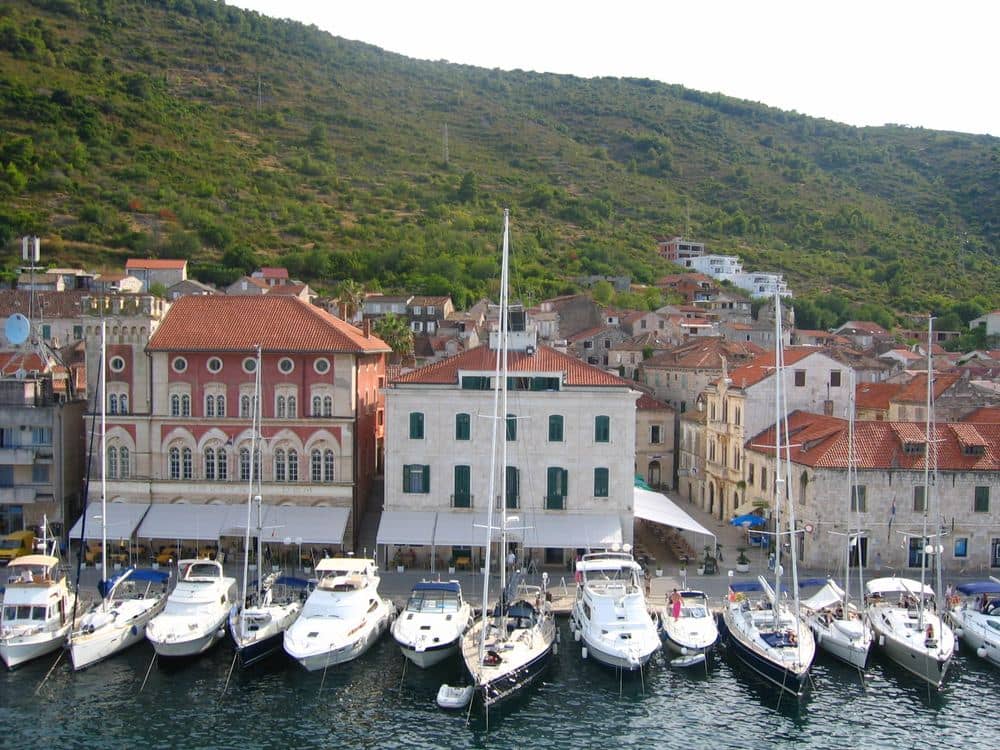
The bay that holds Vis town is more than 2 km long, narrow and open only to the north, so the sirocco never gets in. That shelter is why the Greeks chose the site, and it still counts: ships bound for Split come in here when the sea is rough. Along the shore run the waterfront, the taverns and the cafes, with yachts and fishing boats side by side at the berths. The walk from the western end of Luka to the last houses of Kut follows the whole shore and takes about 30 minutes. Do it toward evening, when the waterfront is at its liveliest and the light comes down the bay.
Vis Market
The town market works on a small square by the waterfront from early morning until noon. The offer is what the island grows: tomatoes, courgettes, chard and potatoes from the fields, figs and grapes in late summer, rosemary, sage, honey and olive oil. The wine matters most. Vis is known for plavac mali and for vugava, a white variety that grows almost only on this island, and a bottle bought straight from the producer is often found nowhere else. Prices are lower than in the shops, and the choice depends on what each seller brought that morning. The whole market is covered in a few minutes. On Sundays it works shorter hours or closes, depending on the season.
Gospina Batarija Archaeological Museum
Gospina batarija is a 19th century gun position above the harbour, a low stone building with an embankment toward the sea and rooms for crew and ammunition. It takes its name from a church nearby. Once it lost its military use it was restored and given to the Archaeological Museum of Vis, which keeps the finds from Greek and Roman Issa: pottery, coins minted at Issa, jewellery, stone fragments and objects lifted from the seabed around the island. The display explains how people lived in the ancient town and how trade moved along the Adriatic. The museum is small, the visit takes about an hour and the ticket is cheap.
Prirovo Peninsula
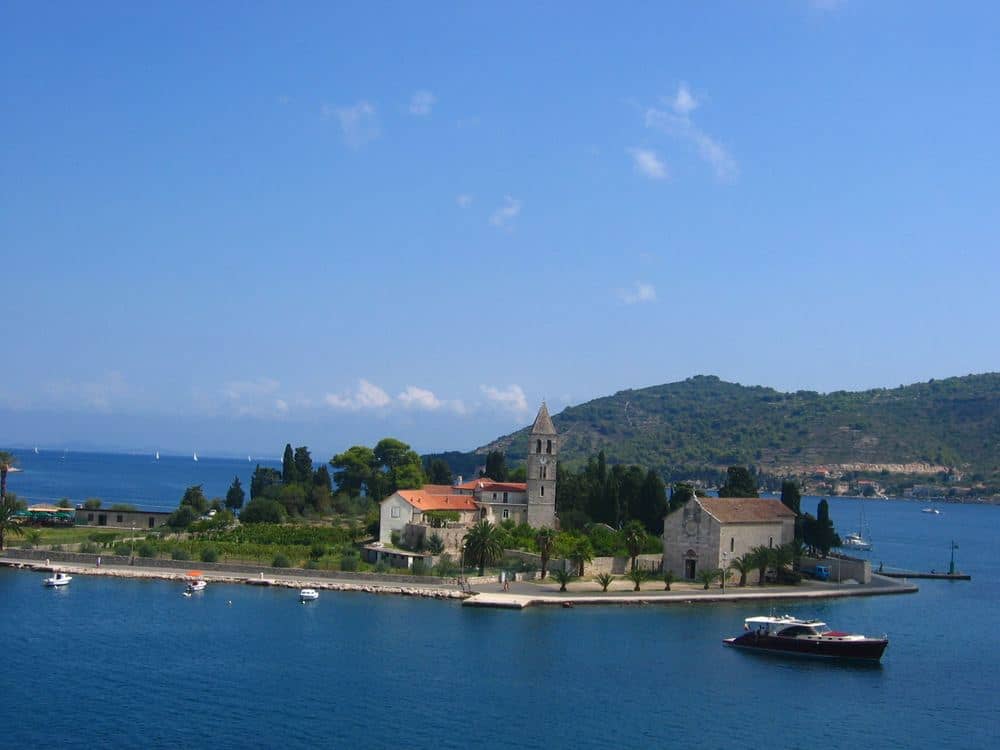
Prirovo is the low, pine-covered peninsula that pushes into the bay and splits it into 2 coves. The Franciscan monastery and its church of St Jerome stand on it, raised in the 16th century on the foundations of the ancient theatre. The houses around the monastery follow the old auditorium in a gentle arc, which is clearest from the sea or from the air, and on the ground shows as a single curving street. Beside the monastery is the cemetery, with the tombs of seafaring families and a monument to those who fell in the naval battles off Vis. A promenade circles the peninsula with the whole harbour in view. From the centre it is a walk of 10 minutes.
Host Island
Host is the small, uninhabited islet in front of the harbour entrance, and its name comes from naval history. In 1811 a British squadron under William Hoste defeated a much larger French and Italian force in the waters around it, and the islet was named after him. In 1866 the battle of Vis was fought off the same rocks, when the Austrian fleet under Wilhelm von Tegetthoff sank 2 Italian ironclads, the last great sea battle decided by ramming rather than by guns. Today the islet carries low scrub and a lighthouse. Boats from the harbour tour it, you can swim off the rocks, and landing depends on the wind.
Parja Submarine Tunnel
The tunnel in Parja cove is one of several submarine shelters cut into the coastal rock while the island was a closed military zone. Between the middle of the 20th century and 1989 Vis served as a base of the Yugoslav navy, and in those years tunnels, shelters, gun positions and underground depots were built across the whole island. This one is large enough for a small submarine or a boat to enter, it is concreted, and its far end is sealed inside the rock. You go in by boat, by kayak or swimming. Inside it is cold, dark and quiet, and the water is unusually clear. Excursion boats from Vis call here. In your own craft, take care at the narrow entrance.
Stončica Beach
Stončica sits at the north-eastern end of the island and is one of the few sandy bays on Vis. The bottom is sand, you wade a long way out and the water warms fast, which is why it counts among the best bays in the central Adriatic for small children. The bay is drawn deep in and sheltered on both sides, so the sea stays calm even when it blows outside. A pinewood stands above the beach, a fish tavern works in the bay and a 19th century lighthouse marks the cape beyond. A taxi boat from Vis takes about 15 minutes, or you drive and walk the last 10 minutes on a path. Parking is limited. In July and August come in the morning, when the bay is empty.
Rukavac Bay
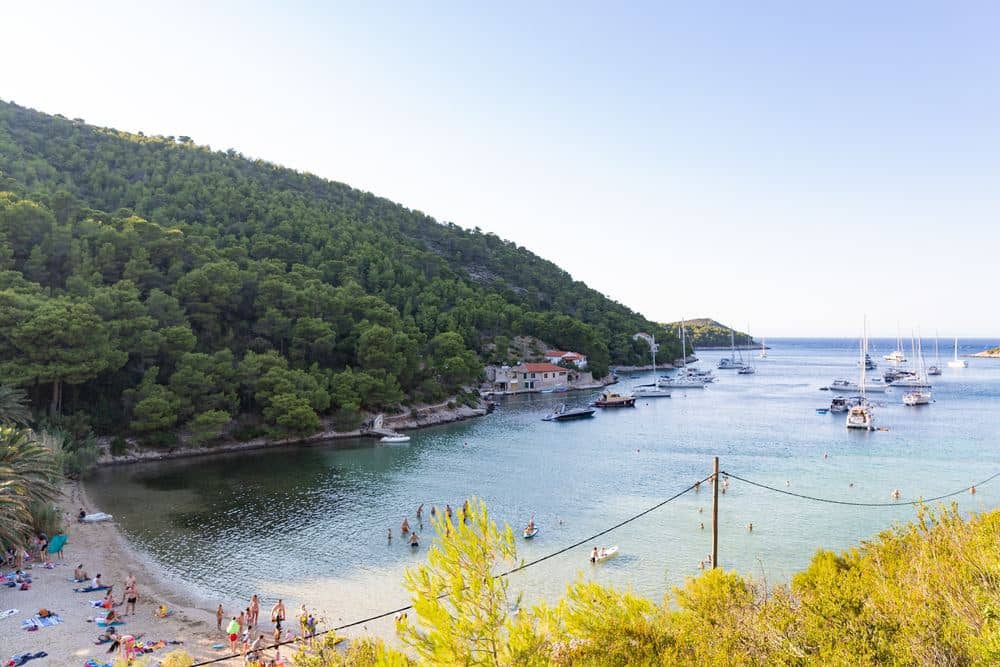
Rukavac is a settlement of some 30 houses along a bay on the south coast, with a small harbour for boats and a few taverns. It began as a fishing shelter for an inland village whose people came down here to the sea, a pattern repeated across the Dalmatian islands. Today it is the base for the southern coast: Ravnik and Budikovac are nearest from here, and taxi boats run several times a day in season. The bay itself has a shingle bathing place with calm water and rocky sections where people jump in. From Vis town it is 8 km across the middle of the island. Parking in the village is limited, so arrive early.
Srebrna Beach
Srebrna lies west of Rukavac and takes its name from the white, smooth pebbles that look silver in the sun. The pebbles are large and rounded, and the bottom drops away quickly, so this is a beach for confident swimmers. Children with less experience in the water do better in the shallow bays on the eastern side of the island. The sea is markedly clear, since there is no sand or river silt, and the rocks and pines give shade only late in the afternoon. You reach it by a gravel track from the main road and the last few hundred metres on foot, or by boat from Rukavac and Vis. A small bar works in season and there is little else, so bring water, food and water shoes.
Stiniva Cove
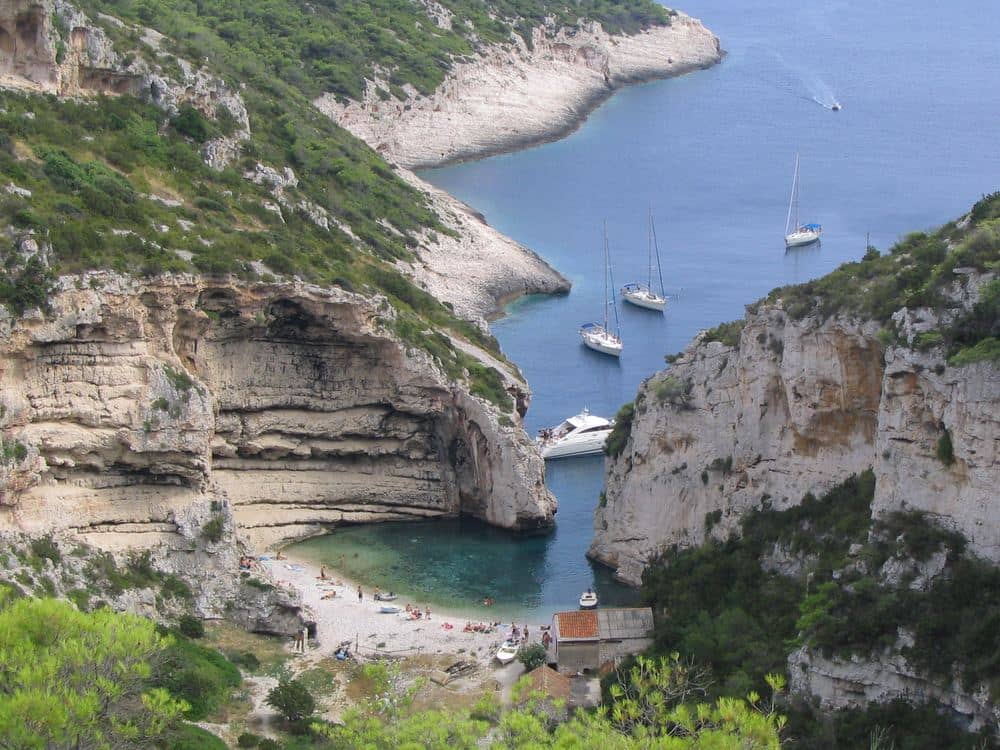
Stiniva is a former cave whose vault fell in, leaving a small shingle strand closed on every side and a gap toward the sea only a few metres wide between the cliffs. In 2016 it was declared the finest beach in Europe, and excursion boats have stopped here ever since. You arrive by boat from Vis or Komiža, or on foot from the road above by a path that descends steeply in about 20 minutes. The climb back needs water and a good sole. The cove falls into shade in the afternoon, when the sun goes behind the cliffs, and it is quietest early in the morning before the first boats come in.
Tito's Cave
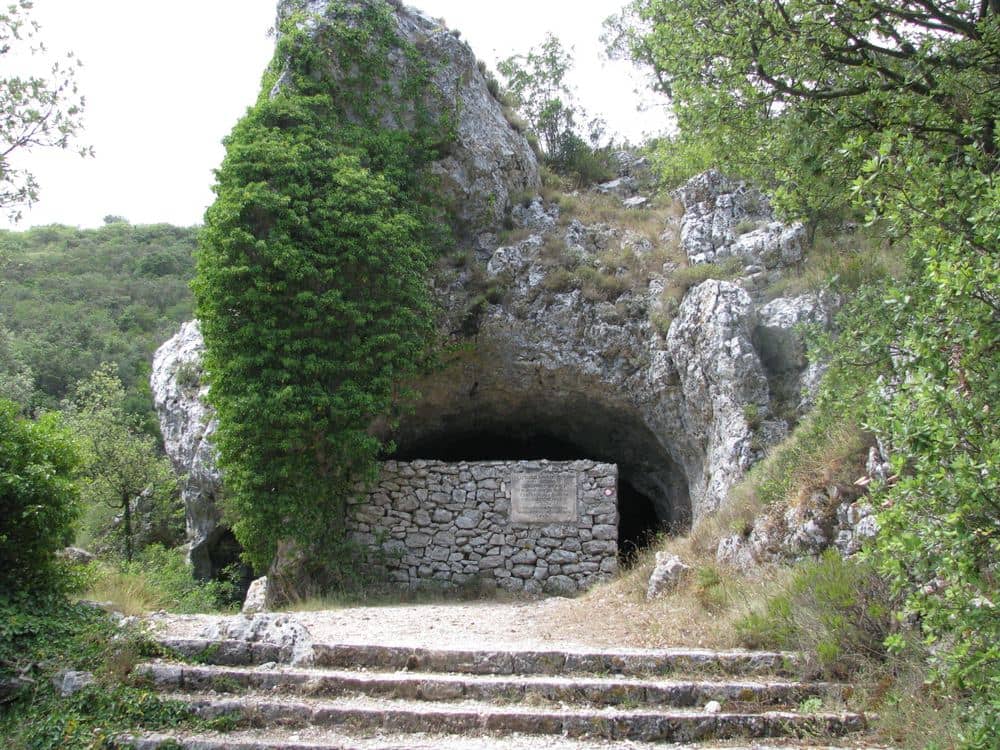
Tito's Cave is a natural cavern on the slope of Hum above Komiža. From June to September 1944 it housed the supreme command of the partisan movement, after Josip Broz Tito left Drvar following the German landing there in May 1944. That year Vis was the only part of Croatia under continuous partisan control and Allied protection, with an airstrip, a hospital and radio links to London and Cairo. Tito's office and quarters were inside, and agreements with British envoys were signed here. Explanatory boards now stand in the cavern. The approach is a path from the road toward Hum, a climb of about 10 minutes. Entry is free. Bring a light and shoes with a good sole.
Hum Viewpoint
Hum is the highest point of the island at 587 m and rises directly above Komiža, so nearly the whole island lies below you: Komiža, Biševo, Sveti Andrija and Jabuka to the west, and on an exceptionally clear day the Italian coast across the open sea. On the summit stand the small church of the Holy Spirit and the remains of military structures from the closed years. The road up is asphalted, narrow and full of hairpins. The footpath from Komiža takes about 1 hour 30 minutes and passes Tito's Cave. The top is exposed to the wind and has no shade in summer, so carry water and a hat. Sunset is the moment, with the sun dropping into the sea behind Biševo.
St Nicholas Monastery Komiža
The monastery of St Nicholas stands on the hill above Komiža, on a spot that takes in the whole bay and the open sea toward Biševo. The Benedictines founded it in the Middle Ages, and in the 16th century it was fortified with a wall and a tower against pirate raids, which is why it looks more like a fortress than a monastery. St Nicholas is the patron of seafarers, a fitting choice for a fishing town. One custom here is found nowhere else: on 6 December, the feast day, an old wooden boat is burned in front of the church as thanks for safe returns and a farewell to a vessel that has served its time. From the town it is a climb of 20 minutes up steps.
Komiža Castle
The Kaštel was raised in 1585 right on the shore, at a time when pirate attacks were frequent and Komiža was wealthy from fish. It is Renaissance in form, with a massive square body and a round tower at the corner suited to firearms, from which the bay entrance and the approach to the shore were watched. During an attack the townspeople took shelter inside, and the communal store was kept here too. The building now holds the fishing museum. It stands at the end of the waterfront and is seen from outside at any hour, and the interior is entered with a museum ticket. Look for the falkuša replica inside. It opens mainly in summer, so check the hours.
Blue Cave
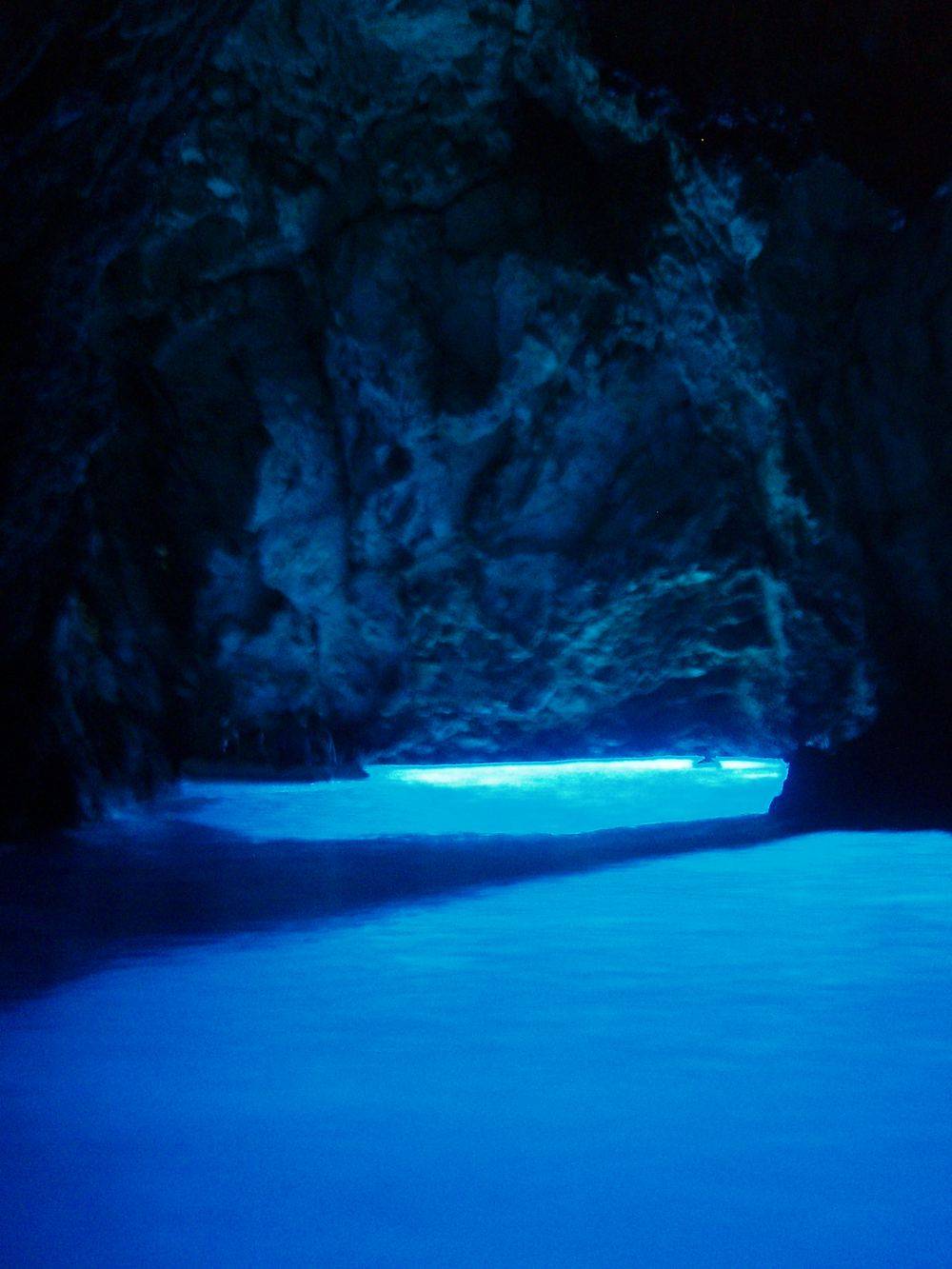
The Blue Cave lies in Balun bay on the islet of Biševo. Sunlight enters through an underwater opening on the southern side, reflects off the pale bottom and fills the chamber with a blue glow, while anything in the water turns silver. The cave is about 24 m long and the vault rises to 15 m. Until 1884 the only way in was to dive through the underwater passage. In that year, at the urging of the Austrian explorer Eugen von Ransonnet, an artificial entrance was cut, and that is the opening boats pass through today. You come on an organised excursion from Vis or Komiža, and the visit inside lasts only a few minutes, so the light on the day decides how good it is.
Frequently asked questions
- How do you get to Vis and how long does the ferry take?
- Only by ferry or catamaran from Split. The car ferry takes about two and a quarter hours, the passenger catamaran roughly an hour and a half. There is no airport and no bridge, and in July and August car places sell out days ahead, so book early or travel as a foot passenger and rent a scooter or car on the island.
- Is Vis worth a day trip from Split?
- Not really, and this is the one island where that matters. With four to five hours on the ferry there and back, a day trip leaves time for Vis town and little else, while Komiža, Stiniva and the caves all sit on the other side of the island. Two nights is the minimum that makes the crossing worthwhile. If you only have one day, an organised boat tour to the Blue Cave and Stiniva uses the time better than the ferry does.
Share this guide
Questions about your trip?