65th Concerts in the Euphrasian Basilica
- Date
- 7 August 2026
Plan a focused visit to Poreč's sixth-century UNESCO basilica, from the apse mosaics and Bishop Euphrasius's clues to the ciborium and bell-tower view.
Checked: 20 September 2026
Poreč gives the Euphrasian Basilica an unusually rich setting. Along with Pula, the town was among Istria's first Roman colonies, and its old centre still preserves the ancient street layout and remains of a Roman temple. Within that history, the sixth-century basilica is the landmark known worldwide. The Istria Tourist Board describes it as one of the best-preserved early Christian structures, and the complex joined the UNESCO World Heritage List in 1997. Begin with two time layers in mind: Roman Parentium outside, early Christian art inside.
Read Bishop Euphrasius's ambition in the building
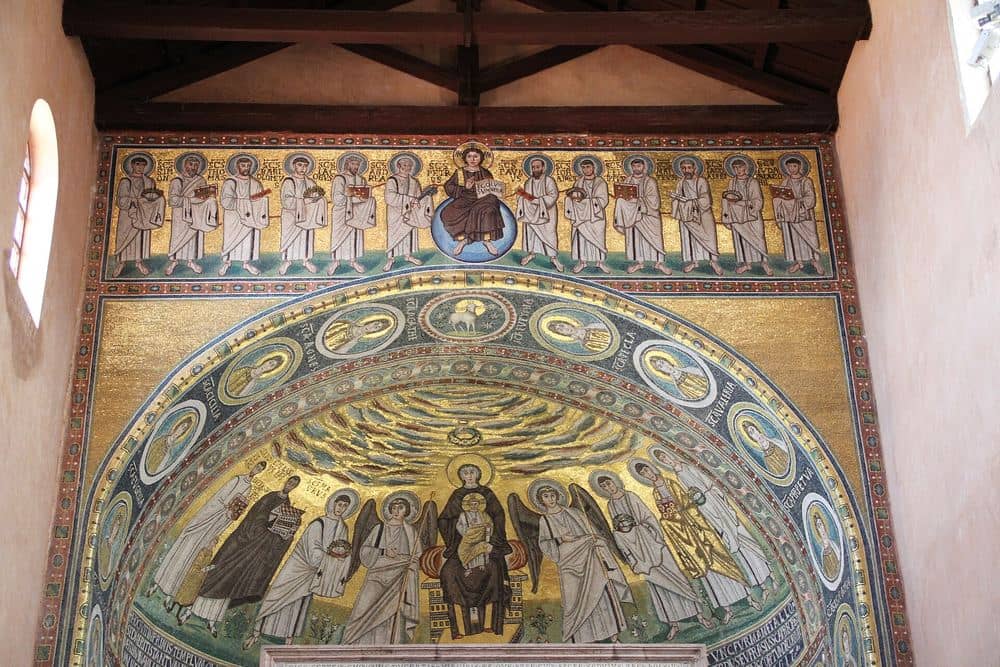
The present basilica was built in the first half of the sixth century on the remains of an earlier three-naved basilica, during the episcopate of Euphrasius. The official account presents a bishop inspired by Byzantine art who wanted to give provincial Parentium a lasting monument. His presence is visible: find his initials in prominent places, then Euphrasius among the figures in the apse mosaic. The building is therefore more than decoration. It is a statement about its builder, his town and the artistic world that inspired him.
- Start with the upper part of the apse. Its mosaics, assembled from coloured stones about fifteen centuries ago, are still remarkable for their brightness and freshness.
- Find the Virgin and Christ Child on the heavenly throne, surrounded by archangels and Saint Maurus, the patron saint of Poreč. Notice the Virgin's Byzantine clothing and veil.
- Shift to the triumphal arch. Female saints and Christ represented as a Lamb appear on its inner face, while Christ Pantocrator and the twelve apostles are pictured above.
- Move towards the ciborium, the stone canopy above the altar. Look upward again to see a starry sky formed from blue and golden stones.
Finish with context, not a rushed photograph
Leave time to look twice. From a distance, read the apse as a complete composition; from closer range, notice how small coloured stones still carry brightness after about fifteen centuries. The contrast between the monumental programme and its individual signs, including Euphrasius's initials and portrait, is the core of the visit. Visitor tours are possible except during religious rituals, so treat worship as the priority and be ready to adjust the order of your visit. If access is available, finish by climbing the steeple for a view across Poreč and its surroundings. Check the official visitor information before going because access arrangements can change.
Give the whole complex an hour
The ticket covers more than the church, and the buildings around it are the reason the complex is rare. In the apse, look left of the Virgin for Euphrasius holding a model of the church, the oldest such portrait of a donor in this part of Europe. The tesserae are glass paste and gold leaf, so the gleam changes with the hour: come in the morning, when light reaches the apse directly. The listed hours are 09:00 to 18:00, different in winter, so check before you fix a time. Then walk the rest: the atrium, the octagonal baptistery, the bishop's palace with its lapidarium and the bell tower, climbed by narrow steps. Allow an hour, more if you read every panel.
| Part | What it is | Worth knowing |
|---|---|---|
| Atrium | Open court in front of the church | The way in from the street, with the church front above it |
| Baptistery | Octagonal building opposite the church | The bell tower rises beside it |
| Bishop's palace | 6th century residence, now the museum | Lapidarium with inscriptions and mosaic fragments |
| Older floors | Floors of the churches that stood here before Euphrasius | Look for the fish, an early Christian sign |
| Bell tower | Built in 1522, climbed by narrow steps | View across the roofs to Sveti Nikola island |
How to get to Poreč
Poreč lies on the west coast of Istria. The nearest airport is Pula, about 60 km south. Trieste airport in Italy is about 110 km away and Zagreb about 250 km east. From each the onward leg is by bus or hire car. There is no railway, the Parenzana line to Trieste closed in 1935, so the bus is the practical public transport. Buses link Poreč with Pula, Rovinj, Rijeka, Zagreb and Trieste, and the bus station stands east of the old core, about 10 minutes on foot from the basilica. By car, leave the Istrian motorway at Baderna, about 10 km inland. The old core has no room for cars: park outside the walls and walk in. In summer a passenger catamaran crosses to Venice, with a schedule that changes each season.
Where to stay for an early start
Where you sleep decides how early you reach the apse. Lodging inside the old core puts you a few minutes from the door before the coach groups arrive, at the cost of noise and no parking. The hotel zones south and north of the walls are 10 to 20 minutes on foot along the sea. The resort settlements at the lagoons, 5 km south, suit families, and a boat or tourist train brings you to town in about 15 minutes. Out of season part of the resort offer closes, so check what is open before you book.
- Old core: apartments in stone houses a few minutes from the basilica, no car access, full in July and August.
- South of the walls: the hotel zone 10 minutes on foot from the centre, with the small town beach below the Valamar Parentino.
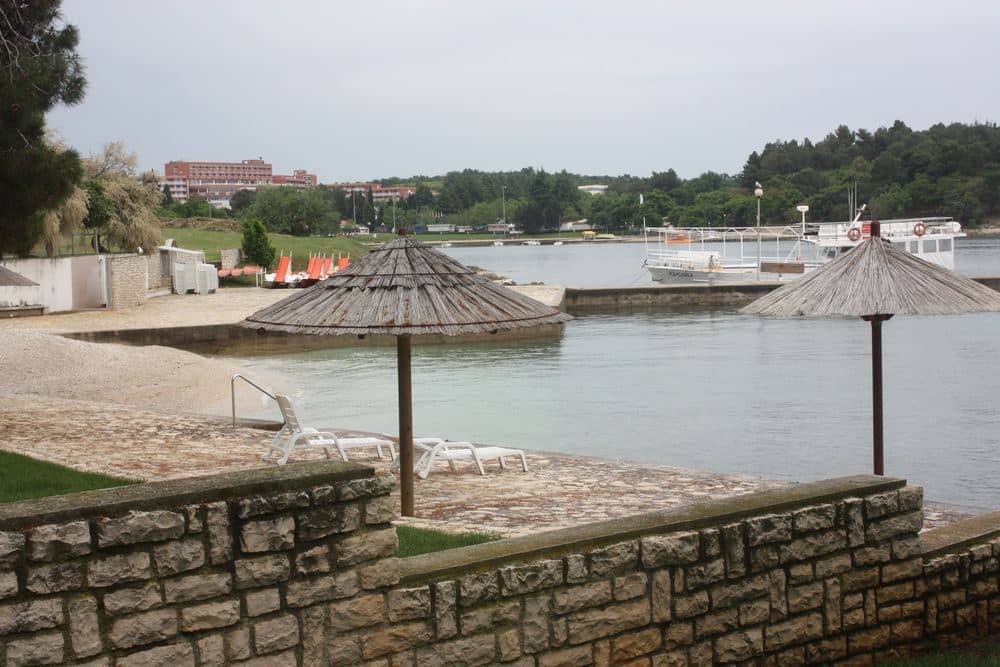
- Zelena Laguna and Plava Laguna: resort settlements 5 km south, built from about 1960, with shops, beaches, a boat and a tourist train to town.
- Lanterna: large campsites on a pine peninsula 15 km north, a 20-minute drive, a better base for the beach than for the basilica.
What else to see while you are there
The basilica stands a few steps north of the Decumanus, the Roman main street that still runs the length of the peninsula and is walked in 10 minutes. Along it, the Poreč Heritage Museum in the Baroque Sinčić palace, founded in 1884 and the oldest museum in Istria, shows the inscriptions and stone fragments of Roman Parentium that put the basilica's lapidarium in context, in about an hour. The Northern Tower, a few minutes from the basilica, and the Istrian Assembly Hall in a former 13th century Franciscan church open according to their exhibition and concert programmes.
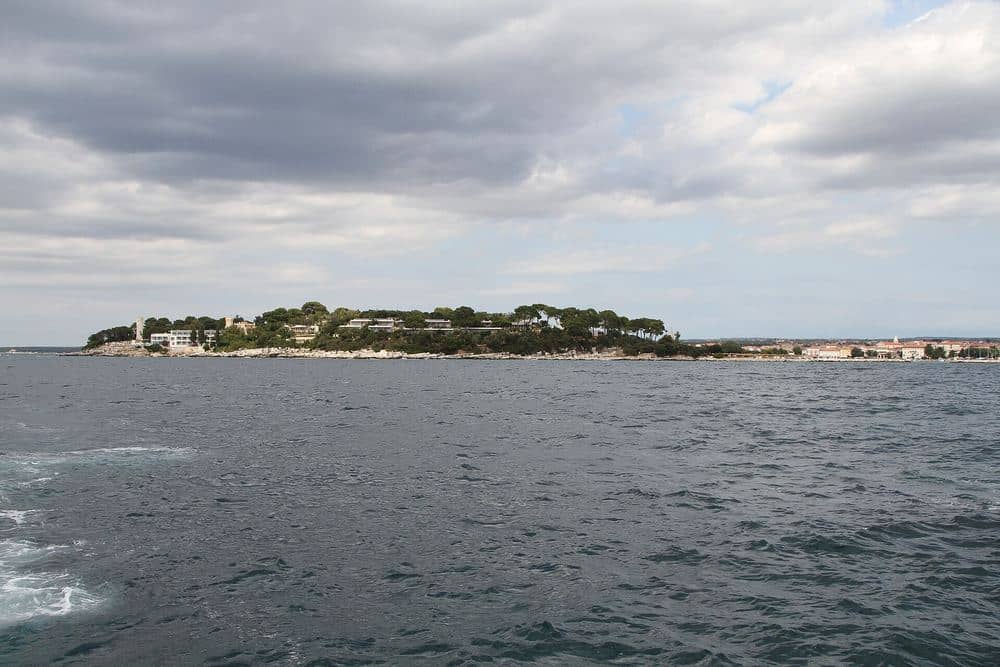
For the bell tower seen from outside, take the boat to Sveti Nikola island, 10 minutes from the Riva, with sailings every half hour in season and a cheap ticket valid both ways. The island takes its name from a medieval Benedictine monastery, and from its shore the whole old core lines up with the tower in the middle. Vrsar, 15 km south, belonged to the bishops of Poreč for centuries, who kept a fortified summer residence on its hilltop, and its church of St Mary of the Sea is from the 12th century.
Eating and practical notes
For lunch, the taverns along the Decumanus and the Riva serve Istrian cooking, and waterfront tables cost more than those a street back. If you cook for yourself, the fish market beside the town market near the harbour opens early and sells sole, hake, red mullet, scorpionfish, sardines and langoustines from the northern Adriatic until sold out, with a smaller choice on Mondays. The green market next to it has olive oil from family mills, cheese, prosciutto and truffles in season, and the best choice is before 09:00.
- Cover shoulders and knees, as in every working church in Croatia, and keep quiet if a service is under way.
- The bell tower is climbed by narrow steps and is not suited to anyone with limited mobility or a pushchair.
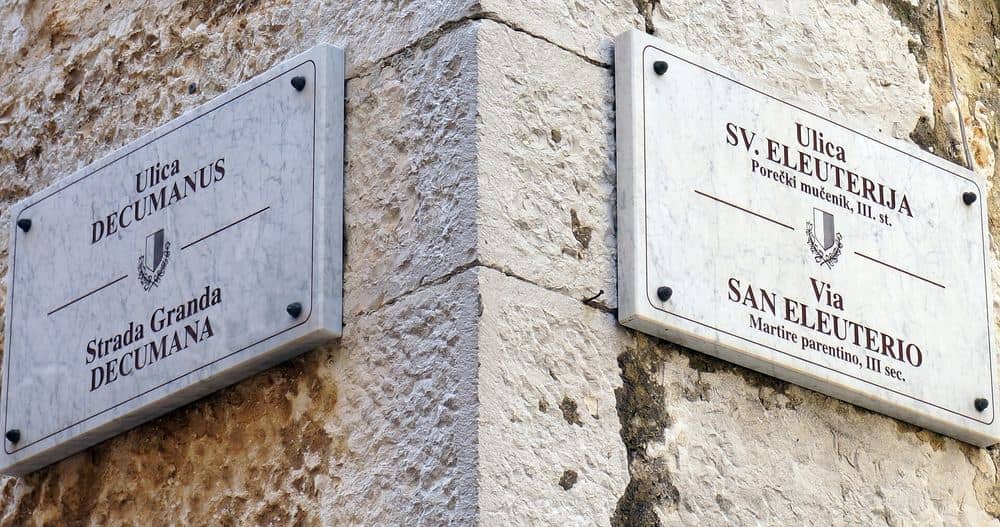
- Street signs are bilingual: Poreč and Parenzo name the same town, and Parentium was the Roman colony.
About the event
65th Concerts in the Euphrasian Basilica
Quinta Essentia and fortepianist Terezija Cukrov perform chamber music at 9 pm on 7 August inside Poreč's UNESCO-listed Euphrasian Basilica.
The series and the 2026 concert
The Concerts in the Euphrasian Basilica are a summer series of classical music held inside the 6th century church in the old core of Poreč. The 2026 edition was the 65th, and its chamber evening with the ensemble Quinta Essentia and the fortepianist Terezija Cukrov took place on 7 August at 21:00. The series returns every year around the same time, so a stay in early August has a good chance of catching a concert. The fortepiano is the lighter forerunner of the modern piano, and the stone nave carries it without amplification.
Seats are chairs set out in the nave, and the audience faces the apse with the mosaic of the Virgin and Child behind the players. Tickets are sold at the gate before the concert. Come early, because the basilica remains a working church and worship has priority, so timings can shift. By artificial light the gold leaf of the mosaics reads differently from daylight. To study them properly, return in the morning during normal opening, 09:00 to 18:00, when the light in the apse is best and one ticket covers the whole complex with the atrium, baptistery, bishop's palace and bell tower.
Poreč before the concert
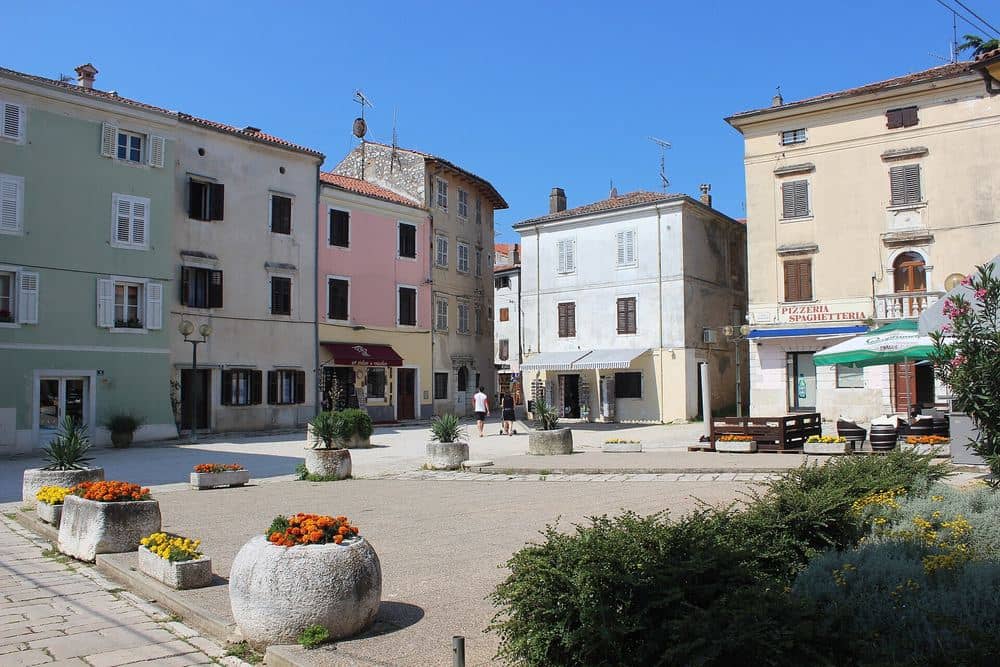
Give Poreč a slow afternoon before the concert. The Decumanus, the Roman main street, runs straight through the peninsula from the Pentagonal Tower to Marafor Square, and the walk takes 10 minutes without stops. Marafor is the old forum, with the foundations of the temple of Neptune, and it is best towards evening when the sun comes through the opening to the sea. The Round Tower and the Pentagonal Tower are both cafes now, and the terrace of the Round Tower looks across the roofs to the bell tower of the basilica. For a swim, the city beach starts behind the walls, and the boat to Sveti Nikola island takes 10 minutes.
Watch
Poreč on video
A short official city film to help you picture the place before you go.
Poreč: you complete us
Frequently asked questions
- Why is the Euphrasian Basilica in Poreč on the UNESCO World Heritage List?
- The complex is one of the best-preserved early Christian structures and a monument of global significance. It was inscribed on the UNESCO World Heritage List in 1997.
- What should I look for in the mosaics of the Euphrasian Basilica?
- In the apse, find the Virgin and Christ Child with archangels and Saint Maurus, as well as Bishop Euphrasius among the figures. At the triumphal arch, look for female saints, Christ as a Lamb, Christ Pantocrator and the twelve apostles.
- Can I tour the Euphrasian Basilica during a religious ritual?
- No. The official visitor information says tours are possible except during religious rituals. The steeple can also be climbed for views of Poreč and the surrounding area when access is available.
Official sources
Share this guide
Questions about your trip?