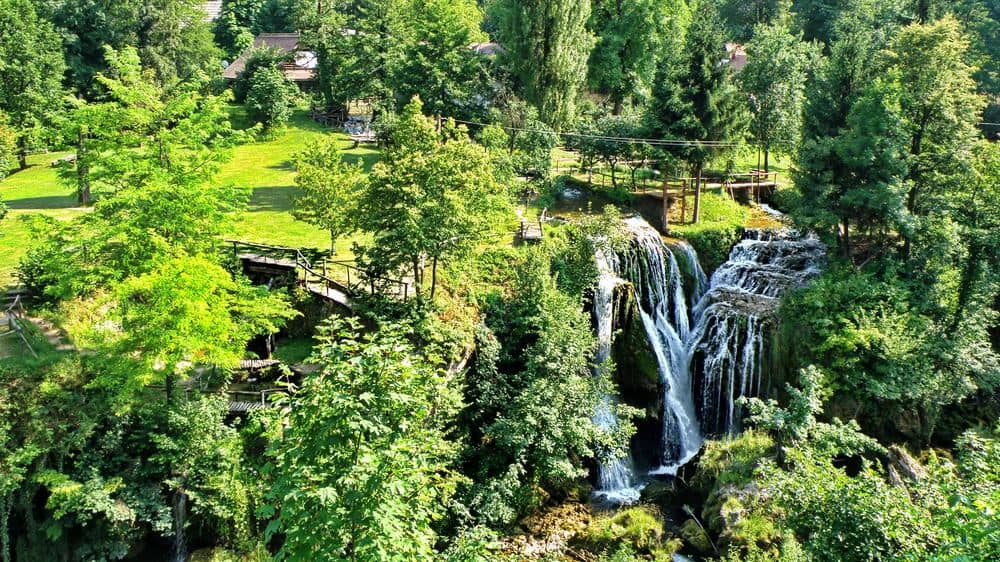
Where the Slunjčica drops over 23 travertine waterfalls into the Korana, 32.49 km from Plitvice. What is free and what costs 5 EUR, where to park, how the old spoon mills worked, and where to swim and eat.
Checked: 17 October 2026, 20:00
Rastoke is the old millers' quarter of Slunj, built where the Slunjčica river breaks up into dozens of channels and falls over travertine barriers into the Korana. It is often sold as Little Plitvice, which is accurate about the geology and misleading about everything else. Plitvice is a national park with ticket gates; Rastoke is a lived-in neighbourhood where the houses stand on the barriers, water runs under the floors and the millstone was once a household tool. Most visitors give it an hour on the way to the lakes. This guide explains what is free and what costs money, where to park, how far it is to Plitvice and how to turn a quick stop into a proper half day.
Rastoke at a glance
- Location: the Rastoke quarter of Slunj in Karlovac County, right on the D1 state road. The Slunj tourist board gives the distance as 104.38 km from Zagreb and 32.49 km from the Plitvice Lakes.
- Walk: the circular promenade is about 2.5 km long, and the tourist board suggests allowing 1 to 3 hours for it.
- Cost: walking through on the public road is free. The full loop over the new bridge and down the Vodene tajne path costs 5 EUR per person, or 9 EUR for a family ticket covering 4 people.
- Parking: 2.00 EUR per hour in Rastoke itself (zone 1) and 0.40 EUR per hour in the town zones 2 and 3, charged from 8:00 to 18:00.
- Tourist information centre: Rastoke 2, open Monday to Thursday 9:00 to 16:00, Friday and Saturday 10:00 to 16:00, closed on Sunday.
How the water built the village
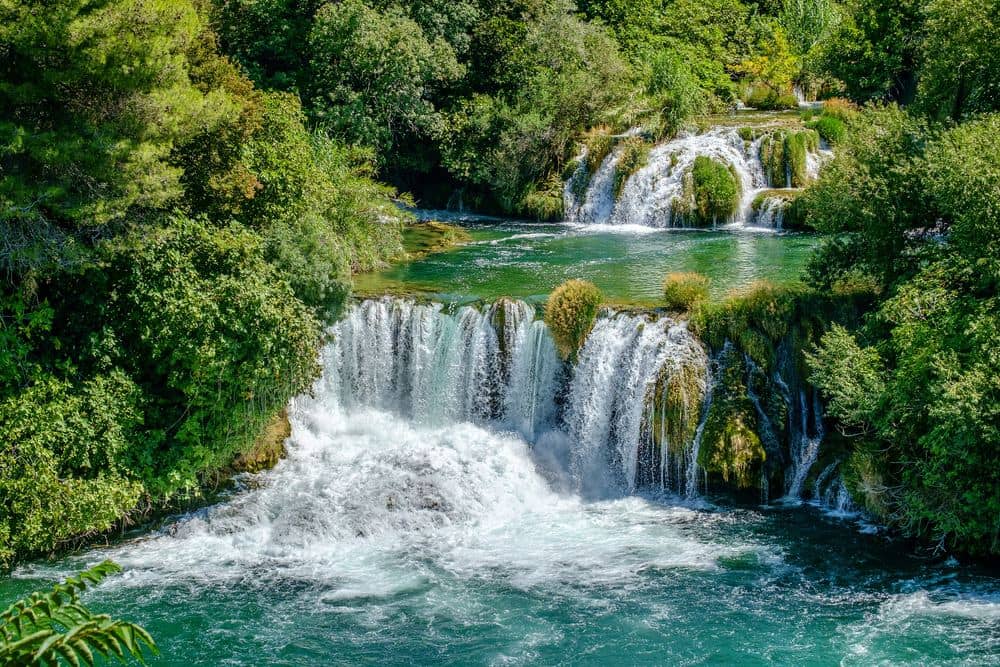
Above ground, the Slunjčica is only 6.5 km long. It rises from a lake-like spring below the village of Slušnica, cuts a deep canyon and, at Rastoke, splits into branched waterfalls that drop into the Korana. Hrvatska enciklopedija gives their height as 22 to 25 m. In its upper course the river is called Jesenica (Jasenica). From the village of Lička Jesenica to the village of Slušnica it flows underground for 14 km. The water carries dissolved limestone, and where it speeds up and mixes with air, calcium carbonate settles as travertine, the same porous rock that builds the barriers at Plitvice. The barriers grow, the water keeps finding new paths, and the result at Rastoke is a cluster of 23 waterfalls on a very short stretch of river.
The Slunjčica was protected as a significant landscape in 1964 and belongs to the Natura 2000 network, partly because creeping celery, a water plant listed in the EU Habitats Directive, grows in it. The Korana, which receives it, starts at the foot of the Great Waterfall at Plitvice and runs 134.2 km to the Kupa in Karlovac. That shared river, not the marketing nickname, is the real link between Rastoke and the national park.
The waterfalls with names
- Buk, the largest waterfall in Rastoke, a thick, veil-like curtain of water. It used to be taller: on a spring night in 1914, during heavy snowmelt, large travertine barriers collapsed and raised the level of the Korana below, which reduced its drop.
- Hrvoje's waterfall, the one most changed by that collapse. It lost its old fan shape, and two broken travertine blocks still lie in the Korana in front of it. Local legend ties the name to a young man who leapt into the water over an unhappy love.
- Vilina kosa, the fairy's hair, the last fall through which the Slunjčica enters the Korana. The name recalls the fairies of Slavic myth, who were said to comb their long hair beside clean springs.
- Prvi slap, the first waterfall, which runs beneath a former mill that is now a tourist property, just as the water once ran beneath the miller's bedrooms.
A village built for milling
The mills of Rastoke are not wheel mills. They are spoon mills, called žličari, in which the falling water strikes spoon-shaped blades directly and turns a vertical shaft connected to the millstone in the room above. They were built on the edge of a travertine barrier where the drop was 3 to 5 m, with a wooden chute set at about 35 degrees. Dams of oak or chestnut, called glave, protected each mill from the full force of the current and steered the flow onto the blades. During heavy milling the stones had to be re-dressed every 8 to 10 days, otherwise every 15 days, and before electricity reached the area Rastoke kept several blacksmiths busy.
The tourist board traces the building heritage back to the 17th century, while most of what stands today dates from the late 19th and early 20th century. During the short French rule in the early 19th century, milling was placed under concessions, and the mills gained living quarters on top: the stone ground floor stayed cool, the wooden upper floor stayed dry for sleeping. The water did the laundry too. Clothes went into a koš, a deep wooden basket with drilled holes, and the current churned them clean, an early washing machine.
In 1962 Rastoke was placed under state heritage protection with 22 water mills, 4 fulling mills for cloth, 7 laundry baskets and 28 houses with farm buildings, and in 1969 it was entered in the register of immovable cultural monuments. Nikola Štefanac, born in house number 7, has written down from memory which house had which machine and counts 57 millstones working in 20 mills in the old days. His recollections and other residents' stories are published by the tourist board and are worth reading before you go.
Free walk or ticket: how the visit works
This is where most visitors get confused, because there is no single gate. Every house and mill in Rastoke is privately owned, and the public part is the promenade around the village. You can walk it in two ways. The half-loop along the public road through the village is free, and from it you can reach every restaurant, souvenir shop and mill that is open to visitors. The full loop uses the new bridge over the Korana below the Jareb mill and the Vodene tajne path, which descends in switchbacks into the Korana canyon, and that section is paid.
| Route | What you see | Price |
|---|---|---|
| Half-loop on the public road | Mills, bridges, the upper falls and the estates that are open | Free |
| Full loop with the new bridge and Vodene tajne | The Korana canyon and the falls seen from below | 5 EUR per person, 9 EUR family ticket for 4 people |
| Private estates and mills | Interiors, gardens and a working mill | Each property sets its own price |
Tickets for the paid section are sold around the clock in the town's web shop and at three web kiosks: at Entrance 1, the first entrance coming from Zagreb, at the start of the Vodene tajne path; at Entrance 3, the first entrance coming from Plitvice, by the St. John bridge over the Slunjčica; and at the new bridge itself. The kiosks accept cards only, not cash, so do not count on paying with coins here. The promenade and the public road are open every day of the year, holidays included.
Estates and mills you can enter
- OPG Jarebovi mlinovi, the Jareb family mill, where you can watch grain being milled and buy flour straight from the miller: corn, rye, proja, white and wholemeal spelt, yellow millet, and white and wholemeal wheat. Visits are arranged in advance by email.
- Slovin Unique Rastoke, a private estate at Rastoke 25b with waterfalls running through the grounds, a small ethnographic collection and a garden of fairy figures made from wire, rags and wood. Tickets are sold at reception in cash or by card. The estate is closed on Tuesdays and throughout the winter.
- Many other houses are simply homes. Stay on the paths, keep your voice down near windows and do not step into yards for a photo.
Getting there
Rastoke sits directly on the D1 state road between Karlovac and Plitvice, so most people arrive by car on the way to or from the lakes. Coming from Zagreb and Karlovac you pass Entrance 1 first; coming from Plitvice you reach Entrance 3 by the St. John bridge first. The tourist board puts Slunj 104.38 km from Zagreb. Slunj is also served by intercity buses, and the tourist board refers travellers to the Arriva and Zagreb bus station timetables for connections. Rastoke is part of Slunj rather than a separate village, so from the stops in town it is a short walk down to the mills.
Parking
| Zone | Location | Rate | m-parking SMS number |
|---|---|---|---|
| 1 | Rastoke | 2.00 EUR per hour | 708898 |
| 2 | Ulica Gojka Šuška | 0.40 EUR per hour | 708899 |
| 3 | Ulica braće Radić, Trg dr. Franje Tuđmana | 0.40 EUR per hour | 708896 |
Zones 1 and 3 are charged every day from 8:00 to 18:00, zone 2 from Monday to Saturday during the same hours. Paying by SMS only works with a Croatian phone number, so most visitors use the meters, which take euro coins or cards; leave the ticket visible behind the windscreen. Unpaid or overstayed parking results in a daily ticket payable to Komunalno društvo Lipa in Slunj. Spaces inside Rastoke are limited, but there are larger car parks within about 500 m, and the cheaper town zones are only a short walk away.
From 18 to 27 September 2026 the town tested a pedestrian zone in the busiest part of Rastoke, closing the road from the D1 entrance on the Karlovac side to the old bridge over the Korana to regular traffic. It was a trial rather than a permanent closure, and the results are still being analysed, so follow the signs on the day. Coaches and minibuses pay per stop from 1 March to 30 November: 10 EUR for an M1 vehicle with 8+1 seats over 5 m long, 20 EUR for a bus with 9 to 30 seats and 50 EUR for a coach with more than 30 seats, booked online or at the kiosks. Campervans have designated parking at Ulica Nikole Zrinskog 3 and Rakovačka ulica 8.
Rastoke and Plitvice in one day
By the tourist board's figure the two are 32.49 km apart, and the D1 connects them directly, so they fit comfortably into one day. Plitvice is the bigger commitment and the one with a peak-hour price, so it usually makes sense to do the lakes first and Rastoke afterwards: the paid path can be bought at any hour, the free half-loop has no opening time, and car parking in Slunj is only charged until 18:00. The tourist board itself recommends autumn for the combination, when Plitvice tickets get cheaper and the forests change colour.
| Period | Adults | Students | Children 7 to 18 |
|---|---|---|---|
| 1 Jan to 31 Mar and 1 Nov to 31 Dec | 10 EUR | 6 EUR | 4 EUR |
| 1 Apr to 31 May and 1 Oct to 31 Oct | 23 EUR | 14 EUR | 6 EUR |
| 1 Jun to 30 Sep, price A | 40 EUR | 25 EUR | 15 EUR |
| 1 Jun to 30 Sep, price B in the afternoon | 25 EUR | 15 EUR | 9 EUR |
Price B applies after 16:00 from June to August and after 15:00 in September. Children under 7, people with a disability over 50 % and their companions enter free. Car parking at Plitvice Entrances 1 and 2 costs 1.50 EUR per hour in spring and autumn and 2.00 EUR per hour from June to September, paid when you leave. A summer day for two adults therefore comes to 80 EUR for Plitvice and 10 EUR for the Vodene tajne loop, before parking.
When to go
Each season shows a different Rastoke. Spring usually brings the most water, as snowmelt swells the rivers; the 1914 collapse happened on just such a night. Summer is the busiest time but also the season for swimming, with the Korana at 24 to 28 degrees. Autumn is the season the tourist board promotes for a Plitvice and Rastoke day, and in October the Plitvice adult ticket costs 23 EUR instead of the 40 EUR summer rate. In winter Slovin Unique Rastoke is closed, but the bridges are lit for Bož'ćevanje, the local Advent programme, which ran from 29 November to 31 December in 2025; the dates for 2026 have not been published yet.
The village also has its own day in the calendar. Mill Days, Dani mlina, open the mills with guided walks and bike tours, workshops, tastings and music; the 2026 edition was held on Saturday 19 September, from a 9:30 bike tour at the tourist information centre to an 18:00 finale on the St. John Nepomuk bridge. If you can choose, a September weekend with this event shows the mills working rather than just standing by the water.
Swimming near Rastoke
The organised bathing spots are on the Korana around town rather than among the mills. The town bathing area below the Korana bridge, also known as the Tonković bridge, has changing rooms, toilets, a café and a section where dogs may swim. Upstream, about 15 minutes on foot, are the natural pools of Škrila, Pod oltarom and Kotlac, shallow enough for small children, with cascades and a spot for jumping in. When the water is low in summer you can wade across the Korana near Kotlac. The nearby Mrežnica is also good for swimming but has no organised bathing zones. Entry to the bathing areas is free.
Where to eat
- Petro, in the heart of the millers' quarter at Rastoke 29: traditional cooking with trout from the Slunjčica, polenta from the Rastoke mills and cakes made to old family recipes.
- Kum, a rustic bistro in the middle of Rastoke known for its pizzas.
- Diva, a pastry shop in Rastoke with strudel, orehnjača walnut roll and baklava.
- Ambar, above Rastoke and below the ruins of Napoleon's Warehouse, with dishes of the Slunj area and a view over Rastoke and the rivers.
- Restaurant Rastoke at the Hotel Mirjana & Rastoke, a few minutes' drive towards Zagreb on the D1, with Lika lamb, veal under the bell, game and vegetarian dishes.
- Pino, a family restaurant on the D1 serving lamb, pork, grilled dishes and spit roasts.
Accessibility, dogs and facilities
The tourist board does not publish a step-free route. The Vodene tajne section descends into the canyon in switchbacks, so visitors in wheelchairs or with pushchairs are better served by the free half-loop along the public road, which is shared with local traffic, and should ask the tourist information centre about current conditions before setting off. For blind and partially sighted visitors, tactile interpretation boards were installed along the route as part of the Vodene tajne project. Dogs are allowed on a lead in public areas, but most private estates do not admit them. The public toilet is paid, and there is no official luggage storage, which matters if you are travelling by bus between Zagreb and the coast.
Staying longer in Slunj
The tourist board divides Slunj into five walking zones, and Rastoke is only the first. A 2.5 km trail leads past the St. John bridge and the monument to Milan Neralić, the first Croat to win an Olympic medal in fencing, to the old town above the bend of the Slunjčica, first mentioned in 1322. The Austrian writer Heimito von Doderer set his 1963 novel Die Wasserfälle von Slunj here. The public institution Natura Viva runs one-hour guided walks along the Slunjčica, and hikers can follow the river 6.5 km to its source and return through the Melnica forest on a 17.5 km loop. In 2023 the UN World Tourism Organization named Slunj one of its Best Tourism Villages, one of 54 chosen from nearly 260 applicants, so a night in town is a reasonable alternative to rushing on to the coast.
Frequently asked questions
- How much does it cost to visit Rastoke?
- Walking through Rastoke on the public road is free. The full loop over the new bridge and down the Vodene tajne path into the Korana canyon costs 5 EUR per person or 9 EUR for a family ticket for 4 people, bought online or by card at the kiosks. Private estates such as Slovin Unique Rastoke charge their own prices, and car parking in Rastoke costs 2.00 EUR per hour.
- How far is Rastoke from the Plitvice Lakes?
- The Slunj tourist board puts Slunj 32.49 km from the Plitvice Lakes. The D1 state road connects the two. Most visitors combine the two in one day, seeing the lakes first and Rastoke in the afternoon.
- How much time do you need in Rastoke?
- The circular promenade is about 2.5 km long, and the tourist board allows 1 to 3 hours. One hour is enough for a quick walk; with the Vodene tajne path, a mill visit and a meal, plan for half a day.
- Where do you park at Rastoke?
- In zone 1 directly in Rastoke for 2.00 EUR per hour, or in the town zones 2 and 3 for 0.40 EUR per hour, charged from 8:00 to 18:00. SMS payment only works with a Croatian number, so use the meters, which take euro coins and cards.
- Can you swim at Rastoke?
- Yes, in the Korana around town. The town bathing area below the Tonković bridge has changing rooms, toilets and a café, and the natural pools of Škrila, Pod oltarom and Kotlac lie about 15 minutes upstream on foot. In summer the water reaches 24 to 28 degrees.
- Can you bring a dog to Rastoke?
- Yes, on a lead in public areas. Most private estates do not admit dogs, and the town bathing area below the Tonković bridge has a section where dogs may swim.
Official sources
- Slunj tourist board: about Rastoke
- Slunj tourist board: guide to tickets and parking in Rastoke
- Town of Slunj: web shop for Vodene tajne tickets
- Slunj tourist board: walking guide through the 5 zones
- Slunj tourist board: Rastoke waterfalls
- Slunj tourist board: mills and spoon mills
- Slunj tourist board: questions and answers
- Slunj tourist board, 15 September 2026: pedestrian zone trial in Rastoke
- Plitvice Lakes National Park: price list 2026
- Croatian Encyclopedia (LZMK): Slunjčica
- Slunj tourist board: swimming
Share this guide
Questions about your trip?