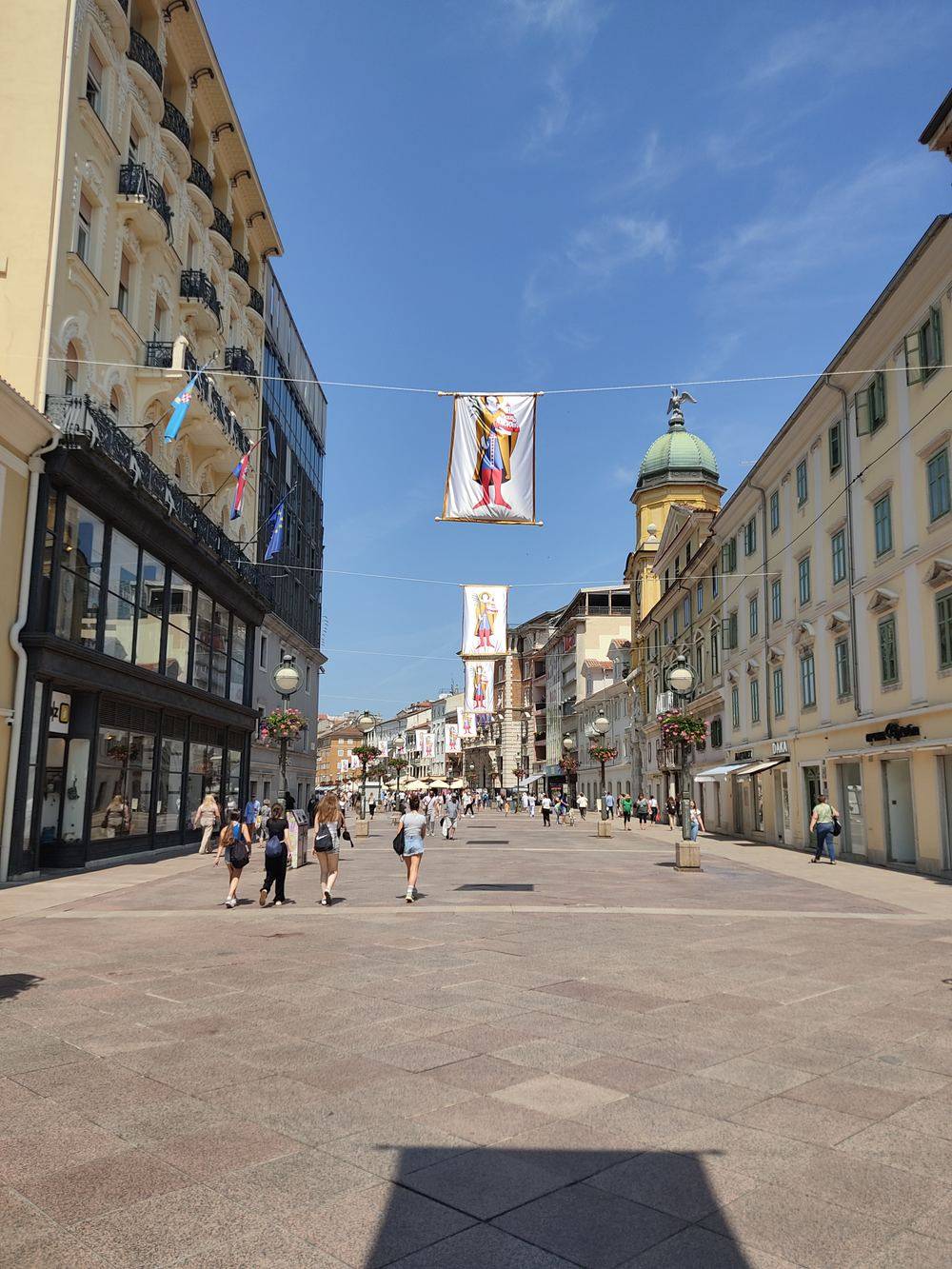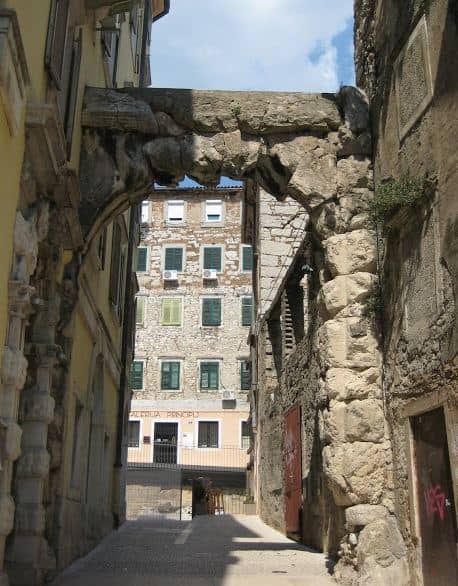
The Korzo is the nineteenth century. The old town starts behind it, through the passage under the City Tower, and holds Rijeka's oldest building, its oldest dated inscription and the only baroque rotunda of monumental proportions in Croatia. A short route with steps, mostly in shade, with no tickets.
Checked: 17 October 2026, 22:25
Most visitors to Rijeka walk the Korzo and think they have seen the old town. They have not: the Korzo is a broad nineteenth century axis, laid out when the city became the main port of the Hungarian half of the monarchy. The real old town lies behind and above it, in narrow streets reached through the passage under the City Tower. There, within a few hundred metres, four layers stack up: Roman Tarsatica, the medieval core, the Habsburg free port and the Hungarian period. The walk takes about an hour.
- 0:00The City Tower, the way in
The only surviving part of the medieval city entrance: through its passage you stepped from the waterfront into the walled core. The upper section, which has carried a city clock since the seventeenth century, was remodelled several times, last at the end of the nineteenth century. The facade carries the Habsburg double eagle and below it relief busts of the emperors Leopold I and Charles VI, honoured in Rijeka for turning the court's policy towards the sea; Charles VI declared Rijeka a free port, which began its maritime rise.
- 0:10Kobler Square and the Roman floor under glass
A small paved space that has been the city's meeting place and market since the middle ages. It is named after Giovanni Kobler, a nineteenth century historian of Rijeka who wrote the first full history of the city and preserved the record of buildings later demolished. Beneath the level of the square, remains of Roman Tarsatica were found, partly visible through glass panels in the paving. The square is in shade for most of the day.
- 0:20The Old Gateway, the oldest building in the city
A stone arch of the third or fourth century, the entrance to the praetorium of the Roman military fort of Tarsatica, part of the defensive system that secured the approach to Italy across the Kvarner. The arch is plain and undecorated, built of large blocks, and is visible to its original height because the street level has barely changed. Excavations around it show the plan of the praetorium and the baths. It stands in a narrow lane, freely accessible at any hour.
- 0:30The Leaning Tower and the 1377 inscription
The bell tower of the Church of the Assumption leans visibly to the south, about forty centimetres out of plumb. Above the doorway the year 1377 is carved, the oldest dated inscription on any building in Rijeka, and the upper part with its octagonal storey was added in the sixteenth and seventeenth centuries. The lean is put down to the ground settling, since the subsoil here is fill and older rubble, including remains of Tarsatica. It is best seen from the small square in front of the church.
- 0:40St Vitus, a monumental baroque rotunda
The only baroque rotunda of monumental proportions in Croatia, its plan modelled on Santa Maria della Salute in Venice. The Jesuits began building in 1638 on the site of a small gothic church, and for lack of money the work dragged on for over a century. Inside stands a thirteenth century gothic crucifix, to which the legend of Petar Lončarić attaches: in 1296 he threw a stone at the cross in anger, whereupon the crucifix bled and the earth swallowed the thrower. It became a cathedral between the two world wars. Entry is free.
- 0:55Back on the Korzo, Palace Modello
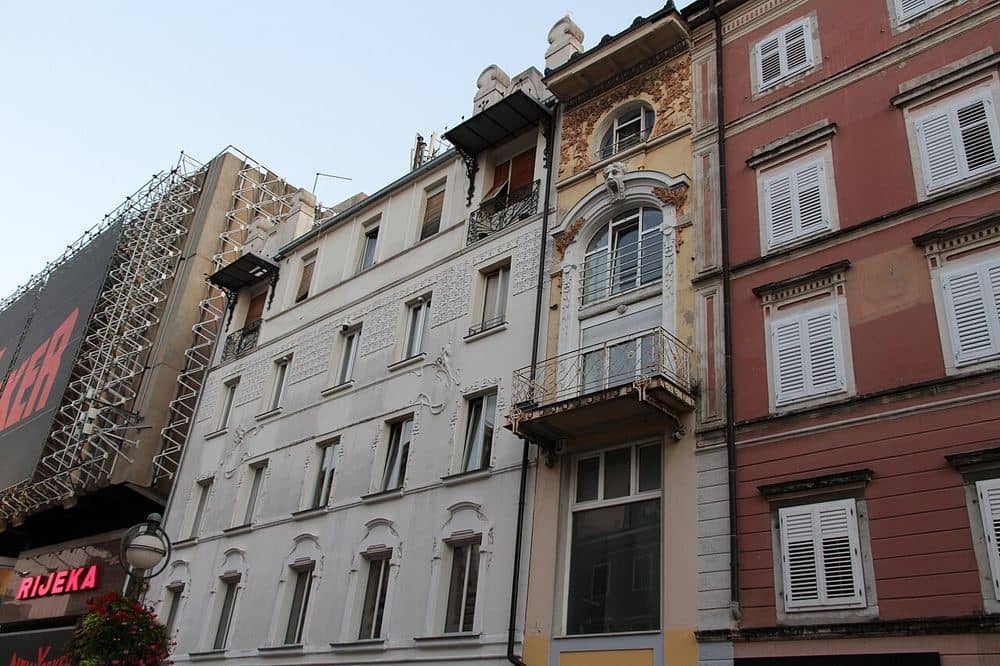
Built in 1885 to a design by the Viennese architects Ferdinand Fellner and Hermann Helmer, the same pair who designed Rijeka's theatre, and set on the site of the demolished Adamić theatre. The name comes from the Italian word for a model: Rijeka wanted its own model of a monumental city palace, and the building first housed the Rijeka Savings Bank and the Casino Patriottico; today it holds the City Library and the Circolo italiano di cultura. Here the difference is visible in a single glance: behind you the fourteenth century, in front of you the nineteenth.
If time is left
The Governor's Palace stands on a rise above the harbour, built between 1893 and 1896 to a design by the Hungarian architect Alajos Hauszmann as the seat of the governor who administered Rijeka on behalf of the Hungarian government, the city then being the main port of the Hungarian half of the monarchy. Much of the original furnishing survives, and the palace houses the Maritime and History Museum of the Croatian Littoral. The visit takes an hour, so it is an outing of its own rather than an add-on to this walk.
Getting to the old town
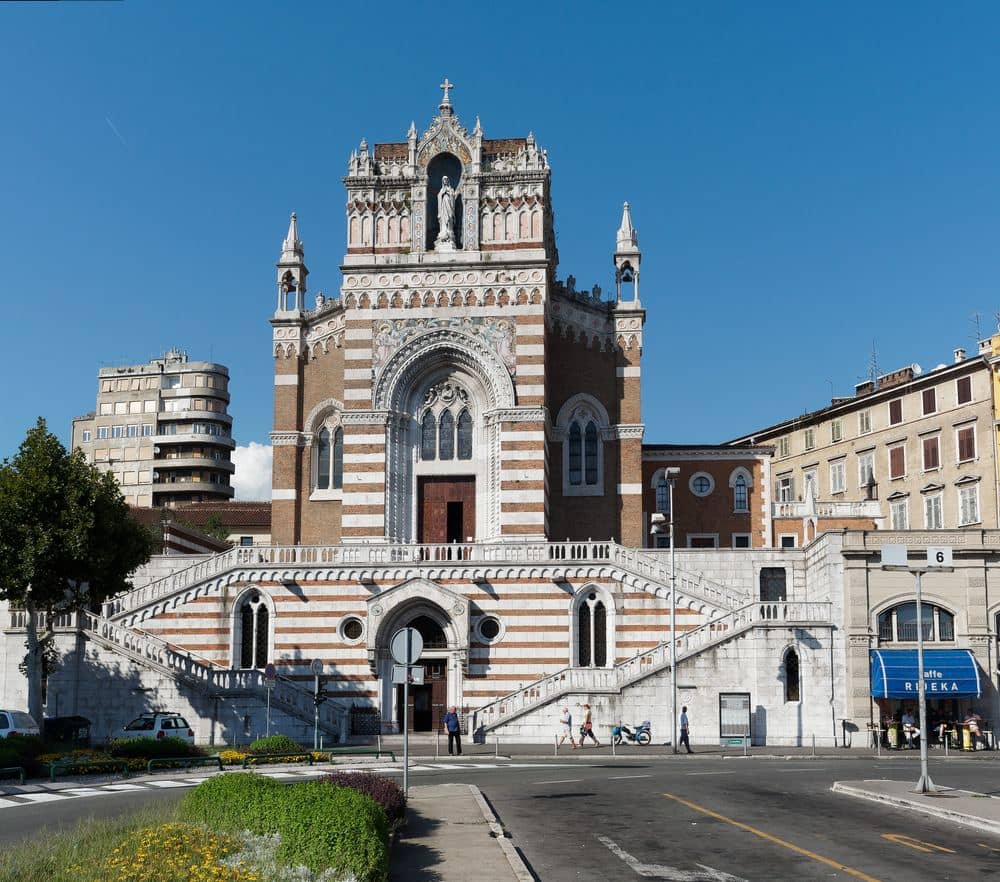
The old town sits directly behind the Korzo, so every arrival point in Rijeka is within walking distance of the City Tower. The bus station on Trg Žabica, beside the Capuchin church, is about 500 m west of the tower along the waterfront. The railway station lies further west on Krešimirova, about 15 minutes on foot. Catamarans to Cres, Rab and Lošinj use the passenger terminal on the Riva, a few minutes below the Korzo. Rijeka Airport is on the island of Krk at Omišalj, about 30 km away across the Krk bridge, with a shuttle bus and taxis at the terminal. From Zagreb the motorway takes about 2 hours by car, and coaches run several times a day. Trieste is about 70 km to the west, so the old town also works as a stop on the way into Croatia.
| From | Distance | How |
|---|---|---|
| Bus station, Trg Žabica | about 500 m | on foot along the Riva |
| Railway station | about 1 km | on foot, 15 minutes |
| Passenger terminal, Riva | a few minutes | on foot |
| Rijeka Airport, Krk | about 30 km | shuttle bus or taxi |
| Opatija | 13 km | city bus along the coast |
| Zagreb | about 160 km | motorway, coach or train |
| Trieste | about 70 km | car or coach |
Where to eat and drink
There are no restaurants on the route itself, so eat before or after, within a few minutes of the City Tower. The City Market pavilions on Vatroslava Lisinskog street, near the theatre, are the natural place for a late breakfast or lunch: the fish hall and the produce pavilions are working buildings, and the small konobas in the streets around them cook what arrived that morning. The market runs in the morning, so plan lunch there before the walk and the walk itself for the afternoon. The Korzo has a cafe every few doors, and the local habit is to sit outside for an hour over one cup. Pastry shops along the same stretch sell cake by the slice. For dinner look at the streets between the Korzo and the theatre, or ride the bus up to Trsat, where the terraces face the bay.
If you have a second day
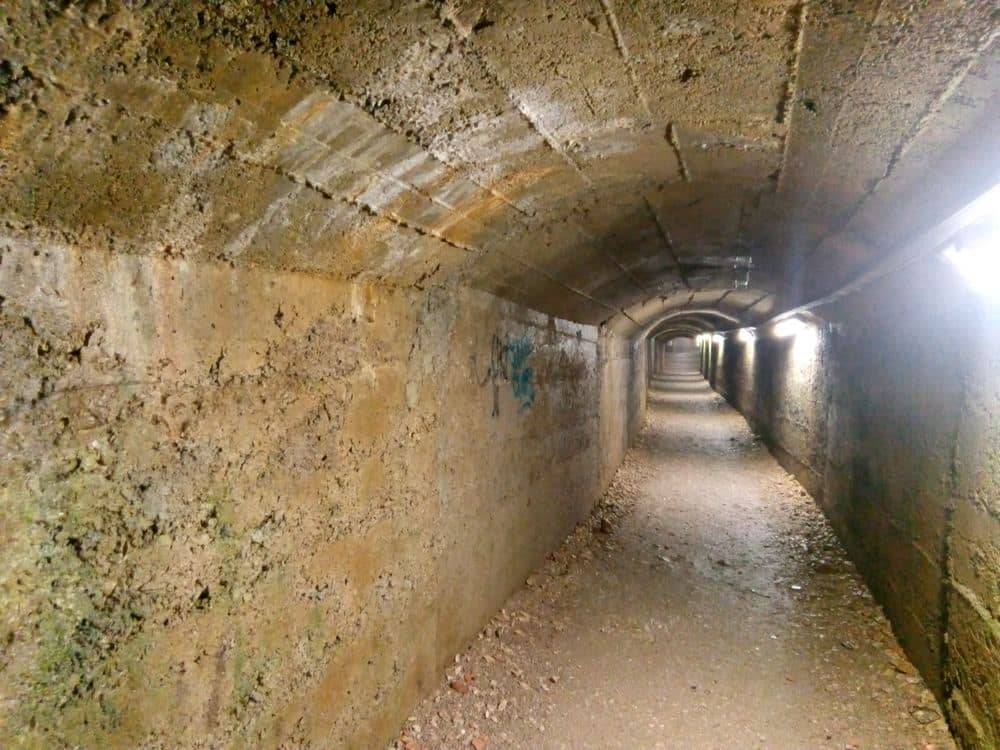
The route covers the medieval core in an hour, which leaves the rest of the centre for a second day. The Rijeka Tunnel starts beside the cathedral and runs about 330 m under the old core to the courtyard of the Dolac primary school. It was dug as an air raid shelter at the start of the Second World War, costs 2 euros for adults from April to September (1.50 euros from October to March) and stays cool in August. Peek&Poke, a few streets from the Korzo, shows home computers made between 1970 and 2000. West along Krešimirova, the Benčić quarter holds the City Museum, the Museum of Modern and Contemporary Art and the Children's House in the halls of a former factory. In the other direction the Petar Kružić Stairs climb 561 steps from Titov trg to Trsat, with a city bus back down as the alternative, and Molo Longo, the 1.7 km breakwater, is the level walk for the end of the day.
Day trips from Rijeka
Rijeka makes a practical base because the motorway and the bus lines run in every direction. Opatija, 13 km west, has the Lungomare shore path and the hotels of the Austrian resort period, and a city bus runs there along the coast. Učka rises behind Opatija, 22 km from Rijeka, to the Vojak summit at 1401 m with its stone tower and a view over the Kvarner and Istria: you reach it by car or by a long hike. Risnjak National Park, 35 km north in Gorski kotar, is forest and lynx country, and the easy Leska trail loops from the Crni Lug entrance. Grobnik Castle, 15 km north-east above the Grobnik field, needs a car. The coves and sea captains' houses of Kostrena, a few kilometres east, are a short bus ride.
When to go
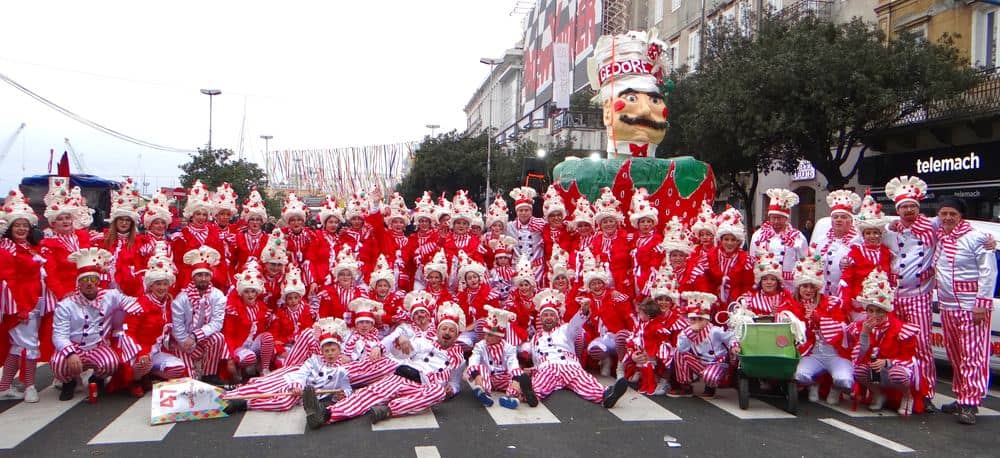
The old town works in any month because Rijeka is a city, and its cafes, churches and lanes do not close for the winter as the island resorts do. Rijeka is among the wettest cities in Croatia, and rain falls in every season, so carry something waterproof and mind the polished stone on the steps. In summer the lanes behind the Korzo are in shade for most of the day, which makes the walk easier in the afternoon than the open waterfront. Winter brings the bora, a cold dry wind from the north-east that can stop the catamarans. Carnival season ends with the parade on the Korzo on the Sunday before Lent, when the centre is closed to traffic and hotels fill. On Sunday afternoons most shops shut and the market is over.
Common mistakes
The route is short and free, so the errors people make here are about timing and footwear. The stone underfoot has been polished by centuries of use and turns slippery when wet, and the lanes above Kobler Square climb in short flights of steps. Both churches on the walk are in regular use, and during a service you should wait outside. Trsat and the Governor's Palace are each an outing of their own and do not fit inside the hour, so plan them for the afternoon or the next day.
- Looking for the Roman arch in the City Tower passage: the Old Gateway stands in a lane behind Kobler Square, a few minutes further in.
- Driving to the Korzo: the streets around the old town are narrow and one way, so leave the car at Delta or in a garage on the edge of the centre.
- Arriving on a Sunday afternoon: the shops and the market are shut, and only the cafes and churches are open.
- Wearing smooth-soled shoes: the steps and lanes are polished stone and turn slippery after rain.
- Walking into the cathedral during a service: wait until it ends before going in to see the crucifix.
- Expecting a ticket office: none of the stops on this walk charges admission; only the Rijeka Tunnel, if you add it, charges a small fee.
Frequently asked questions
- Where does Rijeka's old town start?
- Behind the Korzo, through the passage under the City Tower. The Korzo is a nineteenth century axis, while the medieval core lies behind and above it.
- What is the oldest building in Rijeka?
- The Old Gateway, also called the Roman Arch, from the third or fourth century. It was the entrance to the praetorium of the Roman fort of Tarsatica and is freely accessible.
- How long does the old town walk take?
- About an hour for six stops, with steps and narrow lanes. The cathedral and the Church of the Assumption charge no admission.
Official sources
Share this guide
Questions about your trip?