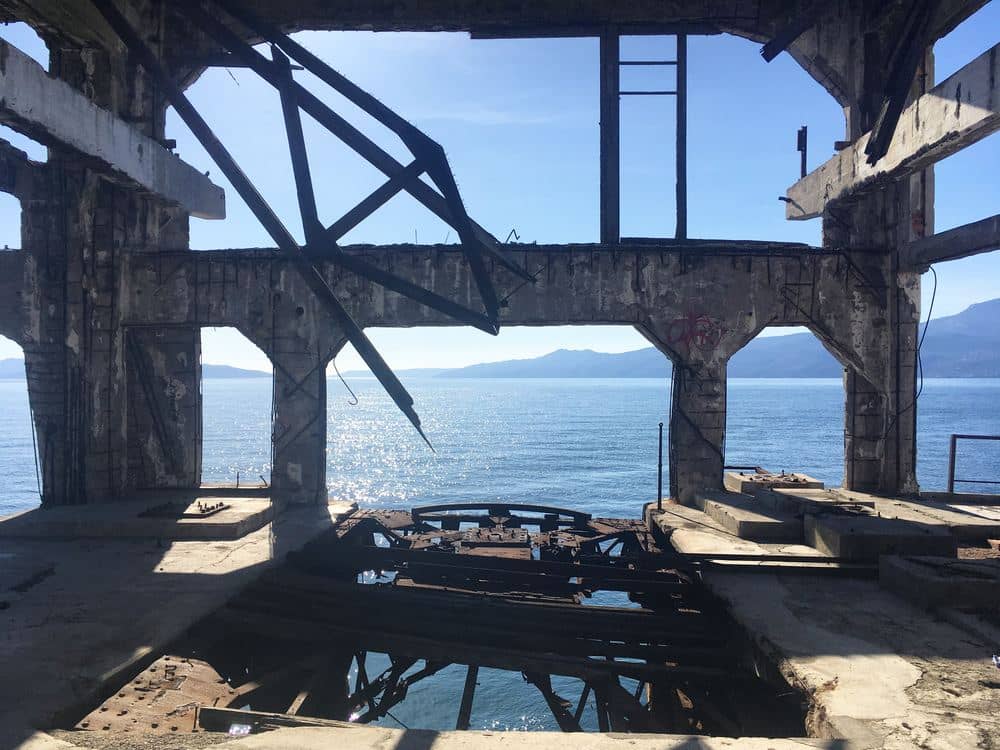
Rijeka keeps its best outside the centre: a torpedo launch ramp, a Frankopan castle above the Grobnik field, sea captains' houses in Kostrena and an unmarked fort. Where they are, how to reach them, and what genuinely needs a car.
Checked: 4 September 2026
Most lists of hidden gems in Rijeka in fact name things anyone walking the Korzo already sees. The real case is different: what gets missed in Rijeka lies outside the narrow centre, along the coast to the east, on the plateau above the city and in the hinterland. Several of these places have neither a sign nor opening hours, and one of them is the last of its kind in the world.
The torpedo launch station
Rijeka is the city where the torpedo was invented. The idea of a self-propelled underwater device came in the 1860s from Giovanni Luppis, a retired officer from Rijeka, and the engineering was worked out by the English engineer Robert Whitehead, who ran the Rijeka machine works. The first working torpedo was presented in 1866 and was soon bought by almost every naval power. The concrete ramp by the sea was used for testing: the torpedo was fired into the channel and its run was tracked. It is now protected as a monument of technology and is the last of its kind preserved anywhere in the world. It is visible from the coastal road, and that is half the story: it stands there with no fence and no ticket, a piece of industrial archaeology most drivers pass without knowing what they are looking at.
Grobnik castle
Fifteen kilometres northeast of Rijeka, on a rocky hill above the Grobnik field, stands a castle of the Frankopans, the family that held Vinodol and the hinterland from the thirteenth century. The site was chosen to control the route from the interior to the sea, because goods passed this way to the port of Rijeka. Tradition attaches to it a great battle on the Grobnik field in 1242, in which legend says the Tatar forces were halted. Walls, a tower and the inner courtyard survive, the courtyard used for events. A road leads up from Čavle, so this one is a destination for a car.
The sea captains' houses in Kostrena
East of Rijeka, along the Kostrena shore, stands a row of old stone houses built by seafaring families. From the eighteenth century Kostrena produced captains and sailors who sailed the Mediterranean and the oceans under sail, and money earned at sea went into houses on the shore: hence their size, the stone terraces, the shutters and gardens with palms, unusual for ordinary fishing villages. Two of them are called the Turkish House and the Roman House, names passed on by word of mouth along with stories of voyages and owners. The ground floors are built of large blocks with a covered passage to the sea, the upper floor held the family's home, and the stair runs outside on the facade. The interiors are not open to visitors; the houses are seen from the shore path linking the Kostrena coves.
Solin fort, with no signage at all
On a rise above the coast east of Rijeka, from where the entrance to the bay and the road towards Bakar can be watched, lie the remains of a fort. The summits above this coast were fortified as far back as prehistory, when the Liburnians built hillforts, rings of drystone wall on commanding hills, and later the same points served as lookouts because they gave a view over sea and road. On the ground you can make out remains of walls, foundations and a levelled plateau, with the slope around grown over with maquis and low pine. There is no prepared access and no signage; an unmarked path leads up. Come outside the summer months and wear firm shoes: the ground is often uneven.
Two places inside the city itself
- The Mlaka lighthouse stands at the end of a mole in the western part of Rijeka's port and marks the entrance to the berths there. It was built when the port expanded westward in the second half of the nineteenth century, because steamer traffic needed marks at night too, and Rijeka was then one of the busiest ports on the Adriatic. A low white tower, a concrete quay around it, working boats moored alongside. It is about twenty minutes on foot from the centre along the shore path.
- The Drenova local museum sits on the plateau above the city and is devoted to life in this area before it became part of Rijeka. For centuries Drenova was a village supplying the city with vegetables, wood and lime, and its people worked in quarries and lime kilns; those are the themes of the display, together with farm tools, household objects, dress and family photographs. A local association runs it, the visit takes about twenty minutes, and opening hours are limited: call ahead.
What needs a car and what does not
| Place | Getting there | Note |
|---|---|---|
| Mlaka lighthouse | on foot, 20 min | always accessible |
| Drenova museum | bus or car | call ahead |
| Grobnik castle | car, 15 km | road from Čavle |
| Kostrena houses | car plus shore path | exterior only |
| Solin fort | car plus footpath | unmarked, firm shoes |
| Launch station | car or bus | visible from the road |
Frequently asked questions
- What is the biggest hidden gem in Rijeka?
- The torpedo launch station. Rijeka is the city where the torpedo was invented in 1866, and the ramp is the last of its kind preserved anywhere in the world, standing by the coastal road with no admission charge.
- Do you need a car for Rijeka's hidden gems?
- Not for the Mlaka lighthouse, which is a twenty minute walk. For Grobnik, Kostrena and Solin yes, because they lie outside the city.
Share this guide
Questions about your trip?