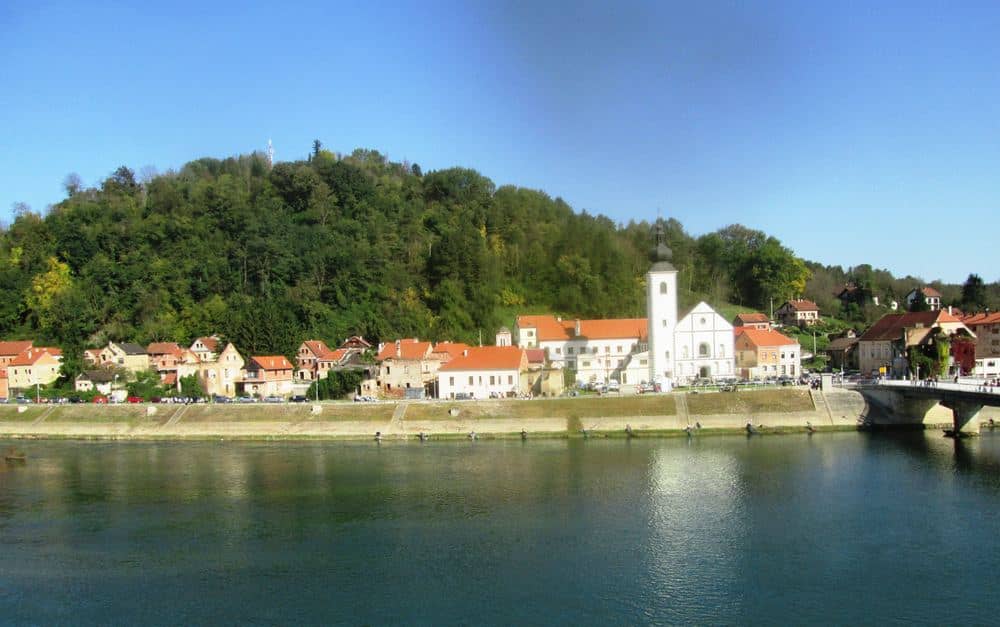
Every October, chestnut roasters line the Una in Hrvatska Kostajnica for three days of Kestenijada: stalls on the main square, knights at the Zrinski castle and concerts every evening. Dates, food, train, parking and the 2027 outlook.
Checked: 20 October 2026, 20:00
Chestnut roasters set up their drums along the Una every October in Hrvatska Kostajnica. For three days, Friday to Sunday, the Kestenijada fills the old centre with stalls, smoke and music. The town of Hrvatska Kostajnica organises it with the Banovina-Pounje tourist board. The first official edition took place in 1997, and the 2026 festival was the 29th. The town takes its name from the chestnut, and chestnut woods cover the hills around it. Official documents for each edition appear on the town's Kestenijada page.
Kestenijada at a glance
| Topic | Details |
|---|---|
| When | Three days, Friday to Sunday, in the first half of October |
| Where | The old centre: Trg Nikole Šubića Zrinskog, Ulica Vladimira Nazora, the Una promenade and the Zrinski castle (Stari grad) |
| Entry | Free in recent editions; you pay at the stalls, bars and rides |
| Organisers | Town of Hrvatska Kostajnica and the Banovina-Pounje tourist board |
| First edition | 1997 |
| Last edition | 29th, Friday 9 to Sunday 11 October 2026 |
| 2027 | Date to be announced by the town and the tourist board |
Advertisement
Kestenijada 2027
The date of Kestenijada 2027 is still open. On 20 October 2026 neither the town's Kestenijada page nor the news of the Banovina-Pounje tourist board listed a 2027 edition. In recent years the date came out in late summer. The mayor's decision on the 2026 festival appeared in August 2026, and the tourist board opened the call for stallholders on 28 August.
The last four editions followed one pattern: three days from Friday to Sunday in the first half of October. These are past dates, shown as a pattern only:
- 2023: Friday 6 to Sunday 8 October, 26th edition
- 2024: Friday 4 to Sunday 6 October, 27th edition
- 2025: Friday 10 to Sunday 12 October, 28th edition
- 2026: Friday 9 to Sunday 11 October, 29th edition
The official 2027 date will appear first on the town's Kestenijada page and on the tourist board's site tzpbp.hr.
Advertisement
A town named after the chestnut
Hrvatska Kostajnica is a town of about 1,950 people on the Croatian bank of the Una, roughly 95 km by road south-east of Zagreb. Its name comes from kostanj, an old word for the chestnut. The name first appears in a sales contract of 1240. The Zrinski family owned the town from 1541. The Ottomans took it in 1556 and held it until 1688. Afterwards it belonged to the Military Frontier until 1871. The Una still marks a border, today with Bosnia and Herzegovina. The town was occupied in the war of 1991 to 1995 and damaged by the earthquake of December 2020.
The festival grew from one woman's roaster. Baka Jela, the town's best-known chestnut seller, roasted chestnuts by the church of St Nicholas. She filled paper cones for generations of schoolchildren. The first official Kestenijada followed in 1997.
What happens over the three days
Headliners change every year. The building blocks of the programme return each October:
- Market: craftspeople and local producers fill the main square and the streets of the old centre, from small family farms to well-known brands.
- Medieval fair: knights, warriors and blacksmiths take over the courtyard of the Zrinski castle and show life in the time of the Ottoman raids.
- Folklore: cultural and artistic societies from across Croatia perform on the main stage through the afternoon.
- Evening concerts: Croatian singers and bands play under the central tent every night.
- Culture: an art exhibition of more than 100 works, book and poetry presentations and choirs.
- Children: a funfair, inflatable slides and trampolines, pony rides and a meadow with horses, donkeys, goats and sheep between the castle and the Una.
- Walks: guides lead visitors up Djed, the wooded hill behind the town, from the church of St Anthony of Padua.
The 2024 brochure, the last full programme the town published, shows a typical rhythm. The art exhibition opened on Friday at 17:00. The official opening on Trg Nikole Šubića Zrinskog followed at 18:00, the castle walls were lit at 19:30 and the headline concert began at 20:30. Saturday ran from an eco market at 10:00 and a parade at 13:00 to a horse show and fire show beside the castle from 18:00, with concerts at 20:00 and 22:00. Sunday brought a vintage vehicle parade at 14:00 and closed with concerts at 17:00 and 19:00.
Advertisement
Where everything is in town
The festival fills the flat old centre between the Una and Djed hill, and everything lies within a short walk. Trg Nikole Šubića Zrinskog, the main square with the town hall, gets wooden stalls and the caterers' tents. Stalls line Ulica Vladimira Nazora and Ulica Davorina Trstenjaka. More stalls, roasters and food vans stand along the riverside promenade, Šetalište dr. Franje Tuđmana. The plateau of the former bus station serves as the gastro zone. Ulica Krešimira Hajdića leads to the Zrinski castle at the water's edge. The town licenses the chestnut roasting spots for each edition.
Chestnuts, stalls and food
Roasted chestnuts are the heart of the weekend. They come hot from drum roasters, which locals call dagara, in a paper cone called a fišek. People peel them with their fingers as they walk. The stalls sell what the woods and farms along the Una produce: chestnut purée and cakes, spreads of chestnut and hazelnut, honey, home-made pasta, rakija and wine. The warm food is continental: bean stew with sausage, grilled meat and spit-roast lamb. In 2023 the hosts roasted 150 lambs, and the tourist board counted almost ten thousand visitors.
| Croatian | What it is | How it is eaten |
|---|---|---|
| Pečeni kesteni | Roasted chestnuts | Hot from the dagara in a paper fišek, peeled as you walk |
| Kesten pire | Chestnut purée | With whipped cream, eaten with a spoon |
| Med od kestena | Chestnut honey | Dark and a little bitter, on bread or in tea |
| Kesten rolada | Chestnut roll | A rolled cake of chestnut purée and cream, sold by the slice |
| Grah s kobasicom | Bean stew with sausage | In a bowl with bread, the warm lunch |
| Janjetina s ražnja | Spit-roast lamb | Sold by weight, with bread |
| Sir i vrhnje | Fresh cheese and cream | Spread on bread, with paprika or spring onion |
| Šljivovica | Plum brandy | A small glass, sipped; taste before you buy a bottle |
- Raw chestnuts are sold by the kilo; score each one with a cross before roasting at home, or it will burst.
- Keep raw chestnuts in the fridge and use them within a couple of weeks, as they dry out quickly.
- If you fly home outside the EU, check your country's rules on raw nuts and plant products; jars of honey and bottles usually travel more easily.
- Sunday is the quietest day to buy chestnuts by the bag without queuing.
Advertisement
Getting there by car and train
By car from Zagreb it is about 95 km. Take the A11 motorway towards Sisak, then the D30 state road through Petrinja to the border crossing in Hrvatska Kostajnica. Allow about an hour and a half. Sisak is about 40 km away, Petrinja 35 km. Road conditions and border waiting times are on the HAK traffic page.
The town runs a special traffic regime for the festival. Parking is banned in the festival zones, and Tekijska and Davorina Trstenjaka streets close to traffic. Coaches park at the bus station on Antuna Pavičića street or at the Ivan Trnski secondary school on Hrvatskih branitelja street. Private cars stop on the edge of the centre where signs allow, and visitors walk in.
Regular HŽPP trains link Zagreb with Hrvatska Kostajnica in about 1 hour 40 minutes, and Sisak in 45 to 50 minutes. The station lies about 2.5 km north-west of the main square, roughly half an hour on foot. On the festival weekend the tourist board and HŽ Putnički prijevoz have run the Kesten cug, a special excursion train from Zagreb, with a shuttle bus to the centre. In 2026 the last regular train back to Zagreb left at 19:31, before the evening concerts. For a headliner, visitors need a car or a bed nearby.
Advertisement
Crossing to Bosanska Kostajnica
The Una is the border with Bosnia and Herzegovina. The crossing sits next to the old centre, with Bosanska Kostajnica on the far bank. It is an external Schengen border, so both sides check documents each way. EU citizens can use a valid identity card or a passport; Croatian cards must have been issued after 1 January 2003. Everyone else needs a passport valid at least three months beyond the planned departure from the Schengen area and issued within the last ten years.
Non-EU visitors are recorded in the EU Entry/Exit System when they leave Croatia and when they come back; our ETIAS and EES guide has the details. Bosnia and Herzegovina uses the convertible mark, fixed at 1.95583 marks to the euro. Cars with Croatian, EU or UK plates need no green card. Bosnia and Herzegovina is outside EU roaming. Guests who stay the night on the Bosnian side must be registered with the police within 72 hours, which hotels normally do. Our driving guide covers the trip across by car.
Advertisement
Where to stay
Hrvatska Kostajnica has only a handful of private rooms and apartments, and they go early on the festival weekend. Sisak, about 40 km away, has hotels and trains to Zagreb. The villages of Lonjsko polje, such as Čigoč and Krapje, have rural guesthouses in traditional wooden houses. Zagreb works as a day-trip base: leave after breakfast, reach the stalls by late morning and drive back after the evening concert. Rooms in Bosanska Kostajnica across the bridge are another option, with a border check each way.
| Base | Distance | Good for |
|---|---|---|
| Hrvatska Kostajnica | In town | Walking to everything, few rooms, book early |
| Sisak | About 40 km | Hotels, the fortress, trains to Zagreb |
| Petrinja | About 35 km | Rooms on the road from Zagreb, a town rebuilding after the 2020 earthquake |
| Čigoč and Krapje | About 1 to 1.5 hours | Rural guesthouses, Lonjsko polje nature park |
| Zagreb | About 95 km | Day trip, widest choice of hotels |
| Bosanska Kostajnica | Across the bridge | Rooms in Bosnia and Herzegovina, border check each way |
Advertisement
Around Kostajnica
Djed, the wooded hill behind the town, has an educational trail and the best view over Kostajnica and the Una valley. The church of St Anthony of Padua and its Franciscan monastery at its foot were built between 1729 and 1756. The ruins of Zrin, the castle that gave the Zrinski family its name, stand on a wooded hill about 25 km south-west of town.
Downstream, the D47 follows the Una to Hrvatska Dubica, about 27 km east, and on to Jasenovac, where the Una meets the Sava. The Jasenovac Memorial Site marks the largest concentration camp of the wartime Ustaša state, with a memorial museum and Bogdan Bogdanović's concrete Flower monument. It lies about 40 km from Kostajnica. The museum opens Monday to Saturday from 9:00 to 17:00 between March and November, and entry is free. From Jasenovac the A3 motorway reaches Zagreb in about an hour and a quarter.
Practical tips
- October in Banovina is continental: cool, often misty mornings by the river, mild afternoons and frequent rain. A jacket and shoes for wet grass around the castle help. Our October weather guide has typical temperatures for inland Croatia.
- The traffic regime starts on Friday morning; on Saturday an early arrival keeps the car close to the centre.
- Stage times come late. In 2024 the programme was presented in Zagreb on 23 September, eleven days before the festival; in 2026 the tourist board posted it on 7 October. The tourist board's site tzpbp.hr and its Facebook page carry it first.
- Small notes and coins work best at the roasters and the farm stalls.
- With small children, the meadow by the castle with the animals and pony rides and the play area on the football pitch are the calmest corners.
Advertisement
Kestenijada 2026 in review
The 29th Kestenijada ran from Friday 9 to Sunday 11 October 2026. The mayor's decision of August 2026 set the dates, locations, opening hours and traffic rules. Chestnuts were roasted at eight licensed spots: on the main square, on Davorina Trstenjaka street, three along the promenade and three on Vladimira Nazora street. The town kept the space in front of the ruined church of St Nicholas free of stalls that year.
Stela Rade headlined on Friday, Matija Cvek on Saturday and Tamburaški sastav Fijaker on Sunday. The Grine funfair brought bumper cars, a swinging ship, bungee trampolines and, new that year, a mechanical arena. Guided walks went up Djed hill on Saturday at 11:00 and 14:00 and on Sunday at 11:00, and scout games for children ran near Restoran Djed. The tourist board published the programme on 7 October.
On Saturday and Sunday the Kesten cug left Zagreb Glavni kolodvor at 8:00, called at Buzin, Velika Gorica, Lekenik and Sisak, arrived at 9:41 and started back at 17:08. Adults paid 8 € from Zagreb or Velika Gorica and 6 € from Lekenik, Sisak or Sunja, and children aged 7 to 12 paid 4 €. A regular single from Zagreb cost 6.79 €. Family farms and traditional crafts paid half the commercial stall fee: 100 € for a two-metre stand on the main square.
Advertisement
Frequently asked questions
- When is Kestenijada 2027?
- The date is still open: on 20 October 2026 neither the town of Hrvatska Kostajnica nor the Banovina-Pounje tourist board had announced it. Recent editions ran from Friday to Sunday in the first half of October: 6–8 October 2023, 4–6 October 2024, 10–12 October 2025 and 9–11 October 2026. That is a pattern of past dates, and the official 2027 date will come from the town.
- Where does Kestenijada take place?
- In the old centre of Hrvatska Kostajnica on the Una, about 95 km south-east of Zagreb. Stalls fill Trg Nikole Šubića Zrinskog, Ulica Vladimira Nazora, Ulica Davorina Trstenjaka and the riverside promenade, and the medieval fair takes over the Zrinski castle.
- Does Kestenijada charge entry?
- Recent editions had no entry ticket. The festival takes place in public streets and squares, and visitors pay at the stalls, bars and rides. Small notes and coins help at the roasters and farm stalls.
- How do I get to Kestenijada from Zagreb?
- By car it is about 95 km via the A11 towards Sisak and the D30 through Petrinja, about an hour and a half. Regular HŽPP trains take about 1 hour 40 minutes to Hrvatska Kostajnica station, 2.5 km from the main square. On recent festival weekends the special Kesten cug train ran from Zagreb on Saturday and Sunday, with a shuttle bus to the centre.
- What do I need to cross into Bosanska Kostajnica?
- EU citizens need a valid identity card or passport; everyone else needs a passport, and non-EU visitors are recorded in the EU Entry/Exit System on exit and re-entry. Bosnia and Herzegovina uses the convertible mark, and cars with Croatian, EU or UK plates need no green card.
Official sources
- Town of Hrvatska Kostajnica: decision on Kestenijada 2026 (dates, locations, hours, traffic)
- Town of Hrvatska Kostajnica: Kestenijada documents
- Town of Hrvatska Kostajnica: about Kestenijada
- Official Kestenijada 2024 programme (PDF)
- Town of Hrvatska Kostajnica: history
- Banovina-Pounje tourist board: 29th Kestenijada, 9 to 11 October 2026
- Banovina-Pounje tourist board: Kestenijada 2026 programme (7 October 2026)
- Banovina-Pounje tourist board: news (no Kestenijada 2027 date as of 20 October 2026)
- Public call for chestnut roasting spots 2026 (PDF)
- Banovina-Pounje tourist board: Kestenijada 2024 press conference
- Banovina-Pounje tourist board: report on Kestenijada 2023
- Banovina-Pounje tourist board on Facebook: Kesten cug 2026 times and fares
- Banovina-Pounje tourist board on Facebook: Stela Rade, Friday 9 October
- Banovina-Pounje tourist board on Facebook: Matija Cvek, Saturday 10 October
- Banovina-Pounje tourist board on Facebook: Tamburaški sastav Fijaker, Sunday 11 October
- Banovina-Pounje tourist board on Facebook: Grine luna park at Kestenijada 2026
- Restoran Djed on Facebook, shared by the tourist board: walks and scout games on Djed hill
- Sisak-Moslavina County: preparations for Kestenijada 2026
- Croatian National Tourist Board: Kestenijada 2025 programme
- HŽ Putnički prijevoz: timetable and tickets
- HŽ Putnički prijevoz: excursion trains through the year
- Sisak-Moslavina police: Hrvatska Kostajnica border police station and crossings
- Croatian Ministry of the Interior: crossing the border with an ID card
- Croatian Ministry of the Interior: border checks on persons
- Ministry of Foreign Affairs of Bosnia and Herzegovina: visas and ID cards
- European Commission: Entry/Exit System (EES)
- UK Foreign Office: Bosnia and Herzegovina entry requirements
- HAK: no green card needed to enter Bosnia and Herzegovina
- Green Card Bureau of Bosnia and Herzegovina: foreign vehicles
- HAK: road conditions and border waiting times
- Central Bank of Bosnia and Herzegovina: exchange rate
- Jasenovac Memorial Site: opening hours
Share this guide
Questions about your trip?
Make Croatia Atlas a preferred source
One click and Google shows you our stories more often in Top Stories and in AI answers. It changes your own results only.