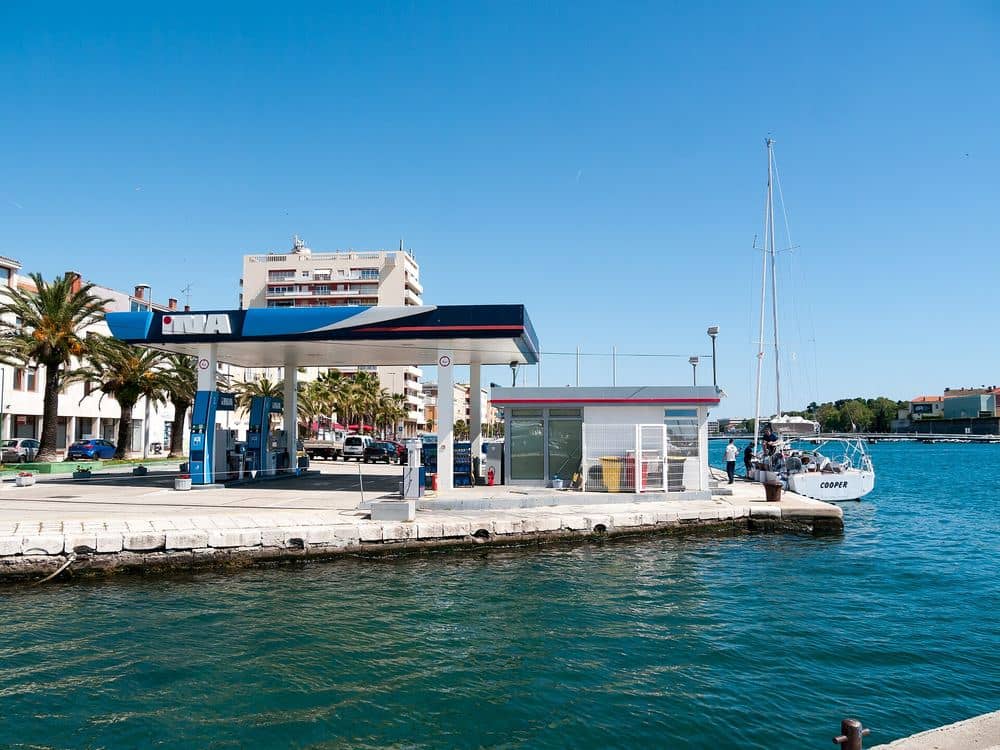
From Tuesday 6 October 2026 petrol costs at most 1.74 euro a litre and diesel 1.84 euro in Croatia, 2 cents less than last week. LPG for tanks and cylinders rises by 3 cents. The caps hold for seven days and do not apply at motorway stations.
Checked: 5 October 2026, 13:53
Status of the reports: Monday 5 October 2026, 13:53. At a telephone session on Monday, Croatia's government set new maximum fuel prices, and this time petrol and diesel both come down. From 00:00 on Tuesday 6 October, Eurosuper 95 petrol may cost no more than 1.74 euro a litre and Eurodiesel no more than 1.84 euro, in both cases 2 cents less than the week before. Blue diesel falls by 4 cents to 1.38 euro, while liquefied petroleum gas (LPG) for tanks and cylinders goes up by 3 cents a kilogram. The new caps run for seven days, until Monday 12 October (vlada.gov.hr).
| Fuel | Until 5 October | From 6 October | Change |
|---|---|---|---|
| Eurosuper 95 (petrol) | 1.76 €/l | 1.74 €/l | -2 ct |
| Eurodiesel | 1.86 €/l | 1.84 €/l | -2 ct |
| Blue diesel | 1.42 €/l | 1.38 €/l | -4 ct |
| LPG for tanks | 1.52 €/kg | 1.55 €/kg | +3 ct |
| LPG in cylinders | 2.10 €/kg | 2.13 €/kg | +3 ct |
What a 60-litre tank costs
A full 60-litre tank now costs at most 104.40 euro with petrol and 110.40 euro with diesel, in both cases 1.20 euro less than last week. The government also published what drivers would pay without its measures, meaning without the cap on company margins and the excise cut: 1.95 euro a litre for petrol and 2.13 euro for diesel. For 60 litres that would come to 117.00 and 127.80 euro.
| 60-litre tank | Until 5 October | From 6 October | Without government measures |
|---|---|---|---|
| Petrol (Eurosuper 95) | 105.60 € | 104.40 € | 117.00 € |
| Diesel (Eurodiesel) | 111.60 € | 110.40 € | 127.80 € |
What the government changed
On Monday morning Novi list reported unofficial figures pointing to cuts of 3 cents for diesel and 2 cents for petrol. In the final decree the margin that fuel companies may add to petrol stays the same, but for diesel and blue diesel it rises by 1 cent a litre. Excise duty on diesel also goes up by 1 cent, to 0.26 euro a litre, while petrol stays at 0.3973 euro. According to the excise decree, both remain well below their pre-crisis level, by 11.5 cents for petrol and 14 cents for diesel (vlada.gov.hr). The government again cites the war in the Middle East and disrupted crude supplies as the reason for the caps. On Monday morning a barrel of Brent crude traded at around 101.50 dollars, Novi list reported (Novi list).
What it means for drivers
The cap only covers standard fuel without multifunctional additives at stations off the motorways. At motorway service stations fuel companies may set their margin freely, and higher-octane and premium fuels are free-priced everywhere, as the explanatory note to the decree says (vlada.gov.hr). HAK, the Croatian automobile club, notes that motorway stations usually charge the most. On Monday its price list showed regular Eurosuper 95 at INA stations typically at 1.76 euro but at up to 1.86 euro, and regular Eurodiesel typically at 1.86 euro but at up to 2.01 euro (HAK). A gap of 10 or 15 cents a litre adds 6 or 9 euro to a 60-litre tank.
- Fill up off the motorway: stations in towns near the exits are bound by the cap.
- If a station off the motorway only sells fuel with additives, it may charge no more than the capped price for it.
- Autogas (LPG for cars) is not covered by the cap. HAK listed it at between 0.80 and 0.95 euro a litre on Monday.
- The caps are reset every week. Recently the government has decided on Mondays, with new prices from Tuesday.
Compared with Slovenia and Austria
Slovenia also caps standard 95-octane petrol and diesel at stations away from its motorways and expressways. From Tuesday 6 to Monday 12 October the Slovenian cap is 1.744 euro for petrol and 1.883 euro for diesel, down from 1.760 and 1.929 euro the week before (gov.si). That puts Croatia's cap practically level with Slovenia's for petrol and about 4 cents a litre lower for diesel. For Austria, the European Commission's Weekly Oil Bulletin, with prices from Monday 28 September 2026, gives a national average of 1.956 euro for Eurosuper 95 and 2.259 euro for diesel. On the same day the averages were 1.745 and 2.011 euro in Slovenia and 1.808 and 2.036 euro in Croatia (European Commission). These are averages, not caps, so compare them with each other: on that day diesel was about 22 cents a litre dearer in Austria than in Croatia, and petrol about 15 cents.
| Country and basis | Eurosuper 95 | Diesel |
|---|---|---|
| Croatia, cap from 6 October | 1.74 €/l | 1.84 €/l |
| Slovenia, cap off motorways, 6 to 12 October | 1.744 €/l | 1.883 €/l |
| Austria, average on 28 September | 1.956 €/l | 2.259 €/l |
| Slovenia, average on 28 September | 1.745 €/l | 2.011 €/l |
| Croatia, average on 28 September | 1.808 €/l | 2.036 €/l |
Frequently asked questions
- How much do petrol and diesel cost in Croatia from 6 October 2026?
- At stations off the motorways, at most 1.74 euro a litre for Eurosuper 95 and 1.84 euro for Eurodiesel, from Tuesday 6 to Monday 12 October 2026. Stations may sell for less.
- Do the capped prices apply at motorway service stations?
- No. On the motorways fuel companies set their margin freely, and premium fuels are free-priced everywhere. HAK notes that the highest prices are usually found at motorway stations, so it pays to fill up in a town near an exit.
- Is autogas (LPG for cars) capped too?
- No. The government caps LPG for tanks and cylinders, at 1.55 and 2.13 euro per kilogram from 6 October. Autogas for cars is free-priced; HAK listed it at between 0.80 and 0.95 euro a litre on 5 October.
- Is fuel cheaper in Croatia than in Austria or Slovenia?
- Than in Austria, yes, on the latest EU figures: on 28 September 2026 the average was 1.956 euro for petrol and 2.259 euro for diesel in Austria, against 1.808 and 2.036 euro in Croatia. Slovenia's averages were slightly lower than Croatia's, at 1.745 and 2.011 euro. Comparing the caps from 6 October, petrol costs practically the same in both countries (1.74 against 1.744 euro) and diesel about 4 cents less in Croatia (1.84 against 1.883 euro).
Official sources
- Croatian government: lower fuel prices from Tuesday (5 October 2026)
- Croatian government: 211th session, decrees on fuel prices and excise duty
- Croatian government: fuel prices from 29 September 2026
- HAK: current fuel prices in Croatia
- Slovenian government: lower petrol, diesel and heating oil prices from 6 October
- Slovenian government: regulated fuel prices from 29 September 2026
- European Commission: Weekly Oil Bulletin
- Novi list: government decides on new fuel prices today
- tportal: government publishes new fuel prices
- Index.hr: government publishes new fuel prices
Share this guide
Questions about your trip?