Questa pagina non è ancora disponibile in italiano. Stai leggendo la versione inglese.
Rovinj is built on a former island, and it still behaves like one. Here is what to see, in the order the streets actually take you.
Verificato: 18 ottobre 2026, 19:11
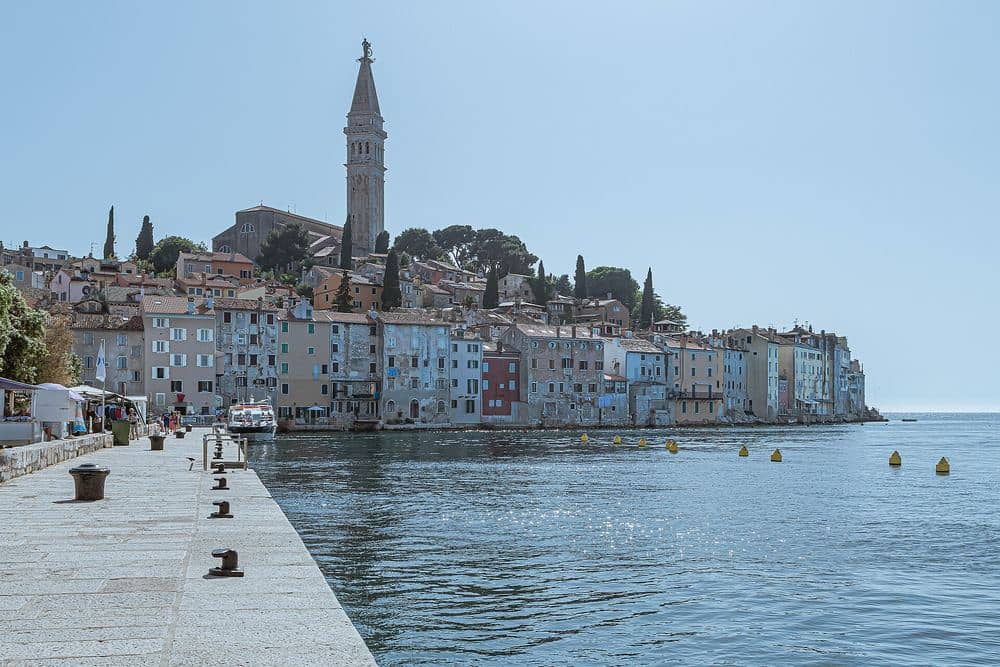
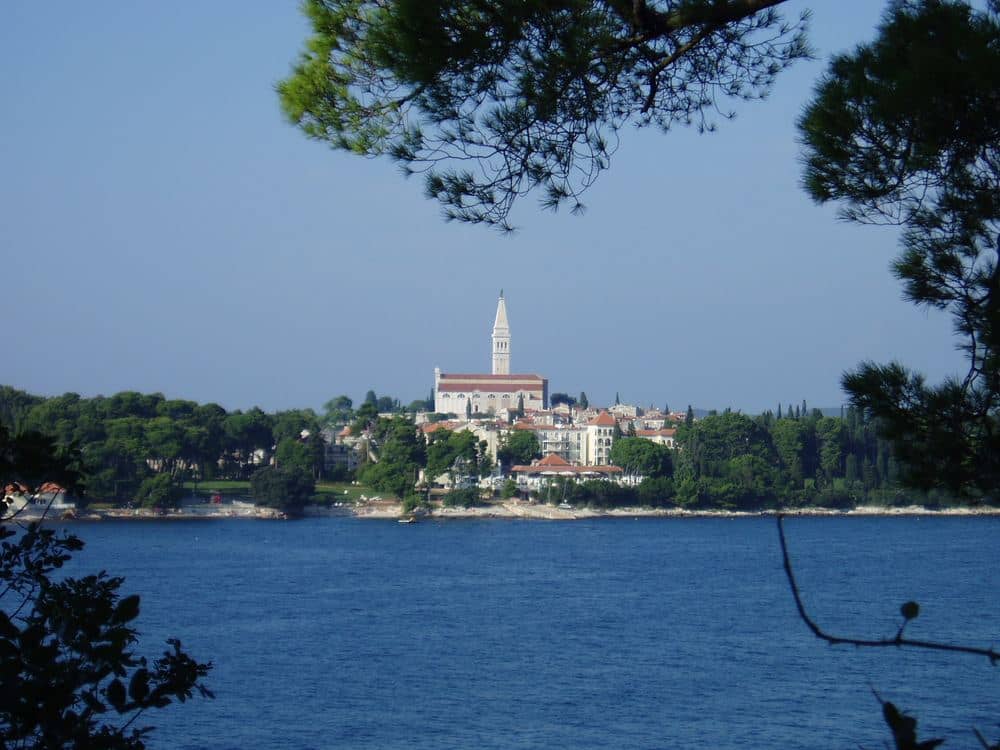
Until 1763 Rovinj was an island, separated from the mainland by a narrow channel. The channel was filled in, but the shape stayed: a tight oval of stone rising to a single church tower, with the sea on three sides. That is why the town reads so clearly from a distance and confuses people once they are inside it. Every lane bends uphill toward St Euphemia, so getting lost here is temporary.
Start at the harbour, not at the top
The harbour is where the town explains itself. Fishing boats sit against the same waterfront the old warehouses face, and the Batana Eco-Museum right there is the one museum in Rovinj worth planning around: the batana is the flat-bottomed local boat, and the museum exists because the tradition around it is recognised as living heritage rather than a display piece. From the harbour, Grisia Street is the obvious way up, and the Balbi Arch marks the old entrance to the town.
St Euphemia and the tower you can see from everywhere
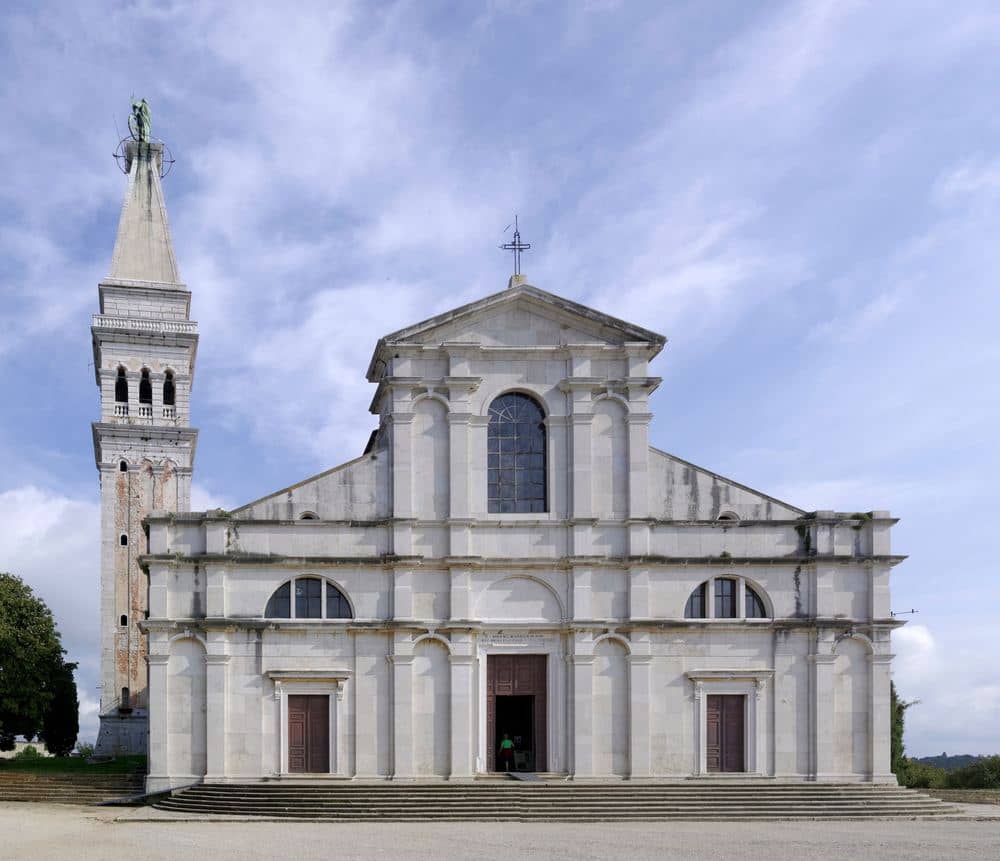
The church sits at the highest point and its bell tower is modelled on the campanile of San Marco in Venice, which tells you most of what you need to know about who built this town and why it still looks the way it does. Inside, the church holds the sarcophagus of St Euphemia. Outside, the terrace is the view everyone comes for. The climb up the tower is not for everyone: wooden stairs, steep, and worth checking before you commit if heights are an issue.
- Grisia Street: the lane of galleries and the main way up, busiest in the middle of the day.
- Balbi Arch and the town clock: the old gate and the square just inside it.
- Golden Cape (Punta Corrente): the forest park south of town, and the reason to bring shoes you can walk in.
Two names, one town
Rovinj is officially bilingual, and Rovigno is not a translation but the other local name. Street signs carry both, the Italian community here is old rather than touristic, and it shows in the food and in what people call things. If you arrive expecting a Croatian town with Italian decoration, you have it backwards: this is a place where both have been normal for centuries.
- Red Island (Crveni otok): a short boat hop from the harbour, good for a half day.
- Lone Bay and Monte Beach: the two swimming options that do not need a car.
- Rovinj Heritage Museum: small, in a baroque palace on the main square, good for a rainy hour.
“Rovinj is one of the few Adriatic old towns where the tourism came after the shape, not the other way around.”
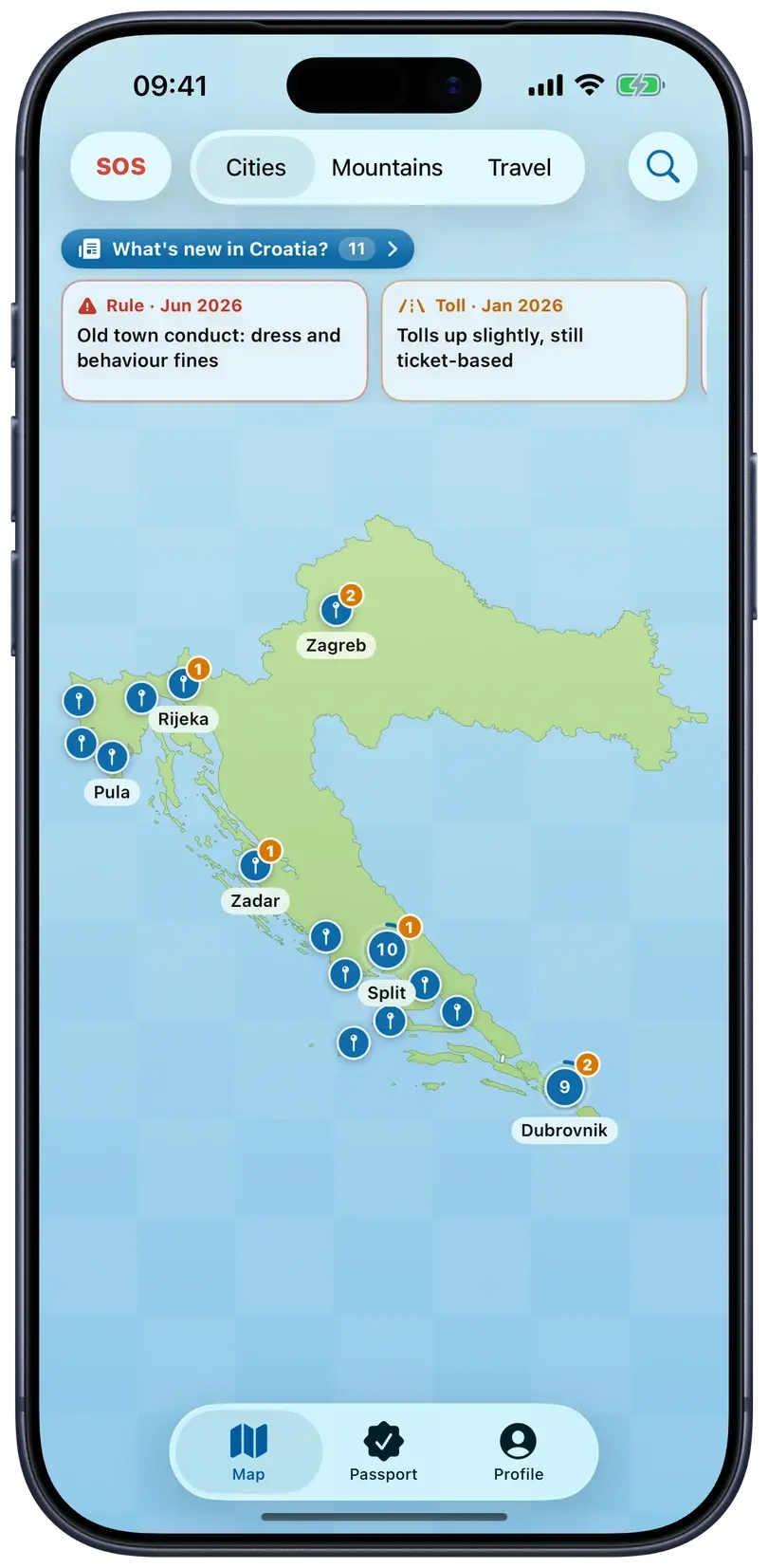
Practically: the old town is car-free and the walk up is cobbled and uneven, so plan footwear rather than time. Mornings and late afternoons are noticeably calmer than the middle of the day. The route from harbour to St Euphemia, with the stops in order, is mapped in the CroVenture app.
Getting to Rovinj
The nearest airport is Pula, about 40 km south, a drive of around 45 minutes, with seasonal direct flights from the UK. Rovinj has no railway station, so almost everyone arrives by car or bus. From the Istrian Y motorway take the Kanfanar exit and follow the road west for about 15 km. From Trieste airport count on 2 hours, from Venice and Zagreb about 3 hours, and there have been no border checks between Slovenia and Croatia since 2023. The bus station stands at the edge of the old town, 2 minutes from the chapel of the Holy Trinity, with hourly buses to Pula, Poreč and Pazin. In summer a fast boat to Venice runs from the harbour, so you can arrive by sea.
| From | How | Time |
|---|---|---|
| Pula airport | taxi, transfer or hire car | about 45 minutes |
| Kanfanar motorway exit | road west into town | about 15 minutes |
| Pula | hourly bus | about 1 hour |
| Poreč | bus or car | about 40 minutes |
| Trieste airport | car on the motorway | about 2 hours |
| Venice | car, or summer fast boat | about 3 hours by road |
Parking and getting around
The car stays outside the old town. The large car park on Valdibora is closest to the Balbi Arch and charges by the hour, the garage by the bus station and the car parks towards Borik and Zlatni rt work out cheaper for a whole day. In July and August the Valdibora car park fills by late morning, so arrive before 09:00 or leave the car at the accommodation. Once parked, the car can stay put for the week: the peninsula takes 15 minutes to cross on foot, boats to Katarina and Red Island leave the southern waterfront every half hour in season, a summer tourist train runs to Amarin and the forest park, and a hired bicycle covers the flat coastal path from Zlatni rt south to Veštar and north towards the Lim channel. Charter agencies at the marina sell day trips with a skipper, the easiest way to see the town from the sea.
Valdibora, the markets and the aquarium
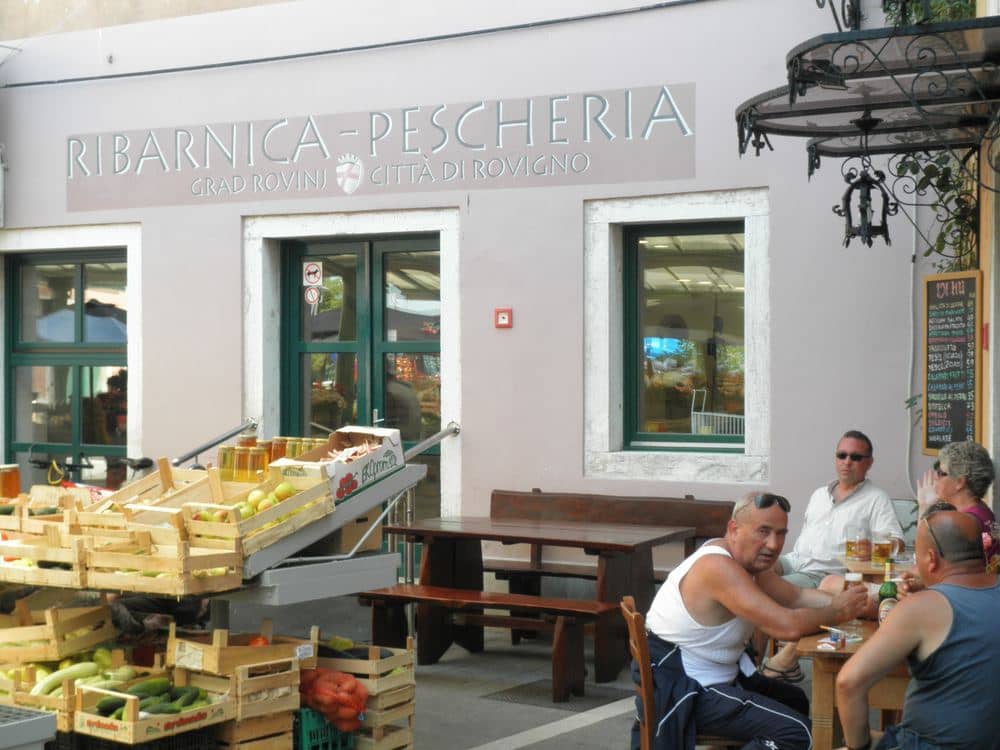
Valdibora is the northern harbour and the working side of town, and the best morning starts here. The fish market under its roof fills from dawn with the night's catch, sardines and squid in summer, scorpionfish and crabs in winter, plus oysters and mussels from the Lim channel, and by 09:00 the best has gone. The green market beside it sells Istrian olive oil, honey, cheese and truffles in jars, with tasting before buying and cash at every stall. Across the way, the aquarium, open since 1891 in a former Berlin zoological station, keeps Adriatic species in stone pools: octopus, moray, seahorses and rays, half an hour that suits a rainy day or the midday heat.
More beaches, and who they suit
None of the beaches has sand: the shore is rock, pebble and concrete platforms, so water shoes matter more than a parasol. Porton Biondi, 3 minutes north of the Balbi Arch over fine pebble, is the swim between two sightseeing stops. Baluota, the rocks south of Monte, belongs to local families who have used the same slabs for generations: you are welcome as long as you leave marked stones alone and play no music. Mulini, at the marina end of the park, is reached without a single step, which makes it the beach for prams and for a drink at the water.
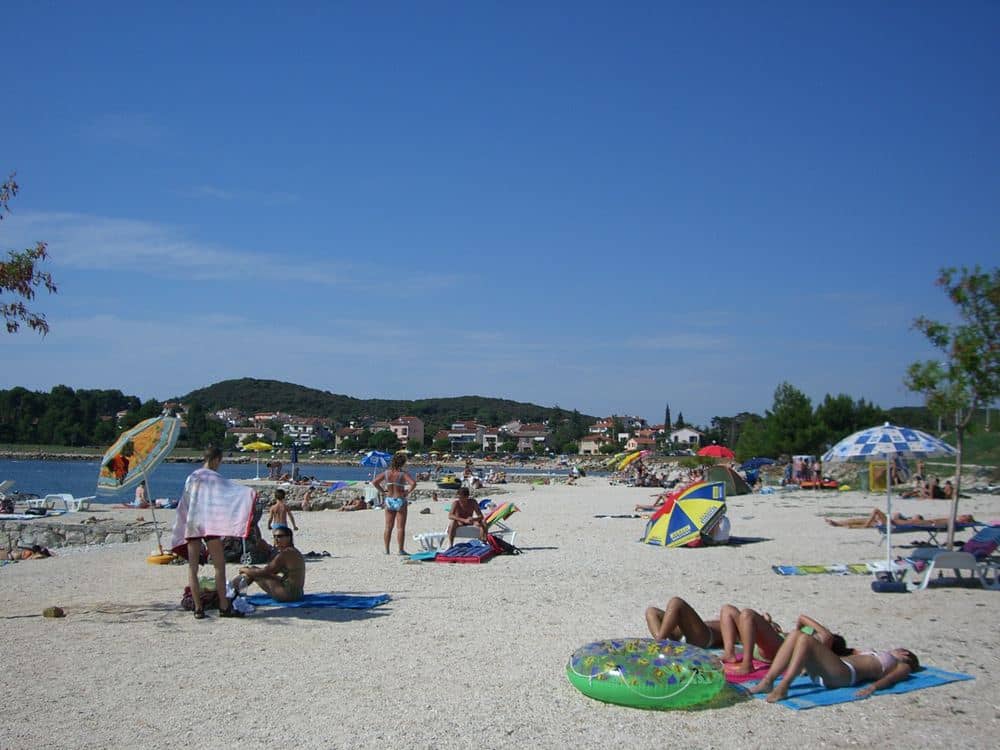
- Cisterna: a pebble and slab cove 20 minutes into the Zlatni rt park, no sunbeds, no music, pine shade into the afternoon.
- Škaraba: the rocky far end of the park, rock jumps of 2 to 6 m into deep water, no facilities, keep small children back from the shelves.
- Cuvi: a long pebble stretch south of the park, 3 km by car or half an hour on the coastal path, with a marked dog section.
- Veštar: a shallow sand and pebble bay 5 km south, the warmest water near town, the choice for toddlers and September swims.
- Amarin: a wide family bay 4 km north with slides and playgrounds, reached by the tourist train or 15 minutes by bicycle.
Day trips with a car
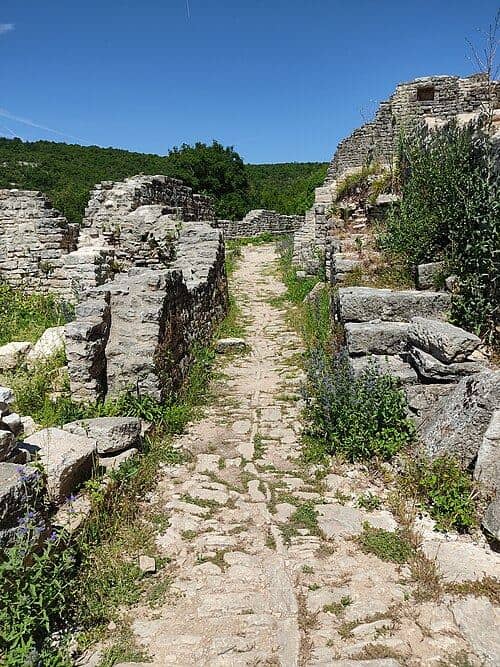
With a car, the sites around town join into one or two afternoons. Monkodonja, 5 km from the sea, is a Bronze Age hillfort inhabited between 1800 and 1200 BC, with restored drystone ramparts, free entry and the best light before sunset. Dvigrad, 20 minutes' drive towards Kanfanar, is a whole medieval town abandoned in the 17th century after plague and malaria: gate, main street, house shells and the basilica of St Sophia on top, with a token entry in season. North of town the Lim channel pushes 10 km inland, the viewpoints line the road to Vrsar about 10 km out, and two konobas at its head serve the oysters and mussels grown in its water. Palud, 8 km south, is Istria's only bird reserve: an easy hour round the marsh with a watchtower, then a swim in the cove.
When to go, month by month
June and September are the months locals recommend: sea around 23 degrees, the town at half its August density, restaurants and boats all running. July and August are full, Monte fills by 10:00, and on a Sunday in the middle of August the Grisia hangs its open-air exhibition along the whole street. 16 September is St Euphemia's day, with pilgrims from all Istria, and at the end of September the Weekend Media Festival fills the hotels with a business crowd and prices follow, in 2026 from 24 to 27 September. October opens the truffle season inland. From November the town belongs to residents, many restaurants close for winter, and 21 November is the feast at the chapel of Madonna della Salute. April and May have open cafés, empty lanes and a sea still too cold for most.
Rovinj with children
Rovinj works with children when the day is built round water and short distances. The aquarium, Porton Biondi and the square under the town clock, where children circle the fountain in the evening, all lie within 5 minutes of the Balbi Arch. Veštar and Amarin have the shallows, Palud has herons to count and a tower to climb, and a batana evening from the museum, booked days ahead in summer, is the one evening to reserve. Inside the old town a carrier beats a pushchair, while the promenade to Mulini and the park trail are flat enough for wheels.
The places, one by one
| Place | What it is | Time needed |
|---|---|---|
| Balbi Arch | Baroque town gate of 1678 | 10 minutes |
| Rovinj Town Clock | Last tower of the medieval walls | 10 minutes |
| Rovinj Heritage Museum | Town museum in the Califfi palace | 1 hour |
| Grisia Street | Steep lane of galleries up to the church | 30 minutes |
| Church of St Euphemia | Baroque church with a 60 m bell tower | 30 minutes to 1 hour |
| Batana Eco-Museum | Museum of the local fishing boat | 30 minutes |
| Carrera Street | Everyday shopping street and evening corso | 30 minutes |
| Church of the Holy Trinity | Romanesque chapel from the 12th century | 10 minutes |
| Rovinj Marina | Piers, bars and charter boats | 30 minutes |
| Punta Corrente Quarry | Climbing walls inside the forest park | 30 minutes to 1 hour |
| Borik Beach | Neighbourhood cove on the northern shore | 2 hours |
| Katarina Island | Swimming island 5 minutes by boat | half a day |
| St Andrew Island | Monastery island with hotel and beaches | half a day |
| Sveti Ivan na Pučini Lighthouse | Offshore lighthouse of 1853, boat trip | half a day |
| Lim Hillfort | Iron Age site above the Lim channel | 1 hour |
Balbi Arch
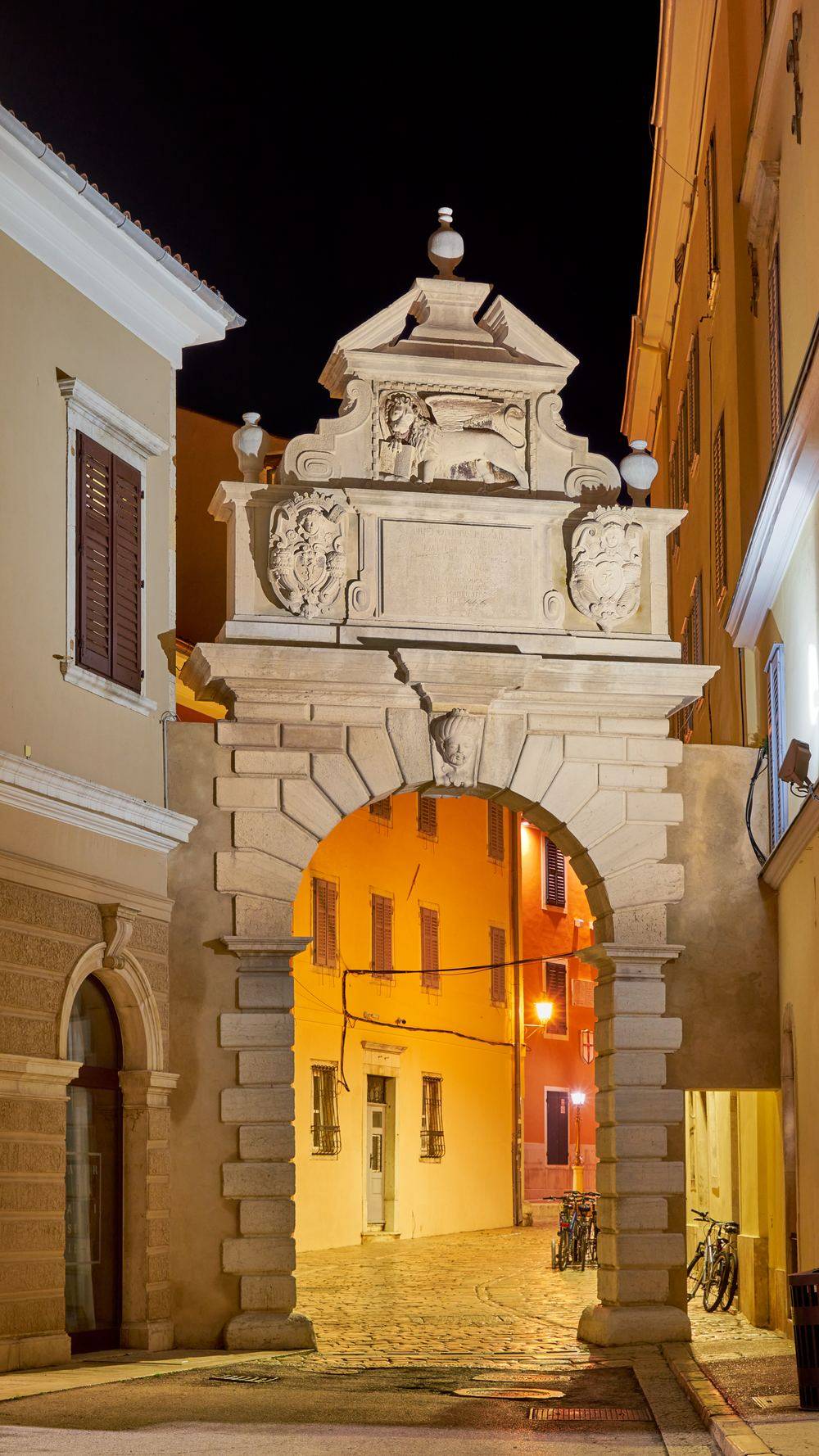
The arch was raised in 1678 on the site of the medieval town gate, when Daniel Balbi was mayor, and it carries his family's coat of arms. Above the passage sits the winged Venetian lion with an open book, the sign that Rovinj submitted to Venice without a fight. Two carved heads face each other: a Turk on the outer side, a Venetian on the inner, so one step takes you from one world into the other. The fish-market gate once stood here, and a guard kept watch from the window above. Walk through twice, once quickly and once for the hinge marks of the old doors and the worn threshold. Early morning is quietest, when the smell of bread comes through the arch instead of the crowds.
Rovinj Town Clock
The clock on Marshal Tito Square is the last of the 7 towers of the medieval walls. The ramparts came down in the 18th and 19th centuries to give the town room, and this southern tower was kept because exact time mattered in a fishing town: tide, market and mass all ran by it. Below the dial sits a Venetian lion, above it a gable bell that still strikes, and the mechanism has been modernised. Visible from the waterfront, the lanes and the sea, the tower is the most reliable meeting point in Rovinj. The square below is the town's living room: newspapers and coffee in the morning, ice cream in the afternoon, street musicians at night. After dark the tower is lit warm, with the harbour behind it.
Rovinj Heritage Museum
The museum occupies the 17th century palace of the Califfi family on Marshal Tito Square and has collected the town's memory since 1954. The rooms cover archaeology from Monkodonja and the hillforts around it, Venetian painting from the 15th to the 18th century, an old Rovinj kitchen, ship models and the tools of the fishing world. The contemporary collection is the unusual part: after 1960 the museum began buying works from each Grisia exhibition, so the history of the painters' colony hangs here too. The building counts as an exhibit itself, with a stone staircase, stucco and a salon window that looks straight at the bell tower. Summer opening runs into the evening, winter hours are shorter. Plan an hour in the middle of a hot day.
Grisia Street
Painters adopted the Grisia after 1960, and the open-air exhibition on one August Sunday dates from 1967: works are hung on facades, windows and washing lines, from academy masters to children, and for that day the street is the longest gallery in Istria. For the rest of the year the ground floors sell oils, watercolours and jewellery, and bells drift down from the top. The climb is short but steep, and centuries of feet have polished the stone, so good soles matter more than fitness. Late afternoon is the best moment, when the sun enters the street head-on and turns the stone gold, and from the top the roofs fall away to the sea. If you buy a picture, ask about it: half the painters here paint the view from their own window.
Church of St Euphemia
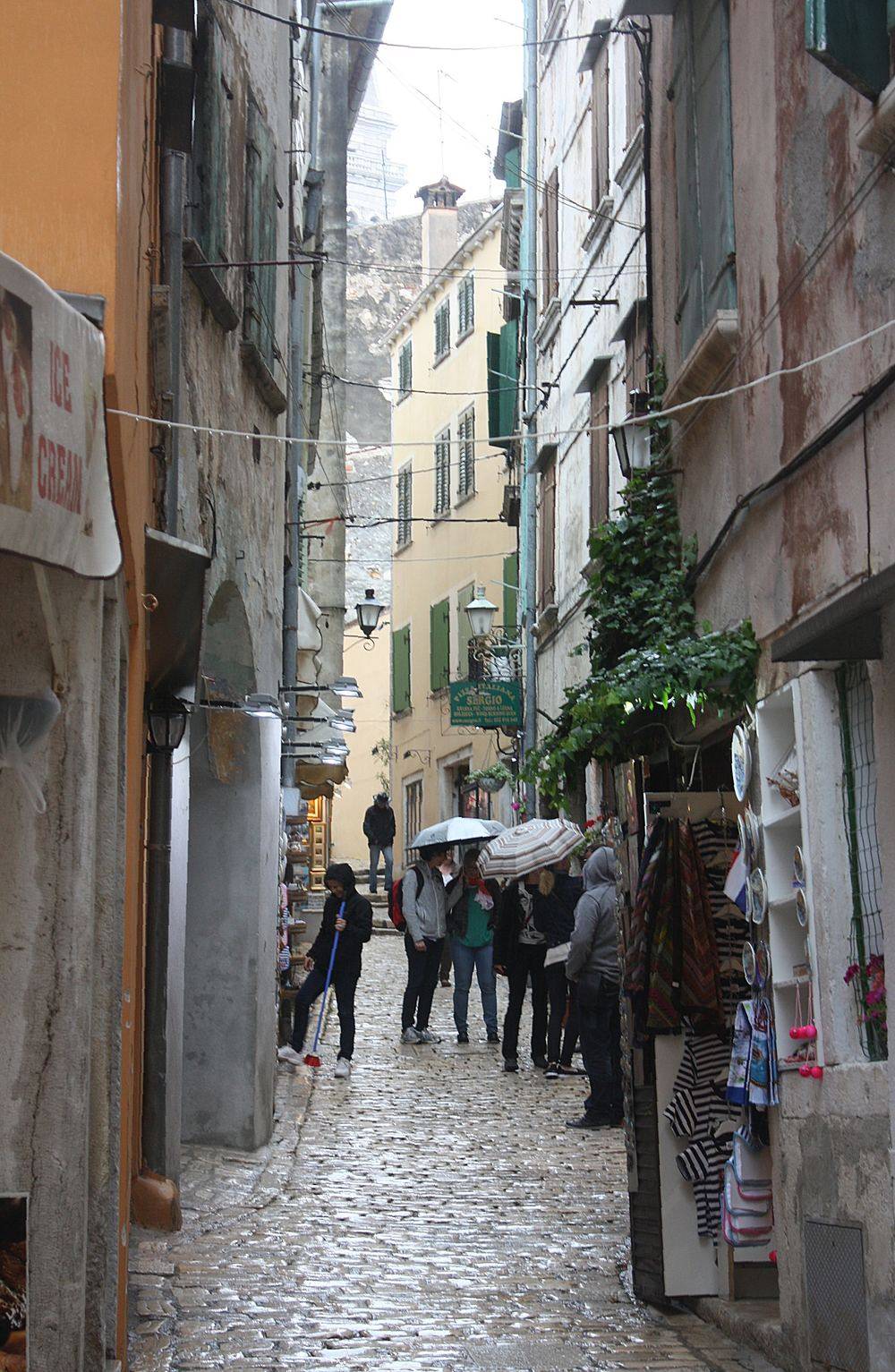
The present church was completed in 1736, and the bell tower stands 60 m high, so ships see it from the open sea before they see the town. On the top turns a copper statue of the saint that works as a wind vane. Fishermen still read it: when Euphemia faces inland, the jugo, the southerly wind, is coming. Tradition says the stone sarcophagus behind the main altar floated in from Constantinople in the year 800 and the townspeople hauled it up the hill. Entry to the church is free and the tower costs a token fee. From the top you see the whole old town, the islands of Katarina and St Andrew and the coast as far as the Lim channel. Come early in the morning, before the stream of visitors starts up the Grisia.
Batana Eco-Museum
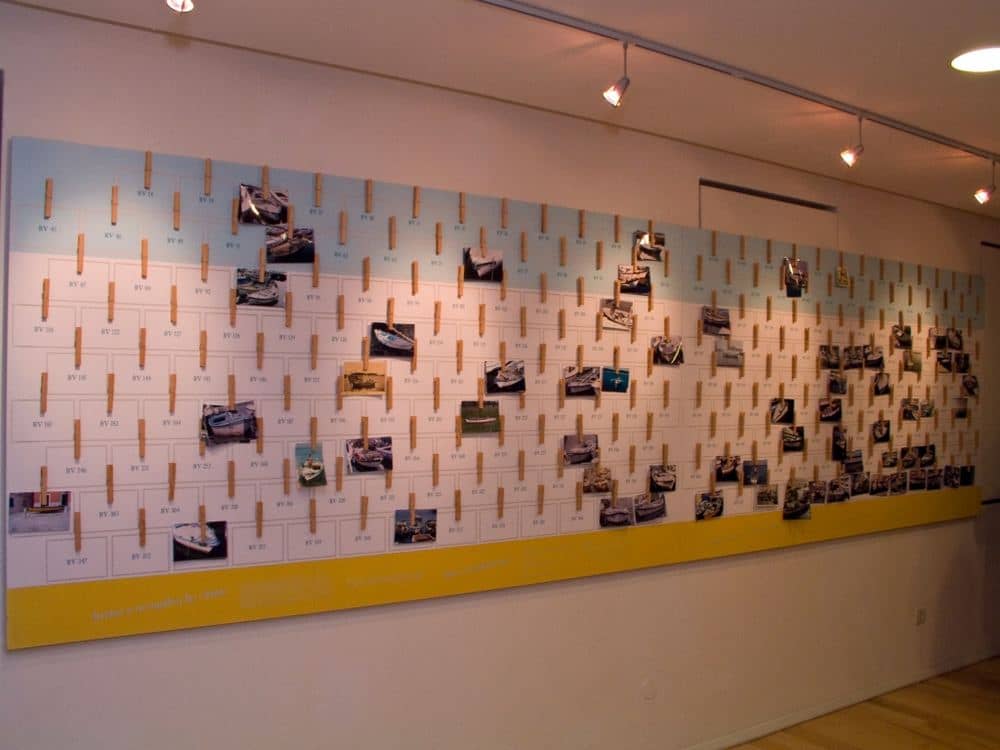
The Batana House opened in 2004 on the southern waterfront, facing the boats it describes. In 2016 UNESCO entered its programme in the Register of Good Safeguarding Practices for intangible heritage, the first Croatian entry of its kind. The display is small and personal: boatbuilders' tools, fishermen's stories told in the Rovinj dialect and recordings of bitinada, the traditional song of Rovinj fishermen. The visit takes half an hour. In summer the museum works outside its walls too, with evening batana trips from Mali Mol under lanterns and dinners in the spacio, the old wine cellar, where sardines and Malvasia come with singing as they once did. The Eco-museum posts the dates on its website.
Carrera Street
The Carrera runs straight east from Marshal Tito Square through the quarter that grew when Rovinj spilled beyond its walls in the 18th and 19th centuries. This is the everyday street: bakeries open from 06:00, small fashion shops, goldsmiths, the corner newspaper kiosk and gelaterias where the evening queue is a social event in itself. Look up above the shopfronts at the Secession balconies and capitals, left from the years when the town lived from a tobacco factory and a cannery. For visitors it is the practical street, the place to buy whatever the apartment lacks, from a phone charger to olive oil to take home. Walk it by day for the shops and again in the evening, when the lights come on and the town steps out for the corso.
Church of the Holy Trinity
This heptagonal chapel from the end of the 12th century is the oldest building in Rovinj still standing in its original form, and the only Romanesque one. Its 7 outer faces hide a circular interior under a stone dome, and the thick walls and small windows show that it served for baptism and for defence alike. It stands on the Square at the Pond, named after the town pond where livestock was watered for centuries. The interior opens only occasionally, for exhibitions and the Night of Museums, but Romanesque reads best from outside: walk round it and watch the light break across the 7 planes. At the edge of the old town, it makes a natural first or last stop of the day.
Rovinj Marina
The marina fills the southern bay between the old town and the Zlatni rt park and is one of the oldest on the Adriatic, opened when sailing holidays were still a pioneer sport. Its roughly 200 berths hold everything from family sailboats to the yachts photographed from the waterfront. Without a boat, treat it as a promenade: walk the piers, read the names and flags, watch crews preparing to leave and hear the masts ring in the evening maestral. The bars along the shore give a front-row seat for arrivals, and the path along the berths is the shortest way from town to Mulini beach and the park. The blue hour is the time to be here, when the mast lights come on before the stars and the old town stands lit across the bay.
Punta Corrente Quarry
In the middle of the forest park lies the old quarry where Rovinj cut its stone for centuries: an amphitheatre of vertical rock faces about 20 m high, open to the sea, with grass and pines on its floor. Limestone left here by boat for waterfronts and palaces until Baron Hütterott bought the cape at the end of the 19th century and closed the quarry for his park. The flat cut planes now serve climbers: several dozen bolted routes of all grades run up the walls, and in summer climbers take turns from morning to dark while people watch from the grass. For everyone else the quarry offers shade, echo and the cypress avenue at its entrance, one of the most photographed tree lines in Rovinj. In winter and at dusk it can be completely empty.
Borik Beach
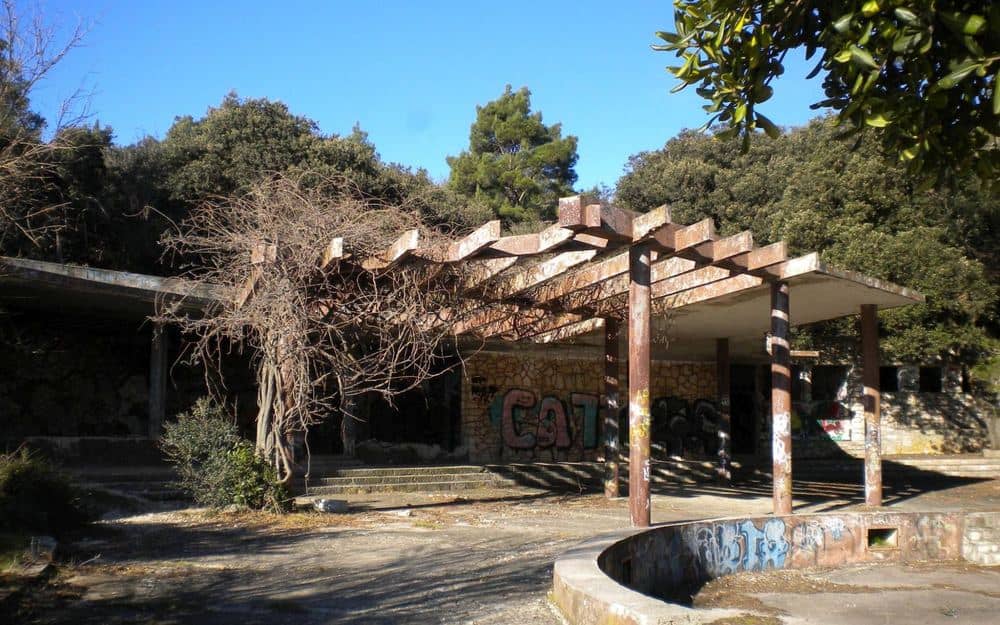
Borik is the neighbourhood beach of the northern side, a shingle and rock cove between Porton Biondi and the Borik streets, with the whole old town spread across the water and the bell tower as its spike. Families from the nearby streets have adopted it, so even in August it keeps a local tone: the same groups in the same places, coffee from the café close by and children diving head-first from the pier, because the water is deep at once. Entry mixes fine pebble and stone slabs, there is a shower and a cabin, and shade comes from the pines the beach is named after. From the centre it is 15 minutes' walk along the shore. Come in the early evening, when the sun drops behind the old town, and stay until the first lights.
Katarina Island
Katarina lies directly opposite the waterfront, 5 minutes by boat, and from it you see the old town whole for the first time, stacked on its peninsula like a stage set. At the end of the 19th century the Polish count Ignacy Korwin-Milewski laid out the island with a park and a summer villa, now a hotel, and his paths, stone parapets and old pines still set its scale. Swimming is the main activity: stone slabs and concrete platforms run round the entire island, the water is deep at the edge and currents keep it among the clearest near town. A towel, a mask and a book are all you need, a kiosk and the hotel bar cover the rest. The boat back in the evening, when the town lights up, is the cheapest panorama cruise in Rovinj.
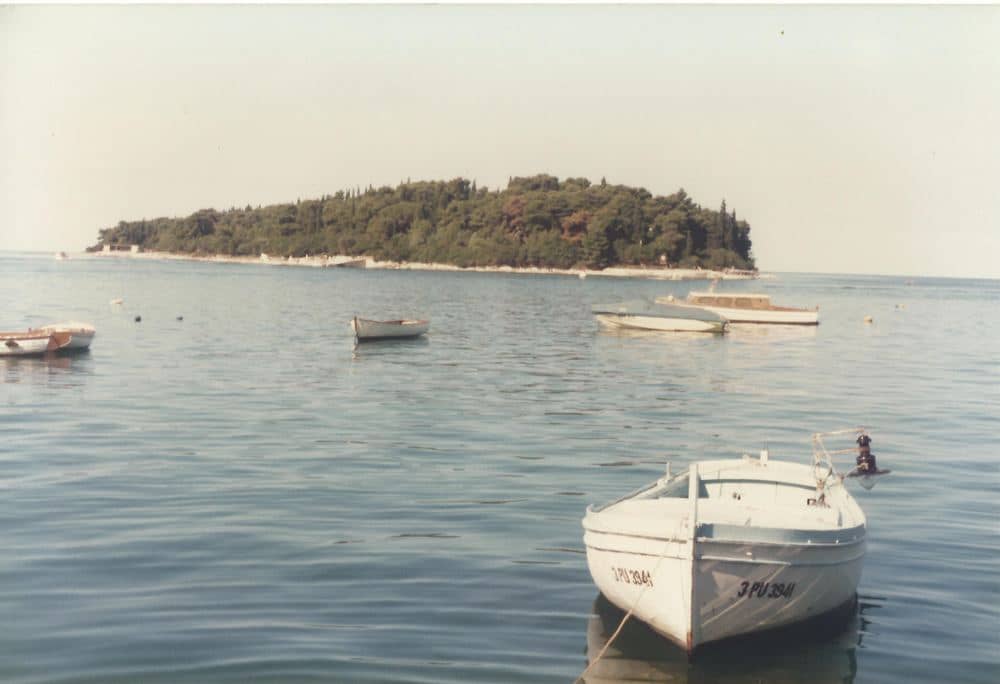
St Andrew Island
St Andrew is the larger of the two islands joined together as Red Island, 15 minutes by boat from the waterfront. Benedictine monks built a monastery here as early as the 6th century, the Franciscans took it over in the 15th, and after 1890 Baron Georg Hütterott turned the monastery buildings into a castle and planted the island with exotic trees. The castle is now part of a hotel, but the island stays public: walks through the old park, beaches of stone slabs and fine pebble, and views of Rovinj the mainland cannot give. The chapel with remains of the monastery church survives, and agaves and pines from the baron's gardener line the shore. Bring a mask for the seabed along the southwestern rocks and stay into the early evening, when the day-trippers leave.
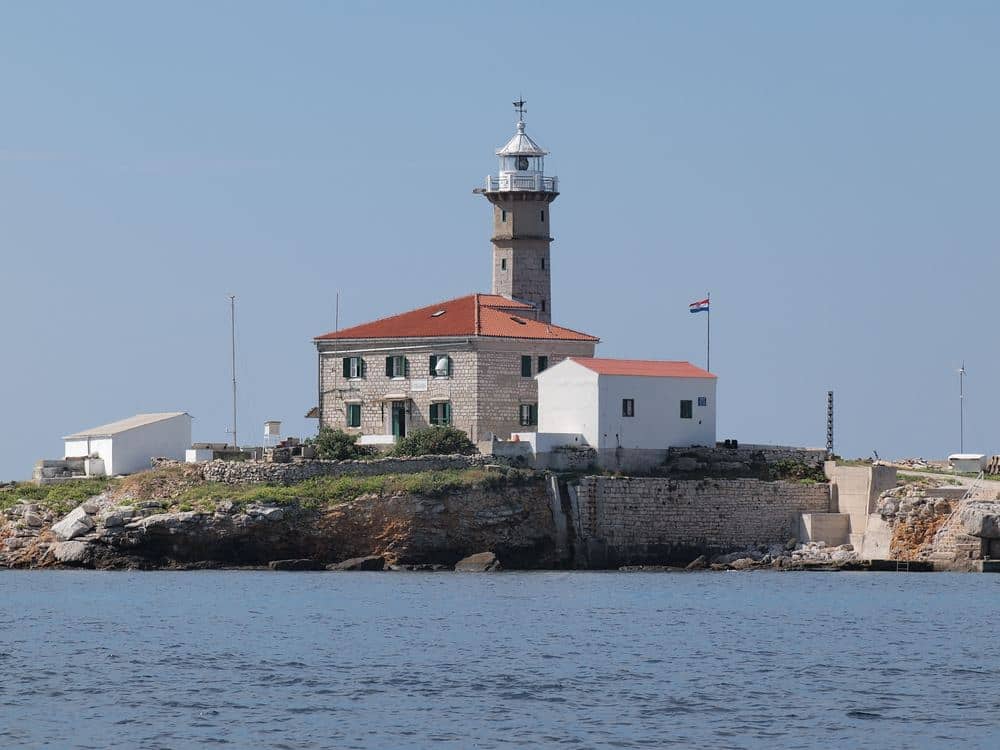
Sveti Ivan na Pučini Lighthouse
The St John lighthouse stands on the outermost rock of the Rovinj archipelago, 5.5 miles southwest of town: a stone tower 23 m high, built in 1853, whose light still guides ships through the middle Adriatic. The rock is bare and low, waves wash over it in bad weather, and for 150 years the keepers lived here in strict solitude. Since automation the keeper's house has been let for overnight stays. For a day visitor it is the goal of a boat trip from the harbour, or a kayak run in calm seas for the experienced. Around the rock the seabed drops steeply into blue, which makes it a divers' favourite. Landing depends on the swell and the skipper, so often you swim from the boat. Bring a hat and water: there is no shade and no spring.
Lim Hillfort
The Lim hillfort is the prehistoric watchtower over the channel: the remains of an Iron Age settlement on the rim of the plateau, from which the Histri, the people Istria is named after, watched the boats in the bay below. Outlines of drystone ramparts and terraces survive down the slope, and the view survives entirely, the channel seen along its whole length as a green ribbon of sea between the woods. A path leaves the Rovinj to Vrsar road and climbs briefly through the maquis. Signposting is modest, so an offline map helps, and there is no ticket and no groomed site. Wear long trousers against the thorns, bring water and come in the morning or towards evening, since there is almost no shade. The roadside viewpoints have buses and stalls, this one has silence.
Domande frequenti
- How do I get from Pula airport to Rovinj?
- The airport is about 40 km from Rovinj, around 45 minutes by road, and there is no rail link. Choose between a transfer booked ahead, a taxi, a hire car, or the airport bus into Pula followed by the hourly bus to Rovinj. With luggage or children, the pre-booked transfer is the least effort.
- Can I stay in the old town if I have a car?
- Yes, but the car stays at Valdibora or in the garage by the bus station, and you carry the bags 5 to 15 minutes over cobbles and stairs. Hosts can arrange a loading permit for arrival and departure only. With heavy luggage or a pushchair, the streets above the harbour or towards Borik are easier and quieter at night.
- Which beach is best for small children?
- Veštar, 5 km south, has shallow sand and pebble and the warmest water near town. Amarin, 4 km north, adds slides and playgrounds in the pines. In town, Porton Biondi has a gentle pebble entry 3 minutes from the Balbi Arch, and the western corner of Lone bay slopes more slowly than the rest. Water shoes help everywhere.
- Is Rovinj worth visiting outside summer?
- Yes, as a different town. June and September have a warm sea and half the crowds. October brings truffles inland and quiet lanes. From November many restaurants close, museums keep shorter hours and the island boats depend on weather and season, but the walk round Zlatni rt, the fish market and the empty Grisia are at their best.
- When is the fish market busiest?
- The fish market on Valdibora works in the morning and is liveliest between 07:00 and 09:00, when the night's catch is unloaded. Sundays are quieter, and Mondays, when the fleet rests, have the smallest choice. The green market beside it runs from early morning to early afternoon, and the best pick is before 10:00, earlier in summer.
- How many days does Rovinj need?
- One full day covers the old town, the tower and an island. Two days add the Zlatni rt park and a proper swim. A week works with a car or a bicycle: the Lim channel, Dvigrad, Monkodonja and Palud, plus Pula and Poreč at 40 minutes each, fill the rest without repeating a beach.
Condividi questa guida
Domande sul tuo viaggio?
Luoghi, eventi e video selezionati per Rovigno.
Croatia Atlas tra le fonti preferite
Un clic e Google ti mostra più spesso i nostri articoli nelle notizie principali e nelle risposte AI. Cambia solo i tuoi risultati.